Every healthcare practice depends on clean claims, timely reimbursements, and accurate patient data to maintain financial stability. Yet many providers continue to lose revenue due to minor demographic errors that could have been prevented during patient registration or eligibility verification. A missing middle initial, outdated insurance policy number, wrong spelling of a patient name, or mismatched date of birth may look minor at first glance, but these details often trigger payer rejections and delayed reimbursements.
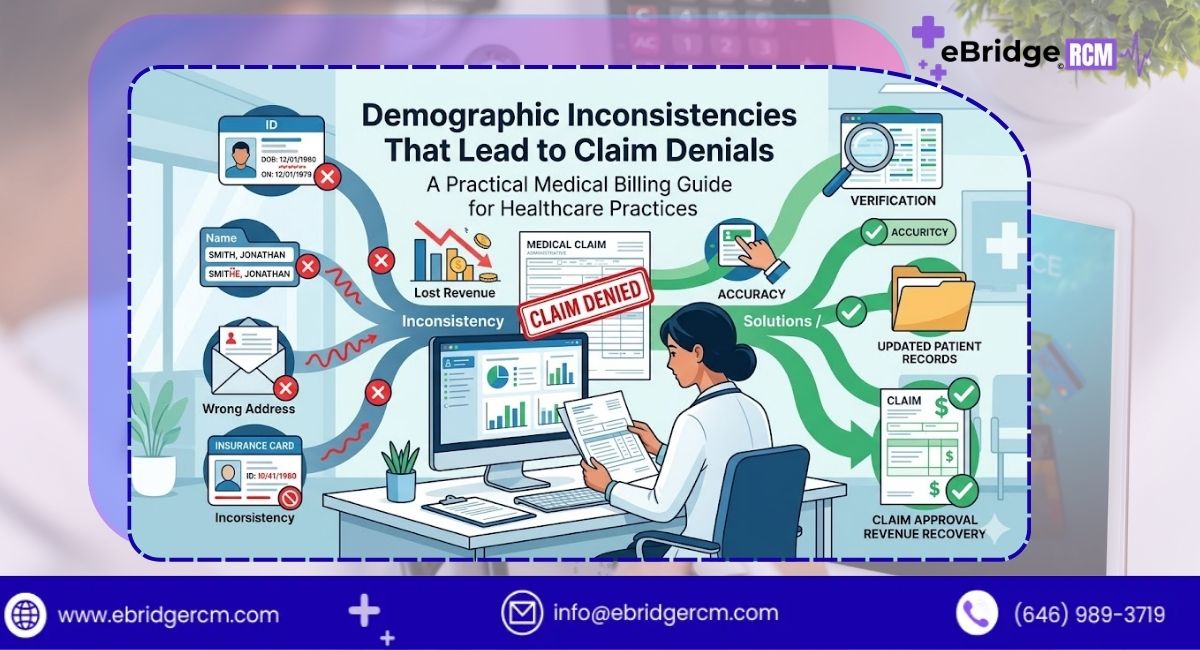
Demographic inconsistencies claim denials are one of the most common administrative problems in healthcare revenue cycle management. These denials affect independent physicians, urgent care centres, hospitals, behavioral health providers, cardiology practices, and specialty clinics alike. The issue becomes even more challenging when practices handle large patient volumes or rely on disconnected systems that fail to synchronize patient data correctly.
Many practices spend significant time appealing denied claims even though the original issue started at the front desk. Administrative staff may enter patient data manually, patients may provide outdated insurance cards, or electronic systems may fail to transfer information accurately between scheduling software and billing platforms. These situations increase the risk of claim denials due to demographic errors and can create unnecessary strain on revenue cycle teams.
Practices that want stronger billing performance often focus on coding improvements and denial management strategies, but demographic accuracy deserves equal attention. Providers that invest in proper eligibility checks, staff training, and integrated systems usually see lower denial rates and faster payments. Many organizations also improve their workflows by implementing stronger verification processes through professional medical billing services.
This guide explains how demographic inconsistencies in insurance claims happen, why payers reject claims because of patient information mismatches, and how healthcare organizations can reduce preventable denials through better operational practices.
Why Demographic Accuracy Matters in Medical Billing
Patient demographics form the foundation of every insurance claim. Before coding, claim submission, payment posting, or accounts receivable follow up even begin, payers first validate patient identity and insurance details. If those details do not match payer records, the claim may never move into the adjudication stage.
Healthcare claim denials demographic inconsistencies often occur because payers rely on automated systems to compare submitted information against existing insurance databases. These systems are designed to identify mismatches quickly. Even one incorrect field can cause the entire claim to fail.
Demographic data typically includes:
- Patient full legal name
- Date of birth
- Gender
- Insurance ID number
- Group number
- Subscriber information
- Address
- Phone number
- Employer details
- Relationship to subscriber
- Coordination of benefits information
When practices fail to maintain accurate patient records, they increase the risk of:
- Payment delays
- Claim rejections
- Denied medical claims
- Increased accounts receivable days
- Rework costs
- Patient billing disputes
- Reduced patient satisfaction
- Compliance concerns
A practice may have excellent clinical documentation and accurate coding, but demographic discrepancies causing denied claims can still stop reimbursement.
Common Demographic Errors That Trigger Claim Denials
The majority of demographic verification claim denials come from repetitive administrative mistakes. Understanding these patterns helps healthcare organizations identify weaknesses in their workflow.
Incorrect Patient Name
One of the most common patient demographic mismatch claim denial reasons is an incorrect patient name. This happens when:
- Nicknames are used instead of legal names
- Hyphenated names are entered incorrectly
- Middle initials are omitted
- Suffixes such as Jr. or Sr. are missing
- Typographical errors occur during registration
Insurance carriers process claims according to the exact name associated with the member ID. If the information submitted by the provider does not match payer records, the claim may reject immediately.
For example, if a patient is registered as “Mike Thompson” instead of “Michael A. Thompson,” the payer system may fail to recognize the member.
Wrong Date of Birth
Date of birth errors are another major source of insurance claim denial demographic issues. Even a single incorrect digit may lead to a rejected claim.
These mistakes commonly occur because:
- Staff manually enter information too quickly
- Existing patient profiles are duplicated
- Information is copied incorrectly from paper forms
- Patients provide inaccurate details
Date of birth mismatches can also create patient identity mismatch concerns that require additional verification.
Invalid Insurance ID Number
Insurance cards frequently change after plan renewals, employer transitions, or payer mergers. Patients may continue presenting outdated cards without realizing their member ID has changed.
When billing teams fail to verify insurance eligibility before services are rendered, practices often face:
- Electronic claim rejection
- Eligibility denials
- Coverage termination denials
- Coordination of benefits issues
Providers that routinely review patient eligibility workflows often reference guidance on insurance eligibility verification in internal medicine to improve front-end accuracy.
Address Mismatches
Patient addresses are another overlooked source of demographic data errors in medical billing. Address discrepancies may not always deny a claim directly, but they can interfere with:
- Insurance verification
- Coordination of benefits
- Medicaid eligibility checks
- Patient statement delivery
- Prior authorization processing
Address mismatches are especially common among:
- College students
- Patients with temporary housing
- Elderly populations
- Patients who recently relocated
Gender Inconsistencies
Gender mismatches can create significant payer edits when procedure codes conflict with demographic records.
For example:
- A gynecology procedure billed under a male patient profile
- Prostate-related services linked to a female demographic record
In many situations, these denials occur because of outdated payer records rather than provider mistakes. However, practices must still correct the inconsistency before reimbursement can proceed.
Subscriber Information Errors
Subscriber-related denials happen when:
- The wrong guarantor is listed
- Dependent relationships are incorrect
- Employer information is outdated
- Spouse information is inaccurate
These errors commonly affect pediatric and family practices where multiple family members share coverage.
How Demographic Errors Impact Revenue Cycle Performance
Many organizations underestimate the financial impact of demographic inconsistencies claim denials. The problem extends far beyond a single rejected claim.
Each denial creates additional administrative work:
- Staff must identify the denial reason
- Patient records must be reviewed
- Insurance eligibility may require re-verification
- Corrected claims must be resubmitted
- Appeals may need documentation
- Follow-up calls may become necessary
This process consumes time and labor costs that could have been avoided.
Revenue Delays
Even when corrected claims are eventually paid, reimbursement delays can affect:
- Payroll management
- Vendor payments
- Practice cash flow
- Operational planning
- Expansion opportunities
Small practices often feel these financial pressures more severely because they operate with tighter margins.
Increased Administrative Costs
Every denied claim increases operational expenses. Billing staff must spend additional hours correcting preventable issues rather than focusing on productive revenue cycle activities.
Healthcare organizations that monitor denial trends through monthly audits often identify demographic verification as a major improvement opportunity. Many practices strengthen these processes through monthly medical billing audit services.
Lower Patient Satisfaction
Demographic discrepancies causing denied claims frequently result in patient confusion. Patients may receive unexpected statements or repeated requests for updated insurance information.
This creates frustration and may damage trust in the provider.
Patients often assume the practice made billing mistakes, even when incorrect information originated from the patient or payer.
Higher Accounts Receivable Days
Claims delayed because of demographic mismatches remain unpaid longer, increasing accounts receivable aging.
As AR days increase, practices may experience:
- Slower collections
- Reduced cash flow
- More write-offs
- Increased follow-up labor
Organizations seeking better AR performance often combine eligibility verification improvements with stronger denial prevention workflows.
Front Desk Registration Errors That Cause Claim Denials
The front desk plays a major role in preventing patient information errors.
Patient registration represents the first opportunity to identify demographic inconsistencies before claims are submitted.
Unfortunately, many registration teams work under pressure:
- High patient volumes
- Limited staffing
- Time constraints
- Walk-in appointments
- Manual documentation
These conditions increase the likelihood of inaccurate patient records.
Common Front Desk Mistakes
| Registration Error | Potential Billing Impact | Example |
| Misspelled patient name | Claim rejection | Wrong spelling on insurance card |
| Incorrect insurance ID | Eligibility denial | Old policy information |
| Wrong date of birth | Identity mismatch | Typing error during intake |
| Missing subscriber details | Coordination issues | Spouse coverage omitted |
| Duplicate patient profiles | Conflicting records | Multiple accounts created |
| Outdated address | Statement delivery issues | Moved to new residence |
Poor Verification Procedures
Some practices collect insurance cards but fail to verify active coverage electronically.
Without real-time eligibility checks, billing teams may not detect:
- Terminated plans
- Updated member IDs
- Changed group numbers
- Secondary coverage
- Coverage limitations
Incomplete Staff Training
Front desk employees often receive minimal education regarding insurance requirements.
Without proper training, staff may not understand:
- Why exact demographic matching matters
- How payer edits work
- Which data fields require extra attention
- How eligibility systems function
- How demographic mismatches affect reimbursement
Practices that invest in ongoing staff education generally experience fewer medical billing claim errors and cleaner claim submission rates.
The Connection Between EHR Systems and Demographic Inconsistencies
Technology can either reduce claim denial management challenges or increase them.
Many healthcare organizations rely on multiple systems for:
- Scheduling
- Registration
- Electronic health records
- Practice management
- Clearinghouse communication
- Medical billing
If these systems fail to synchronize correctly, demographic inconsistencies in insurance claims become more likely.
Data Integration Problems
When patient information transfers between systems incorrectly, practices may experience:
- Missing data fields
- Duplicate patient charts
- Formatting mismatches
- Incomplete insurance details
- Subscriber errors
Organizations reviewing their integration processes often benefit from resources discussing why EHR integration improves medical billing and technical support from EHR integration services.
Duplicate Patient Records
Duplicate charts are especially problematic.
For example:
- One chart may contain updated insurance information
- Another may contain outdated demographics
- Billing staff may accidentally select the wrong profile
This confusion can trigger claim rejection because of demographic mismatch.
Lack of Standardization
Different systems may format demographic information differently.
Examples include:
- Hyphenated names
- Address abbreviations
- Gender identifiers
- Date formatting
Without standardization rules, payer claim rejection reasons become harder to manage.
Insurance Eligibility Verification and Denial Prevention
Insurance eligibility verification is one of the most effective ways to reduce demographic inconsistencies claim denials.
Eligibility checks help practices confirm:
- Active coverage
- Subscriber information
- Plan effective dates
- Copayment obligations
- Coordination of benefits
- Demographic matching
Practices that perform eligibility verification before every visit often achieve stronger clean claim submission rates.
Real-Time Eligibility Checks
Real-time verification allows front desk staff to identify problems before appointments occur.
This gives practices time to:
- Request updated insurance cards
- Confirm legal names
- Correct policy numbers
- Verify subscriber details
- Update addresses
Eligibility Verification Checklist
| Verification Step | Purpose |
| Confirm patient legal name | Prevent identity mismatch |
| Verify insurance ID | Ensure active policy |
| Check date of birth | Match payer records |
| Confirm subscriber relationship | Reduce dependent claim denials |
| Validate group number | Avoid processing errors |
| Review secondary insurance | Prevent COB denials |
Why Eligibility Must Be Repeated
Some practices assume annual verification is enough.
In reality, insurance details can change frequently because of:
- Employer changes
- Plan renewals
- Medicaid eligibility updates
- Marriage or divorce
- Dependents aging out of plans
Eligibility checks should occur before every appointment whenever possible.
How Clearinghouses Detect Demographic Errors
Clearinghouses act as intermediaries between providers and payers.
Before claims reach insurance companies, clearinghouses review submitted data for formatting and demographic inconsistencies.
This process helps identify:
- Missing patient data
- Invalid member IDs
- Incorrect payer IDs
- Formatting errors
- Subscriber mismatches
Practices that use advanced clearinghouse tools often identify problems earlier in the claim lifecycle. Solutions such as clearing house solutions for healthcare billing can help reduce payer rejections before claims are transmitted.
Common Clearinghouse Rejections
| Rejection Reason | Explanation |
| Invalid subscriber ID | Insurance ID does not match payer records |
| Missing patient DOB | Required field incomplete |
| Patient not found | Demographic mismatch detected |
| Coverage inactive | Insurance terminated |
| Invalid relationship code | Subscriber information incorrect |
Why Rejected Claims Matter
Rejected claims differ from denied claims.
- Rejected claims fail before payer adjudication
- Denied claims are reviewed but not approved for payment
Both situations delay reimbursement and increase administrative work.
Specialty Practices and Demographic Denial Challenges
Different specialties experience unique demographic-related billing risks.
Mental Health Providers
Behavioral health organizations often face insurance verification challenges because:
- Coverage limitations vary widely
- Authorization requirements differ between plans
- Patients may switch plans frequently
Mental health practices improving denial prevention may benefit from reviewing these revenue cycle management tips for mental health providers.
Cardiology Practices
Cardiology billing frequently involves:
- Multiple providers
- Diagnostic testing
- High-value procedures
- Prior authorization requirements
Demographic errors in these situations may delay large reimbursements. Practices focused on reducing cardiology-related denials often review this cardiology billing claim denial guide .
Internal Medicine Practices
Internal medicine providers manage broad patient populations with complex insurance arrangements.
Many organizations strengthen operational performance through resources covering internal medicine RCM best practices.
Multi-Location Healthcare Groups
Large healthcare groups face additional challenges because:
- Multiple teams enter patient data
- Systems may vary between locations
- Standardized workflows may not exist
- Staff turnover affects consistency
How Demographic Denials Affect Compliance and Audits
Demographic data errors in medical billing are not only financial concerns. They may also raise compliance risks.
Incorrect patient information can affect:
- HIPAA compliance
- Medical record integrity
- Audit readiness
- Claims documentation accuracy
Practices preparing for payer reviews often prioritize stronger documentation standards and workflow consistency.
Audit Risks
If patient records contain repeated demographic inconsistencies, auditors may question:
- Registration procedures
- Billing accuracy
- Internal controls
- Data management practices
Healthcare organizations seeking stronger compliance performance frequently review a medical billing compliance checklist.
Patient Identity Risks
Incorrect demographic data may also contribute to:
- Duplicate records
- Wrong patient documentation
- Misfiled clinical information
- Privacy concerns
These situations can create legal and operational consequences.
Best Practices for Preventing Demographic Claim Denials
Reducing claim denials due to demographic errors requires a proactive approach.
Successful organizations usually combine:
- Technology improvements
- Staff training
- Standardized workflows
- Real-time verification
- Ongoing audits
Standardize Registration Procedures
Every staff member should follow the same registration process.
A consistent workflow reduces variation and improves patient registration accuracy.
Best practices include:
- Requesting photo identification
- Scanning insurance cards at every visit
- Verifying legal names
- Confirming current addresses
- Reviewing subscriber information verbally
Verify Every Visit
Even established patients should complete demographic verification regularly.
A simple question such as “Has your insurance or address changed since your last visit?” can prevent major billing issues.
Use Digital Intake Forms
Digital intake forms reduce handwriting interpretation problems and improve data consistency.
Online patient portals may also allow patients to update demographic information before appointments.
Train Front Desk Teams Regularly
Staff education should include:
- Insurance terminology
- Eligibility procedures
- Common payer edits
- Registration accuracy standards
- Claim denial consequences
Training should not occur only during onboarding.
Ongoing education helps staff adapt to payer changes and workflow updates.
Monitor Denial Trends
Healthcare organizations should track:
- Denial categories
- Rejection frequency
- Root causes
- Staff-related trends
- Payer-specific issues
Monitoring patterns helps practices identify recurring demographic discrepancies causing denied claims.
Conduct Internal Audits
Routine audits help organizations identify weak points before problems grow.
Audit areas should include:
- Registration accuracy
- Eligibility verification consistency
- Duplicate patient records
- Insurance updates
- Data synchronization issues
Organizations focused on operational accuracy often strengthen workflows through medical credentialing services and integrated revenue cycle support.
The Role of Automation in Reducing Demographic Errors
Automation has become increasingly important in healthcare revenue cycle management.
Modern systems can reduce manual errors by:
- Auto-populating demographic fields
- Running eligibility checks automatically
- Flagging incomplete data
- Detecting duplicate records
- Verifying insurance information electronically
Benefits of Automation
| Automated Process | Operational Benefit |
| Real-time eligibility checks | Faster issue detection |
| Digital patient intake | Reduced manual entry |
| Duplicate record alerts | Better patient matching |
| Insurance scanning tools | More accurate member data |
| Data synchronization | Consistent patient records |
Risks of Poor Automation
Automation is not always flawless.
Incorrect system configurations may:
- Transfer outdated information
- Duplicate patient profiles
- Overwrite correct records
- Create synchronization delays
Practices should regularly review system performance to ensure accuracy.
Coordination of Benefits and Demographic Mismatches
Coordination of benefits issues often overlap with demographic inconsistencies.
Patients with multiple insurance plans may experience claim denials when:
- Primary insurance is incorrect
- Subscriber relationships are outdated
- Secondary coverage is omitted
- Employer information changes
These situations are especially common among:
- Married couples
- Children covered under multiple plans
- Medicare beneficiaries
- Retired individuals
COB Verification Tips
To reduce payer claim rejection reasons linked to COB:
- Verify primary and secondary plans
- Confirm active coverage dates
- Review subscriber information carefully
- Update employer details regularly
- Reconfirm patient relationships annually
Why Small Practices Face Higher Risk
Independent and small healthcare practices often face greater exposure to demographic verification claim denials because they may have:
- Limited staff
- Fewer technology resources
- Manual workflows
- Minimal denial tracking
- Reduced training budgets
Staffing Challenges
Small teams frequently multitask.
Front desk employees may handle:
- Scheduling
- Check-in
- Insurance verification
- Copayment collection
- Patient calls
This workload increases the chance of front desk data entry errors.
Limited Reporting Tools
Without advanced analytics, practices may struggle to identify:
- Denial trends
- Frequent payer issues
- Staff performance gaps
- Root causes of rejections
Many growing practices improve operational performance through outsourced revenue cycle support and billing audits.
How Patients Contribute to Demographic Errors
Patients also contribute to healthcare claim denials demographic inconsistencies.
Common patient-related issues include:
- Forgetting new insurance cards
- Using nicknames
- Providing outdated addresses
- Failing to report employer changes
- Confusing subscriber details
Improving Patient Communication
Practices can reduce these problems through:
- Appointment reminders requesting updated insurance cards
- Online portal updates
- Front desk verification questions
- Pre-visit electronic registration
Patient Education Matters
Patients often do not realize how small demographic mistakes affect claims.
Educational materials explaining why accurate information matters may improve cooperation.
The Financial Impact of Repeat Denials
Repeat denials create long-term financial strain.
When organizations repeatedly resubmit claims because of demographic mismatches, they increase:
- Labor costs
- Delayed revenue
- Staff burnout
- Administrative inefficiency
Denial Cost Breakdown
| Denial Activity | Financial Impact |
| Staff review time | Increased labor expense |
| Corrected claim submission | Additional processing work |
| Follow-up calls | Administrative overhead |
| Delayed reimbursement | Reduced cash flow |
| Potential write-offs | Revenue loss |
Hidden Revenue Losses
Some demographic-related denials never get corrected.
Reasons include:
- Timely filing expiration
- Missing documentation
- Staff oversight
- Patient nonresponse
Practices that fail to monitor denied medical claims closely may lose revenue permanently.
Timely Filing Risks Linked to Demographic Errors
Insurance payers enforce strict filing deadlines.
When demographic inconsistencies delay claim processing, practices risk missing timely filing limits.
For example:
- A claim rejects because of an invalid subscriber ID
- Staff spend weeks obtaining corrected information
- The corrected claim is submitted after the payer deadline
At that point, reimbursement may no longer be possible.
Practices managing high denial volumes often review timely filing limits for insurance claims to strengthen claim submission timelines.
Denial Management Workflow for Demographic Errors
A structured denial management process helps organizations respond quickly when issues occur.
Step 1: Identify the Root Cause
Review:
- Clearinghouse rejection codes
- Payer denial messages
- Patient registration records
- Eligibility verification reports
Step 2: Correct Patient Information
Update:
- Names
- Dates of birth
- Insurance IDs
- Subscriber details
- Addresses
Step 3: Verify Insurance Again
Reconfirm:
- Active coverage
- Effective dates
- Coordination of benefits
- Plan eligibility
Step 4: Resubmit Corrected Claims
Submit claims promptly to avoid timely filing issues.
Step 5: Track Trends
Monitor:
- Recurring payer issues
- Staff-related trends
- System integration problems
- Repeat demographic mismatches
The Importance of Clean Claim Submission
Clean claim submission means claims are accurate and complete when first transmitted.
High clean claim rates typically result in:
- Faster reimbursements
- Lower denial rates
- Reduced administrative work
- Better cash flow
Characteristics of Clean Claims
| Clean Claim Feature | Why It Matters |
| Accurate demographics | Prevents payer mismatch |
| Verified eligibility | Confirms active coverage |
| Correct coding | Supports medical necessity |
| Complete documentation | Reduces payer requests |
| Proper provider information | Avoids credentialing issues |
Why Demographics Matter More Than Many Practices Realize
Some organizations focus heavily on coding while overlooking registration accuracy.
However, even perfectly coded claims may fail if patient demographic data is inaccurate.
How Credentialing and Provider Data Affect Claims
Although patient demographics receive most attention, provider demographic information also affects billing accuracy.
Claims may reject if:
- Provider NPIs are incorrect
- Taxonomy codes mismatch payer records
- Credentialing information is outdated
- Practice addresses differ between systems
Organizations reviewing provider enrollment workflows often benefit from resources such as this insurance payer credentialing guide and professional support from credentialing services for healthcare providers.
Creating a Culture of Accuracy in Healthcare Billing
Reducing demographic inconsistencies claim denials requires more than software upgrades.
Healthcare organizations need a culture that values accuracy at every stage of the revenue cycle.
Leadership Involvement
Practice leadership should:
- Monitor denial trends regularly
- Support staff training
- Invest in technology improvements
- Encourage accountability
- Prioritize operational accuracy
Collaboration Between Departments
Successful denial prevention involves cooperation between:
- Front desk teams
- Billing departments
- Coding staff
- Clinical personnel
- IT departments
- Revenue cycle leadership
When departments work independently, communication gaps increase the risk of inaccurate patient records.
Building Stronger Workflows for Long-Term Results
Improving demographic accuracy is not a one-time project.
Practices should continuously evaluate:
- Registration procedures
- Eligibility verification workflows
- Denial trends
- Technology performance
- Staff training effectiveness
Organizations focused on long-term revenue cycle performance often combine billing optimization strategies with integrated technology support from healthcare software integration services.
Workflow Improvement Checklist
| Improvement Area | Recommended Action |
| Patient registration | Standardize intake procedures |
| Eligibility verification | Verify every visit |
| Staff training | Conduct ongoing education |
| EHR integration | Improve system synchronization |
| Denial tracking | Monitor root causes monthly |
| Data audits | Review patient records regularly |
Final Thoughts
Demographic inconsistencies claim denials continue to create financial and operational challenges across the healthcare industry. While many organizations focus on coding accuracy and payer negotiations, patient demographic verification remains one of the most effective ways to reduce preventable denials.
Small mistakes such as incorrect names, outdated insurance IDs, invalid subscriber details, or mismatched dates of birth can delay reimbursements, increase administrative costs, and create frustration for both staff and patients. The longer these issues remain unresolved, the greater the impact on cash flow and operational efficiency.
Healthcare practices that prioritize accurate patient registration, real-time eligibility verification, staff education, system integration, and denial tracking generally experience stronger clean claim submission rates and fewer rejected claims. A proactive approach also helps organizations reduce accounts receivable days, improve patient satisfaction, and strengthen long-term financial performance.
For practices looking to improve billing accuracy, denial prevention, credentialing support, and revenue cycle efficiency, eBridge RCM LLC provides healthcare billing and operational solutions tailored to modern medical practices. Organizations seeking stronger reimbursement performance can review services such as medical billing services, medical coding services, and accounts receivable recovery services.