
In order to get paid on time, submitting insurance claims on time is one of the most important responsibilities for healthcare providers, clinics, hospitals and speciality care facilities.
Every insurer follows specific deadlines for claim submissions, known as timely filing limits. Missing these deadlines can lead to claim denials, delayed payments, and unnecessary revenue loss. In 2026, timely filing compliance continues to play a central role in keeping medical billing accurate, efficient, and audit-ready.
Whether you’re managing claims for a large hospital network or a private specialty clinic, understanding each payer’s rules is essential. This guide from eBridge RCM provides an updated, easy-to-reference list of filing deadlines for major insurance carriers and Blue Cross Blue Shield (BCBS) plans across different states.
In addition, we’ll discuss how timely filing limits work, why they vary among payers, and how medical billing professionals can avoid denials through consistent workflow management.
If your organization handles specialty areas such as cardiology billing or orthopedic billing, filing accuracy becomes even more important because payer timelines can differ based on service type and plan coverage.
What Does “Timely Filing Limit” Mean?
A timely filing limit is the maximum period of an insurance company for submitting an initial claim after a patient’s date of service. The countdown starts from the day care was provided, not from the date of claim creation.
For example, if an insurance company has a 90-day timely filing limit and a patient was treated on January 1st, the claim must reach the insurer by March 31st. If it’s submitted even one day late, the payer can deny it, and the provider may have to write off the balance unless an appeal qualifies under exceptions.
Every payer has its own rulebook for filing timelines. Medicare, for instance, allows one full year, while many commercial payers range between 90 to 180 days. These rules are designed to ensure prompt reporting and to prevent backdated claims that complicate payer audits.
Why Timely Filing Limits Matter
Timely filing limits may seem procedural, but they directly impact your revenue cycle management (RCM). With payers tightening claim acceptance rules and requiring more detailed electronic submissions, any delay can create financial and administrative stress.
Modern billing environments rely heavily on EHR–billing integration usa and automation to keep up with these evolving requirements. At eBridge RCM, advanced claim tracking and AR recovery services in USA help providers identify claims approaching their filing limits before it’s too late.
Here’s why staying compliant matters more than ever in 2026:
- Faster claim approval: Timely submissions reduce the chance of rejections.
- Better payer relationships: Regular compliance builds trust and improves claim acceptance rates.
- Avoiding write-offs: Missed deadlines often mean losing full reimbursement.
- Audit preparedness: Insurers are increasingly reviewing timelines for compliance validation.
Common Timely Filing Ranges
Although payers differ, here’s a quick reference of typical time frames observed across the healthcare industry:
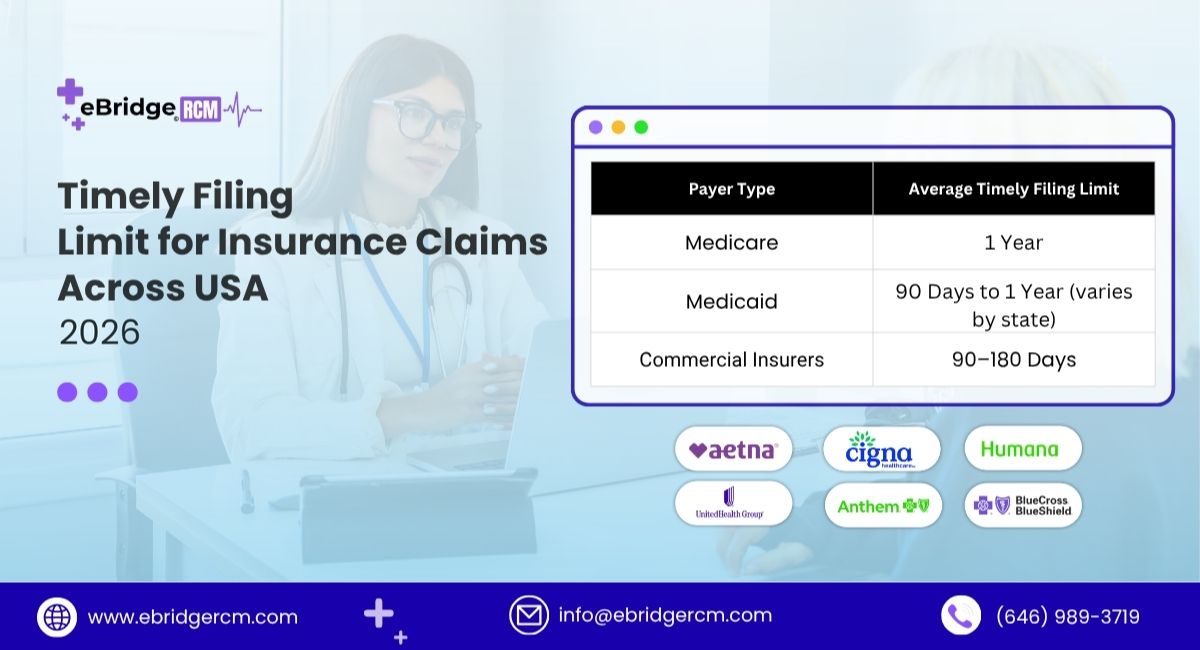
| Payer Type | Average Timely Filing Limit |
| Medicare | 1 Year |
| Medicaid | 90 Days to 1 Year (varies by state) |
| Commercial Insurers | 90–180 Days |
These ranges give a broad picture, but real-world limits depend on each payer’s policy, contract terms, and sometimes the patient’s plan category.
Complete Timely Filing Limit Data for Major Insurance Companies
Below is the updated 2026 reference list for common insurance carriers and their claim submission timelines. The data reflects standard limits from the date of service.

Timely Filing Limit for Major Commercial Insurance Payers
| Insurance Company | Timely Filing Limit (From Date of Service) |
| Aetna | 120 Days |
| Aetna Better Health | 180 Days |
| Aetna Better Health Kids | 180 Days |
| Ambetter | 180 Days |
| AvMed | 1 Year |
| Beacon Health | 90 Days |
| Buckeye | 1 Year |
| Caresource | 90 Days |
| Cenpatico | 90 Days |
| Champus | 1 Year |
| Cigna | 90 Days |
| Cigna (Out of network) | 180 Days |
| Emblem Health | 120 Days |
| Fidelis New York | 90 Days |
| GEHA | 90 Days |
| Harvard Pilgrim Health Care | 90 Days |
| Humana | 90 Days |
| Kaiser Permanente | 180 Days |
| Magellan | 60 Days |
| McLaren Health Plan | 1 Year |
| Medical Mutual | 1 Year |
| Medicare | 1 Year |
| Medicaid | 180 Days |
| Meridian | 1 Year |
| United Healthcare | 90 Days |
Insight:
You’ll notice that many payers, such as Aetna, Cigna, and Humana, follow a 90-day to 180-day timeframe. This shorter period requires consistent claim tracking and prompt documentation. Delays in coding or missing supporting documents often lead to preventable rejections.
On the other hand, payers like AvMed, Medicare, and McLaren Health Plan provide a one-year filing limit, which offers more flexibility. However, providers should still aim to submit claims well ahead of the deadline to account for any potential payer requests or corrections.
Healthcare organizations that manage multiple insurance contracts can benefit from automated RCM systems that flag pending claims approaching their filing limits. These tools significantly reduce manual follow-ups and improve first-pass acceptance rates.
Timely Filing Limit for BCBS (Blue Cross Blue Shield) by State
Blue Cross Blue Shield operates through a network of independent companies across different states, which is why their timely filing limits vary widely. For instance, BCBS Alabama allows up to 2 years, while BCBS Wyoming requires submission within just 60 days. Understanding these state-level variations helps practices adjust workflows and prioritize claims appropriately.
If your clinic handles multiple state plans, particularly for services such as orthopedic billing or pediatrics billing, aligning your billing schedule with the shortest filing period ensures that no claim is missed.

| Insurance Company | Timely Filing Limit for Initial Claim (From Date of Service) |
| BCBS Florida | 1 Year |
| BCBS North Carolina | 18 Months |
| BCBS Rhode Island | 180 Days |
| BCBS Michigan | 180 Days; 1 Year for BCBS Complete Plans |
| BCBS Illinois | 180 Days |
| Blue Cross of California | 180 Days |
| BCBS Alaska | 1 Year |
| BCBS Arizona | 1 Year |
| Highmark BCBS Delaware | 120 Days |
| BCBS Mississippi | 1 Year |
| BCBS Pennsylvania and West Virginia | 1 Year |
| Carefirst Washington DC | 1 Year |
| Florida Blue | 1 Year |
| BCBS Hawaii | 1 Year |
| BCBS Louisiana | 15 Months |
| Anthem BCBS Ohio, Kentucky, Indiana, Wisconsin | 90 Days |
| Wellmark BCBS Iowa and South Dakota | 180 Days |
| BCBS Alabama | 2 Years |
| BCBS Arkansas | 180 Days |
| BCBS Idaho | 180 Days |
| BCBS Kansas | 12 Months |
| Blue Cross Massachusetts (HMO, PPO Medicare Advantage Plans) | 90 Days |
| Blue Cross Massachusetts (Indemnity) | 1 Year |
| BCBS Minnesota | 180 Days |
| BCBS Montana | 180 Days |
| Horizon BCBS New Jersey | 180 Days |
| BCBS New Mexico | 180 Days |
| BCBS New York | 1 Year |
| BCBS of Northeastern New York | 1 Year |
| BCBS Oklahoma | 180 Days |
| BCBS Nebraska | Check with each individual plan as they are all different |
| Anthem BCBS Ohio, Kentucky, Indiana, Wisconsin | 90 Days |
| Independence Blue Cross | 120 Days |
| BCBS Tennessee | 120 Days |
| BCBS Texas | 95 Days |
| BCBS Vermont | 180 Days |
| BCBS Wyoming | 60 Days |
| Anthem California | 90 Days |
Observation:
The difference between states emphasizes how decentralized BCBS operations are. For instance, a practice billing for patients from New York, Texas, and Vermont might juggle three separate filing timelines. Failing to note those differences could result in lost revenue opportunities.
By integrating EHR and billing systems, providers can automatically link payer rules with each patient account. This allows billing teams to receive alerts when filing windows approach their cutoff dates.
How to Stay on Top of Timely Filing Deadlines
Even with accurate data, keeping up with multiple payer timelines can feel overwhelming, especially for growing practices. Below are some reliable strategies that billing teams can use:
1. Use Automated Claim Tracking
A digital billing system or an integrated RCM platform can flag claims that are nearing their deadline. Tools offered by providers like our medical billing services automatically track payer-specific timeframes and send alerts to staff before submissions expire.
2. Maintain Organized Documentation
Ensure every patient visit is documented, coded, and billed promptly. Delays often start at the documentation stage. Using EHR systems integrated with billing workflows prevents data from being lost between departments.
3. Understand Each Payer’s Exceptions
Some insurers allow late filing if specific conditions are met, such as system outages, provider credentialing delays, or retroactive eligibility. Familiarize your team with these scenarios and maintain supporting documentation.
4. Conduct Monthly Audits
Frequent auditing helps identify claim backlogs. eBridge RCM provides a monthly billing audit service that ensures no pending claims slip past filing limits, helping practices maintain predictable cash flow.
5. Leverage Clearinghouse Connectivity
Using clearinghouse tools helps verify claims before submission and confirms payer acceptance instantly. This reduces denials related to missing or incomplete claim data.
Understanding the Role of Timely Filing in Revenue Cycle Management
Timely filing is not just about deadlines. It’s about cash flow consistency and operational discipline. Each late claim represents potential revenue that a provider may never recover. Efficient RCM teams incorporate timely filing compliance into their workflow automation, integrating it with other areas like medical coding and credentialing.
When claim submission timelines are managed properly:
- Reimbursement becomes more predictable.
- Payer communication improves.
- Staff workload decreases due to fewer appeals.
Timely filing is especially important for specialized practices like pain management billing USA or gastroenterology billing services, where detailed documentation and claim accuracy are vital for payer approval.
Stay Ahead of Timely Filing Deadlines With Reliable Medical Billing & Claims Support
Avoid missed deadlines, reduce claim delays, and keep your practice’s revenue cycle moving forward.
Common Exceptions to Timely Filing Limits
While most payers adhere strictly to their deadlines, there are some recognized exceptions. These may include:
- Retroactive insurance eligibility or policy changes
- Provider credentialing delays
- Natural disasters or system interruptions
- Incorrect payer information due to coordination of benefits
To take advantage of these exceptions, documentation must be provided to prove the delay was beyond the provider’s control. Submitting an appeal letter with the appropriate records often helps recover reimbursement.
Steps to Take if a Claim Misses the Filing Deadline
If a claim is denied for being late, here’s what your billing department can do:
- Review payer policy – Some payers allow appeals within a specific window.
- Submit a corrected claim – If an initial claim was sent but rejected for format or data errors, corrected claims may be accepted.
- Appeal with supporting documents – Include EHR timestamps, proof of timely submission attempts, and any payer acknowledgment reports.
- Contact payer support – Always confirm if resubmission is possible before writing off the claim.
For large-volume providers, working with an outsourced billing team such as eBridge RCM LLC can help track these exceptions systematically.
Key Takeaways for Providers
- Keep a master spreadsheet of all payer filing limits.
- File claims electronically to reduce delays.
- Monitor clearinghouse rejections daily.
- Conduct periodic training for billing staff.
- Automate your RCM workflow where possible.
The healthcare billing environment is fast-paced and highly regulated. Staying proactive about timely filing can save thousands in denied claims every year.
Frequently Asked Questions (FAQs)
1. What is the timely filing limit for Medicare claims in 2026?
Medicare allows one calendar year from the date of service for submitting an initial claim.
2. Does Medicaid have the same filing limit in every state?
No. Medicaid limits vary by state, typically between 90 days and 1 year, depending on local regulations.
3. Can a provider appeal a denial due to missed timely filing?
Yes, but it depends on the payer. Appeals must include strong evidence, such as claim submission proof or EHR audit logs.
4. How can automation help meet timely filing deadlines?
RCM automation tools monitor each payer’s submission timelines, flag aging claims, and generate reminders before deadlines pass.
5. What happens if a corrected claim is submitted after the deadline?
Most payers treat corrected claims as new submissions. If the original claim wasn’t filed on time, reimbursement may still be denied.
6. How do clearinghouses affect filing compliance?
They act as intermediaries to validate claims. Using a clearinghouse ensures faster error detection and confirmation of payer receipt.
7. Which insurance company offers the shortest timely filing period?
Magellan typically has one of the shortest filing limits—60 days from the date of service.
Final Thoughts
Understanding and managing timely filing limits is a foundational element of medical billing compliance. Every day counts in the claim submission process. Whether you’re managing high-volume Medicare cases or working with commercial insurers, timely filing discipline ensures steady revenue and fewer denials.
For practices that need reliable end-to-end support, eBridge RCM LLC offers expert RCM solutions designed to handle everything from claim submission and AR recovery to monthly audits and payer credentialing. Their technology-driven billing solutions help healthcare providers maintain full compliance with payer requirements while focusing on patient care.