
A medical practice’s website is often the first touchpoint for new patients, and the way it looks and functions can determine whether they book an appointment or move on to another provider. In today’s digital-first healthcare landscape, patients expect websites to feel intuitive, informative, and trustworthy. When a healthcare provider invests in smart medical website design features, the results are often higher patient inquiries, stronger appointment booking rates, and more efficient front-office operations.
Building a healthcare site with the right design strategies goes beyond appearance. It involves creating experiences that address patient needs while aligning with how people search for medical services online. This is why many practices now pair web development with healthcare marketing and even integrate it with revenue cycle processes such as medical billing services.
In this guide, we’ll cover the top five web design features proven to improve patient conversions. Along the way, you’ll find practical tips, examples, and a structured table to help you evaluate your current website.
Why Web Design Matters for Patient Conversion
Patients no longer find doctors only through word-of-mouth or referrals. Most start their search online, typing queries into search engines such as “pediatrician near me” or “allergy specialist in New York.” A healthcare website that communicates clearly, loads quickly, and provides user-friendly navigation often becomes the deciding factor between scheduling a consultation and bouncing to a competitor’s page.
A well-structured website is also a foundation for healthcare SEO. Optimized design not only improves user experience but also signals trust to search engines, making it easier for patients to discover your practice. For instance, a practice specializing in dermatology can increase visibility by combining strong design with content related to dermatology medical billing, treatment information, and insurance guidance.
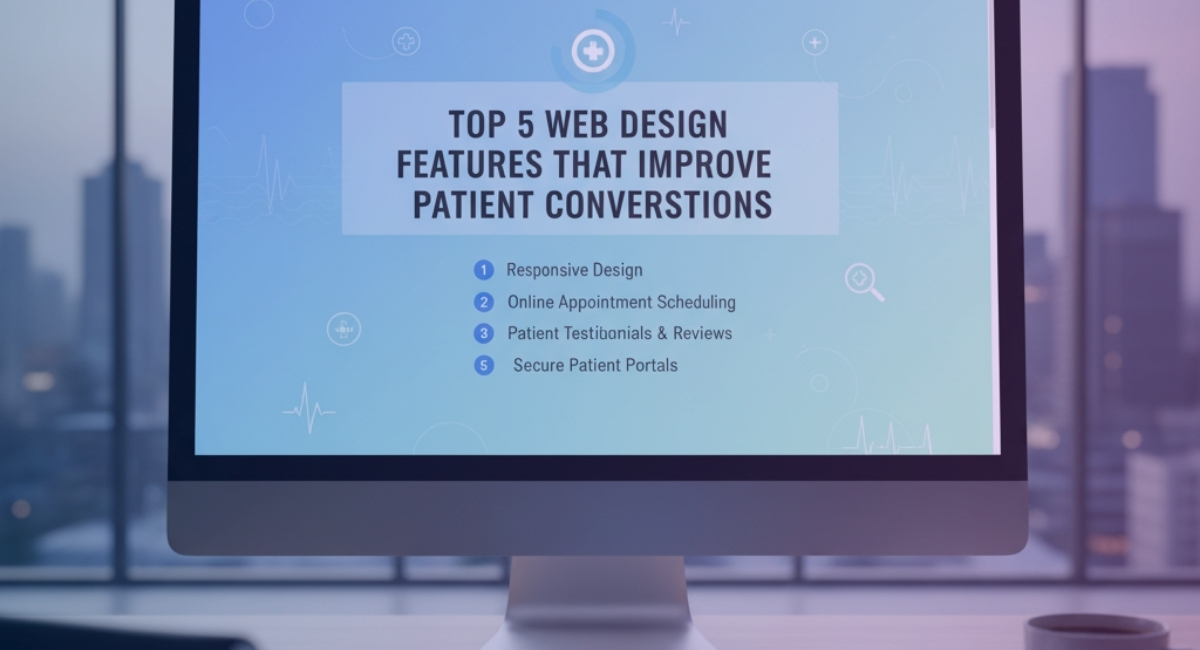
The Top 5 Web Design Features for Better Patient Conversions
While dozens of design elements can influence user experience, five stand out for their direct impact on patient conversions.
1. Mobile-Optimized and Responsive Design
More than 70% of healthcare-related searches come from mobile devices. If your site isn’t responsive, patients may abandon it quickly. Responsive design ensures the website automatically adjusts to different screen sizes, whether viewed on a smartphone, tablet, or desktop.
Key considerations:
- Large, tap-friendly buttons for booking appointments
- Clear contact icons with click-to-call functionality
- Fast-loading content optimized for mobile data speeds
Mobile responsiveness is not just about scaling content. It’s about reducing friction in the journey. A patient searching for urgent care services should be able to schedule a visit in seconds, not minutes.
2. Simple Navigation and Clear Call-to-Actions
Confusing navigation is one of the biggest conversion killers. Patients typically visit medical websites to complete one of three tasks:
- Learn about a condition or treatment
- Confirm a provider’s expertise or insurance coverage
- Book an appointment
A streamlined menu with logical categories helps patients find information without frustration. Pairing navigation with consistent call-to-action (CTA) buttons, such as “Schedule an Appointment” or “Contact Us,” guides users naturally toward conversion.
For example, a cardiology practice can design a homepage with easy pathways to services, physician bios, and a direct link to insurance coverage information. Combined with content that connects to cardiology billing solutions, this creates a user flow that builds both trust and action.
3. Patient-Focused Content and Educational Resources
Content is a silent but powerful web design feature. Patients value sites that not only describe services but also explain conditions, treatments, and preparation steps in plain language. Adding patient education resources helps establish authority while also reducing the burden on front-desk staff who often answer repeat questions.
Content formats that convert well:
- FAQs for common treatments and procedures
- Video walkthroughs of the patient journey
- Downloadable guides for pre-appointment instructions
When structured correctly, educational content doubles as an SEO asset. A pediatrics practice, for instance, can publish content related to developmental milestones while also optimizing for queries around pediatrics billing, which improves both patient awareness and practice credibility.
4. Integrated Appointment Scheduling and Patient Forms
One of the most direct ways to improve patient conversion is by reducing steps between interest and booking. Adding online scheduling functionality and digital intake forms eliminates the need for long phone calls or waiting on hold.
Modern medical websites often integrate scheduling tools that:
- Allow patients to see real-time availability
- Offer multiple appointment types (in-person, telehealth, urgent visits)
- Send automated reminders to reduce no-shows
When paired with secure patient forms, practices can streamline data collection and reduce front-office workload. Integration with EHR or RCM platforms, such as EMR integration services, makes the process even smoother for both patients and staff.
5. Trust Signals and Compliance-Ready Design
Patients want reassurance before handing over sensitive health information. Trust-building elements include:
- Physician bios with credentials and specialties
- Patient testimonials and success stories
- Security features like SSL certificates and HIPAA-compliant form handling
Design that emphasizes credibility is especially important for practices handling specialized services like psychiatry billing or pain management care, where confidentiality and trust are top priorities.
A Practical Guide: Comparing Features That Boost Conversions
The following table provides a quick way to evaluate key medical website design features and their impact on patient conversion.
| Feature | Conversion Impact | Practical Example | Integration Tip |
| Mobile Responsiveness | High | Urgent care website loads quickly on mobile | Optimize images, use adaptive layouts |
| Simple Navigation | High | Clear “Book Now” buttons on every page | Keep menus under 6 main categories |
| Patient-Focused Content | Medium-High | FAQs for common procedures | Add schema markup for better SEO |
| Online Scheduling | Very High | Real-time booking calendar | Integrate with EHR or RCM systems |
| Trust Signals | High | Display board-certified doctor profiles | Ensure HIPAA compliance on all forms |
How These Features Work Together
Each feature on its own contributes to conversion, but their combined effect is where practices see real impact. For example, a gastroenterology practice might implement educational content on digestive health, offer online scheduling, and ensure mobile-friendly navigation. Together, these features improve patient confidence and reduce barriers to booking, leading to better patient acquisition.
Pairing these design strategies with backend improvements such asn healthcare web development and revenue cycle optimization ensures practices maximize both digital visibility and financial performance.
Frequently Asked Questions
Q1: How does healthcare web UX affect patient trust?
Healthcare web UX directly influences trust by making information easy to find and ensuring interactions feel secure. Patients are more likely to book with providers whose sites look professional, are easy to navigate, and clearly display credentials.
Q2: Is online scheduling safe for patient data?
Yes, when implemented with HIPAA-compliant tools. Practices should use secure forms, SSL certificates, and integrated systems that protect sensitive data during transmission.
Q3: What type of content converts best on medical websites?
Educational content, including treatment overviews, FAQs, and preparation guides, tends to perform best. Video introductions from doctors also increase trust and booking likelihood.
Q4: Can improving web design also help SEO rankings?
Absolutely. Features like responsive design, structured content, and schema markup signal quality to search engines, which can improve ranking for relevant searches.
Q5: How often should a healthcare website be redesigned?
Most experts recommend updating medical websites every 3–4 years to stay aligned with user expectations, mobile standards, and compliance requirements.
Final Thoughts
A healthcare website is not just a digital brochure but an active part of the patient journey. Practices that invest in responsive design, simple navigation, engaging content, online scheduling, and trust signals consistently see stronger patient conversion rates. These features also complement broader digital strategies such as healthcare SEO and practice marketing, making the website a growth engine rather than just an informational resource.
For practices looking to improve patient experience while strengthening revenue outcomes, integrating design enhancements with revenue cycle and marketing services is a strategic step. Partnering with an expert provider like eBridge RCM LLC ensures your digital presence supports both patient care and financial performance.