
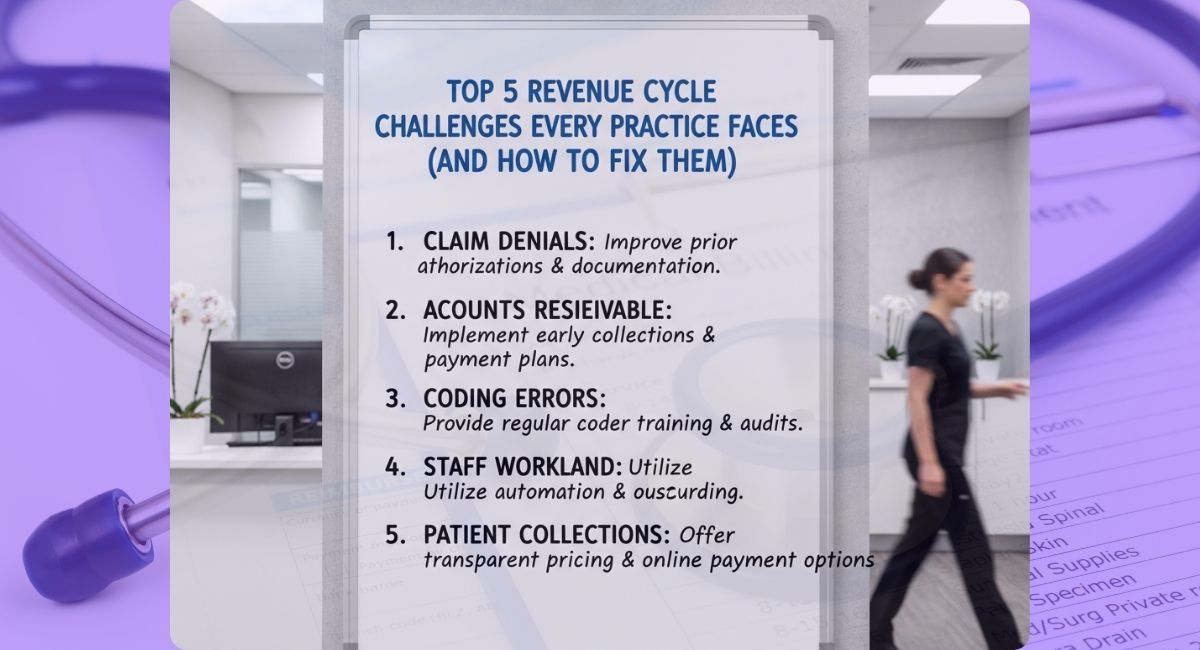
Every practice, no matter its size or specialty, is built on two equally important pillars: delivering quality patient care and maintaining financial health. It is easy to focus entirely on the first, because medicine is about people, not paperwork. Yet the survival of any practice depends on getting paid accurately and on time.
Revenue cycle management (RCM) is the system that holds this balance together. It begins the moment a patient schedules an appointment and does not end until every claim has been processed, every bill has been paid, and every balance has been reconciled. But this process rarely flows smoothly. Many practices face common roadblocks that seem to recycle month after month: claim denials, aging accounts receivable, and endless follow-ups that leave staff frustrated.
Practices from family medicine to cardiology experience the same challenges. Whether you run a small clinic or a busy specialty practice, revenue cycle problems can quietly erode your margins if left unaddressed.
This manual-style guide breaks down the top five challenges in RCM and explains not only how they arise but how to create lasting fixes. Think of it as a hands-on resource to help you understand the cycle better, strengthen weak points, and guide your staff with clear steps.
Challenge 1: High Volume of Claim Denial
Imagine a patient comes in for a minor surgical procedure. The surgery goes smoothly, but a few weeks later, the claim comes back denied because the patient’s insurance information was outdated. The denial sits in a pile while staff scramble with other tasks, and eventually, the deadline for resubmission passes. The revenue is lost forever. Multiply this scenario across dozens of patients, and the financial impact becomes staggering.
Why this keeps happening:
- Eligibility verification is often rushed or skipped.
- Staff rely on outdated payer rules.
- Coding is inconsistent across providers.
- Documentation lacks the detail payers demand.
In fact, industry data suggests that almost 20% of all initial medical claims are denied or delayed, yet most of these denials are avoidable.
Long-term fixes:
- Make eligibility verification a non-negotiable step. Create a workflow where staff cannot finalize a patient check-in until eligibility is confirmed. Automating this step reduces human error.
- Establish a coding “playbook.” Each specialty has recurring procedures and codes. For example, anesthesiology billing involves specific modifiers that, if misused, trigger denials. Building a reference playbook improves accuracy.
- Invest in denial analytics. Don’t just fix one claim at a time—look for patterns. If 30% of denials are from one payer citing “missing documentation,” train providers to include the missing details upfront.
Expanded Table: Common Denial Reasons and Fixes
| Denial Reason | Prevention Strategy | Who Handles It |
| Eligibility not active | Run real-time verification before visit | Front desk staff |
| Wrong diagnosis code | Cross-check ICD-10 updates quarterly | Certified coder |
| Missing prior authorization | Automate prior auth alerts in scheduling system | Scheduling team |
| Late filing | Automated reminders and claim batching | Billing staff |
| Lack of documentation | Provider education and EHR checklists | Physicians + nurses |
Challenge 2: Ineffective AR Follow-Up
AR follow-up is where many practices quietly lose revenue. Think of AR as the money owed to you that is still sitting in someone else’s pocket. The longer it stays there, the harder it becomes to recover.
Example: A neurology clinic submits a $2,500 claim. At 30 days, it remains unpaid. At 60 days, staff try to follow up but are bogged down by calls. At 90 days, the payer requires additional documentation. At 120 days, the claim is written off. This cycle repeats across hundreds of claims, leaving large amounts uncollected.
Why AR spirals out of control:
- No dedicated staff to chase old claims.
- Follow-up is reactive instead of proactive.
- Practices rely solely on payer timelines without escalation protocols.
Fixing the AR process:
- Segment AR reports. Divide receivables into buckets (0–30, 31–60, 61–90, 90+). Assign staff to each bucket so old claims don’t slip through.
- Create escalation paths. After two unanswered follow-ups, escalate the case internally. If payers still delay, transfer to AR recovery services for expert handling.
- Monitor payer behavior. If one payer consistently delays, document and report patterns. Negotiating contract changes may become necessary.
Detailed Table: AR Follow-Up Workflow
| AR Age | Workflow Action | Responsible Role | Recovery Likelihood |
| 0–30d | Monitor payment posting, flag anomalies | Billing coordinator | Very High |
| 31–60d | Weekly calls/emails to payer | AR specialist | Moderate |
| 61–90d | Escalate to manager, review documentation | Billing manager | Low to Moderate |
| 90+d | Move to dedicated AR recovery team | External RCM partner | Very Low |
Challenge 3: Medical Billing Errors
Billing mistakes not only delay payments but also invite audits. These errors often stem from small lapses in attention but create outsized consequences.
Real-world scenario: In one orthopedic practice, staff accidentally billed for a higher level of service than performed. The payer flagged it, triggering an audit. The practice not only lost revenue but also spent months under scrutiny.
Why billing errors persist:
- Overloaded staff multitasking across front and back-end tasks.
- Lack of consistent training in payer updates.
- Limited use of claim scrubbing technology.
Building error-proof systems:
- Regular refresher training. Make it mandatory for billing staff to review payer-specific rules every quarter.
- Automated claim scrubbing. Tools like EDI clearinghouse integration catch missing information before claims are sent.
- Internal audits. Conduct random sample audits monthly. Include providers in the process so they understand where documentation gaps exist.
Challenge 4: Slow Patient Collections
Patient responsibility now accounts for a larger share of revenue due to high-deductible health plans. Practices that fail to adapt find themselves holding unpaid balances for months.
Human perspective: A patient receives a $600 bill weeks after a visit. They don’t understand what it covers and feel blindsided. Instead of paying, they set it aside. The balance grows, and by the time the practice follows up, it feels adversarial.
Common pitfalls in patient collections:
- Confusing bills with medical jargon.
- No upfront discussion about costs.
- Limited payment flexibility.
- Staff avoiding financial conversations with patients.
How to fix collections:
- Transparent pricing. Give patients estimates at check-in.
- Simplify bills. Use plain language and itemized charges.
- Offer payment flexibility. Online portals, mobile payments, and installment plans encourage faster payments.
- Train staff in compassionate communication. Patients respond better when approached with clarity and empathy.
Checklist: Improving Patient Collections
- Provide upfront estimates before services.
- Train staff to explain coverage and balances.
- Use patient-friendly billing statements.
- Offer at least two digital payment options.
- Follow up within 15 days of billing.
Challenge 5: Poor Data Management and Reporting
Without accurate data, practices operate in the dark. You cannot improve what you cannot measure. Many practices lack visibility into key RCM metrics, leaving them unaware of where the real problems lie.
Example: A family medicine clinic assumes their denial rate is low because staff “don’t see many problems.” When reports are finally pulled, it turns out denial rates are over 12%. Without dashboards, these issues were hidden until revenue loss became severe.
Why data is underused:
- Multiple systems (EHR, billing, clearinghouse) that don’t communicate.
- Reports generated only quarterly, making them outdated.
- Staff unsure which metrics truly matter.
Fixing the data problem:
- Integrated systems. Use EMR integration services to connect billing and clinical data.
- Real-time dashboards. A billing dashboard that shows denials, AR days, and collection rates in real-time helps managers act immediately.
- Benchmarking. Compare your metrics with industry standards. For example, a clean claim rate should be above 95%. If yours is 85%, you know exactly where to improve.
Expanded KPI Table
| KPI | Target Benchmark | Why It Matters |
| Clean claim rate | >95% | Minimizes payer delays and denials |
| Average AR days | <40 days | Ensures steady cash flow |
| First-pass resolution rate | >85% | Measures how many claims are paid on first try |
| Denial rate | <5% | Shows billing efficiency and payer compliance |
| Patient responsibility collection rate | >80% | Protects against rising patient balances |
FAQs on Revenue Cycle Challenges
1. Should practices outsource their revenue cycle or keep it in-house?
It depends on size and resources. Smaller practices often benefit from outsourcing since hiring and training staff for every function is expensive. Larger groups may choose hybrid models with some processes handled internally.
2. What is the single biggest cause of denials?
Eligibility issues remain the leading cause, often due to outdated insurance information. Automated eligibility checks reduce this significantly.
3. How can providers motivate staff to stay engaged in RCM tasks?
Incentives tied to clean claim rates, reduced denials, or AR improvements can keep staff motivated. Regular training also builds confidence.
4. Is there a way to reduce patient frustration with billing?
Yes. Clear upfront communication, simplified bills, and multiple payment options reduce friction and improve satisfaction.
5. How often should revenue cycle audits be done?
At least quarterly. Monthly mini-audits are ideal to catch problems before they escalate.
Final Words
Revenue cycle challenges may look different in detail—denials for one practice, AR delays for another—but they all lead to the same outcome: lost revenue and staff frustration. By proactively addressing claim denials, implementing structured AR follow-up, reducing billing errors, improving patient collections, and strengthening data reporting, practices can transform their financial health.
No provider should have to choose between patient care and financial survival. Partnering with experts ensures both are possible. With comprehensive medical billing services and specialized support across multiple specialties, eBridge RCM LLC helps practices not only solve today’s revenue challenges but build stronger systems for tomorrow.