Why Clean Claims Decide Whether Practices Get Paid
A medical claim is not just paperwork. It is the final step between patient care and revenue. Yet across healthcare systems, a large share of claims are delayed, reduced, or denied because of small but costly errors that could have been avoided before submission.
A single incorrect modifier, missing diagnosis code, mismatched patient data, or outdated insurance detail can stop reimbursement completely. For many practices, especially those handling high patient volumes, these errors quietly accumulate and create cash flow pressure that is hard to trace at first.
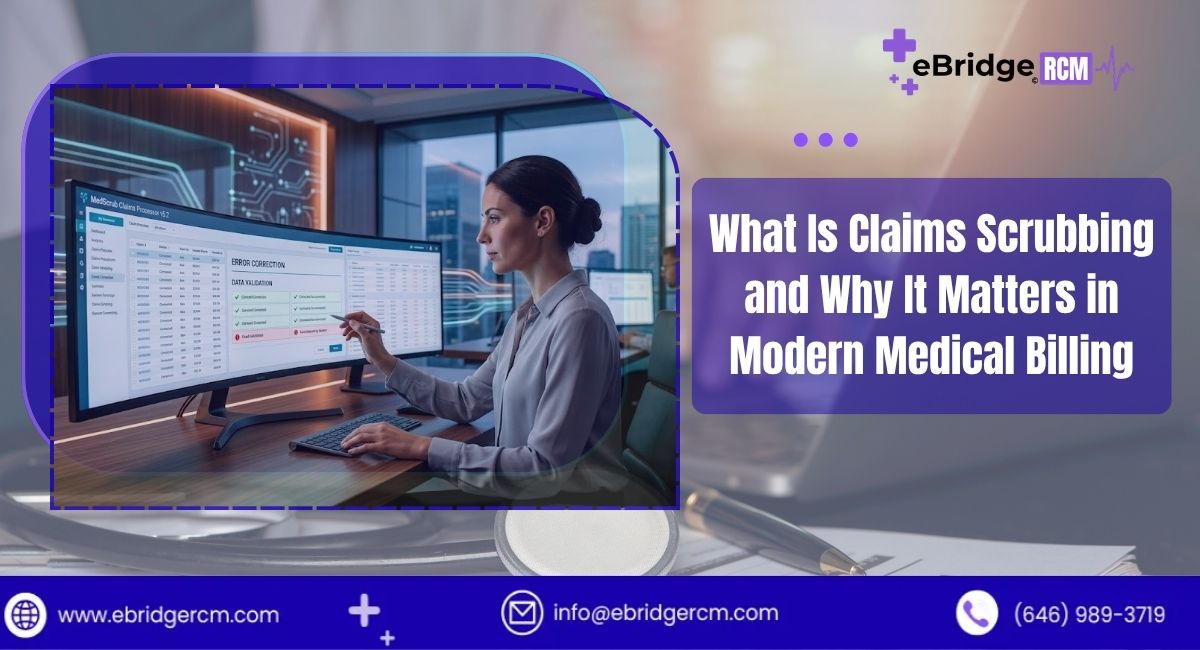
This is where claims scrubbing becomes essential. It acts as a checkpoint between clinical documentation and payer submission, identifying issues before the claim leaves the system.
Modern healthcare organizations rely heavily on automated validation systems integrated into revenue workflows. These tools are often part of broader revenue cycle management claims validation processes that ensure every claim meets payer rules before submission.
At its core, claims scrubbing is about preventing avoidable revenue loss. Not by changing care delivery, but by improving accuracy, consistency, and compliance in billing data.
Understanding Claims Scrubbing in Medical Billing
Claims scrubbing in medical billing refers to the process of reviewing healthcare claims before they are submitted to insurance payers. The goal is to detect and correct errors that could lead to rejection or denial.
This process can be manual, automated, or hybrid. However, modern healthcare systems rely heavily on automation through integrated platforms and clearinghouse networks.
What Claims Scrubbing Actually Does
Claims scrubbing software evaluates medical claims against:
- Insurance payer rules
- Coding guidelines such as ICD-10 and CPT standards
- Patient eligibility data
- Provider credentials and NPI validation rules
- Formatting requirements for electronic submission
If a claim fails any validation check, it is flagged for correction before submission.
This is where medical claims scrubbing software benefits become most visible, because it reduces downstream rework and denial management workload.
Why It Exists in the First Place
Healthcare billing is complex because every payer has slightly different requirements. Medicare rules differ from private insurers, and even within private payers, rules can vary widely.
Without a validation layer, claims would be submitted with a high error rate, leading to:
- Increased claim denials
- Slower reimbursement cycles
- Higher administrative workload
- Revenue leakage
Claims scrubbing acts as a filter that protects revenue integrity before submission.
The Role of Claims Scrubbing in the Revenue Cycle
Claims scrubbing sits between coding and claim submission in the revenue cycle management workflow. It is a critical checkpoint that ensures claims are “clean” before reaching payers.
To understand its importance, it helps to see where it fits:
- Patient registration
- Insurance eligibility verification
- Clinical documentation
- Medical coding
- Claims scrubbing and validation
- Claim submission
- Payment posting and reconciliation
At step five, claims scrubbing validates all prior work. If errors are found, claims are sent back for correction instead of being submitted.
This step is especially important for reducing delays in reimbursement and strengthening financial stability for practices.
For organizations trying to optimize this workflow, resources like revenue cycle management denial prevention strategies help improve long-term billing accuracy and operational efficiency.
Why Claims Scrubbing Matters More Today Than Before
Healthcare billing has become more complex due to regulatory changes, value-based care models, and increasing payer scrutiny. Manual review alone cannot keep up with the volume and complexity of claims.
Key reasons claims scrubbing is now essential:
- Coding systems like ICD-10 contain thousands of codes with nuanced rules
- Payers frequently update reimbursement guidelines
- Electronic claims require strict formatting compliance
- Denial rates continue to rise across specialties
- Staffing shortages increase risk of human error
As a result, automated validation tools are no longer optional. They are a core part of modern billing infrastructure.
Platforms such as Change Healthcare (now part of Optum), Waystar, and Availity provide integrated scrubbing and clearinghouse services that help streamline this process across healthcare organizations.
Common Errors Identified by Claims Scrubbing Systems
Claims scrubbing tools are designed to detect both simple and complex billing issues. These errors often go unnoticed during manual review.
Table 1: Examples of Errors Detected in Claims Scrubbing
| Error Type | Description | Impact if Not Corrected |
| Invalid CPT/ICD codes | Incorrect or mismatched diagnosis and procedure codes | Claim denial or underpayment |
| Missing modifiers | Required billing modifiers not included | Claim rejection or delay |
| Eligibility mismatch | Patient insurance not active or incorrect plan | Full denial |
| Duplicate claims | Same service billed multiple times | Compliance risk and penalties |
| NPI errors | Incorrect provider identification | Claim rejection |
| Date of service issues | Incorrect or missing service dates | Claim delay |
| Formatting errors | Non-compliant electronic submission format | Clearinghouse rejection |
Each of these errors contributes to revenue leakage, especially when repeated at scale.
How Claims Scrubbing Software Works
Claims scrubbing software operates using predefined rule sets and payer-specific guidelines. It reviews claims line by line before submission.
Core functions include:
- Syntax validation of billing data
- Coding accuracy checks
- Policy compliance validation
- Payer-specific rule matching
- Duplicate claim detection
- Eligibility verification integration
This is part of broader medical billing error detection process frameworks used in modern healthcare systems.
Curious How Much Revenue Your Practice Could Recover?
Talk with our team about where your billing stands today and what a stronger revenue cycle could mean for your bottom line.
Integration with Clearinghouses
Clearinghouses act as intermediaries between providers and payers. They transmit claims after scrubbing and format validation.
Tools like Availity Essentials and Waystar Clearinghouse Solutions help automate this flow, ensuring claims are properly formatted and compliant before reaching insurers.
Practices using structured systems like clearinghouse solutions for medical billing often experience fewer rejections at the submission stage.
Medical Claims Scrubbing Software Benefits for Healthcare Practices
The advantages of claims scrubbing extend beyond simple error detection. They directly influence revenue stability, administrative efficiency, and compliance readiness.
1. Reduced Claim Denials
The most immediate benefit is a lower denial rate. By catching errors before submission, scrubbing systems prevent claims from being rejected by payers.
For a deeper understanding of denial reduction strategies, practices often reference top medical billing denial prevention approaches.
2. Faster Reimbursement Cycles
Clean claims are processed faster. When payers receive accurate claims, they spend less time reviewing or requesting corrections.
This improves cash flow consistency, especially for small and mid-sized practices.
3. Lower Administrative Burden
Without scrubbing, billing teams spend significant time correcting rejected claims. Automated validation reduces this workload, allowing staff to focus on higher-value tasks.
4. Improved Compliance
Healthcare regulations require strict adherence to coding and documentation rules. Scrubbing ensures claims align with compliance standards, reducing audit risks.
For compliance-focused workflows, resources like medical billing compliance checklist help practices maintain structured billing discipline.
5. Better Data Accuracy Across Systems
Scrubbing improves overall data integrity across EHR and billing platforms. This supports accurate reporting and analytics.
When integrated with systems like Epic Systems, Cerner (Oracle Health), and athenahealth, scrubbing tools help maintain consistent data flow between clinical and financial systems.
6. Reduced Cost of Rework
Every denied claim costs time and money to correct. Scrubbing reduces these hidden costs significantly.
Claims Scrubbing vs Traditional Claim Review
Before automation, billing teams manually reviewed claims for errors. While still used in some practices, manual review has limitations.
Table 2: Manual Review vs Automated Claims Scrubbing
| Factor | Manual Review | Automated Scrubbing |
| Speed | Slow and labor-intensive | Real-time validation |
| Accuracy | Dependent on staff expertise | Rule-based consistency |
| Scalability | Limited | High scalability |
| Error detection rate | Moderate | High |
| Cost efficiency | Higher labor cost | Lower long-term cost |
| Payer rule updates | Manual updates required | Automated updates |
This comparison shows why automation has become standard in modern healthcare billing environments.
The Connection Between Claims Scrubbing and Denial Prevention
Claims scrubbing is not just a technical step. It is a proactive denial prevention strategy.
Most claim denials fall into predictable categories:
- Coding errors
- Missing information
- Eligibility issues
- Authorization problems
Scrubbing systems identify these issues before submission, reducing the probability of denial.
For practices looking to strengthen this area, guides like ICD-10 coding errors impacting reimbursements provide deeper insight into coding-related denial risks.
Additionally, structured workflows such as denial reduction strategies in revenue cycle management help practices build long-term resilience.
Real-World Scenario: How Claims Scrubbing Prevents Revenue Loss
Consider a multi-provider internal medicine clinic submitting 500 claims per week.
Without scrubbing:
- 8 to 12 percent of claims may be denied
- Staff must manually correct and resubmit claims
- Payment delays extend by 20 to 40 days
- Administrative workload increases significantly
With scrubbing:
- Error rate drops significantly before submission
- Most claims pass payer requirements on first submission
- Rework time decreases
- Revenue cycle becomes more predictable
This difference compounds over time, especially in high-volume practices.
Integration with Revenue Cycle Management Systems
Claims scrubbing does not operate in isolation. It is part of a broader revenue cycle management ecosystem.
Key integrations include:
- Electronic Health Records (EHR)
- Practice Management Systems (PMS)
- Clearinghouses
- Eligibility verification systems
- Medical coding tools
When combined, these systems create a unified workflow for revenue cycle management claims validation.
Organizations that adopt integrated platforms often see fewer bottlenecks between departments and more consistent cash flow outcomes.
For practices scaling operations, end-to-end revenue cycle solutions provide structured support across billing, coding, and collections.
Common Challenges in Claims Scrubbing Implementation
While benefits are significant, implementation is not always simple.
1. Rule Configuration Complexity
Each payer has unique rules. Setting up accurate rule sets requires expertise and ongoing updates.
2. System Integration Issues
Connecting scrubbing tools with existing EHR or billing software can be technically challenging.
3. False Positives
Some systems flag valid claims as errors, requiring manual review.
4. Training Requirements
Billing staff must understand how to interpret scrub reports and correct errors effectively.
Despite these challenges, most organizations find that benefits outweigh implementation complexity.
The Future of Claims Scrubbing in Healthcare
Claims scrubbing is evolving rapidly with the help of artificial intelligence and machine learning.
Emerging trends include:
- Predictive denial analytics
- AI-driven coding validation
- Real-time payer rule updates
- Automated correction suggestions
- Natural language processing for clinical notes
Companies like Waystar, Optum, and Experian Health are actively investing in intelligent revenue cycle tools that reduce manual intervention further.
As healthcare moves toward automation, scrubbing will become more predictive rather than reactive.
Practical Steps to Improve Claims Scrubbing Performance
Healthcare practices can improve scrubbing efficiency by focusing on system design and workflow discipline.
Key steps include:
- Regularly updating payer rule libraries
- Training billing staff on error patterns
- Integrating scrubbing with EHR systems
- Reviewing denial reports monthly
- Auditing claims before submission cycles
For structured improvement, practices often rely on medical billing services in USA that include built-in scrubbing and validation processes.
Why Claims Scrubbing Is No Longer Optional
Claims scrubbing has become a core function in modern healthcare billing, not an optional enhancement. It directly affects revenue stability, compliance readiness, and operational efficiency.
By identifying errors before submission, it reduces denials, accelerates payments, and improves overall financial performance. More importantly, it helps healthcare organizations maintain consistency in an increasingly complex billing environment.
Practices that invest in structured scrubbing systems and integrated revenue cycle workflows position themselves for fewer disruptions and stronger financial outcomes over time.
For healthcare organizations looking to strengthen billing accuracy and reduce claim rework, working with experienced partners such as eBridge RCM LLC can provide end-to-end support across billing, coding, and revenue cycle optimization.