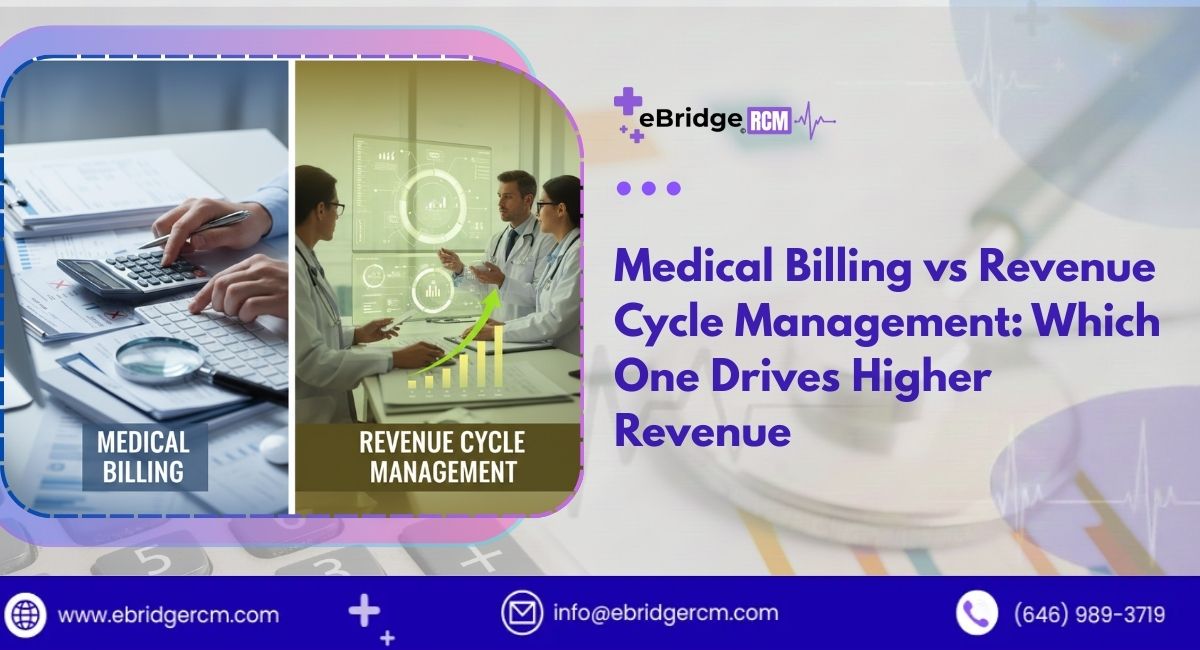
In the healthcare industry, revenue generation is critical for sustaining and growing a practice. For providers, understanding the difference between medical billing and revenue cycle management (RCM) can be the deciding factor in optimizing revenue and minimizing claim delays. While both processes are essential, they serve distinct purposes and contribute differently to a practice’s financial health. This guide provides a detailed comparison of medical billing and RCM, highlighting which approach drives higher revenue, and how practices can leverage both for improved financial performance.
Whether you are a new practice or an established healthcare provider, understanding how medical billing services fit within the broader RCM framework is essential. If your practice focuses on specialties such as cardiology, internal medicine, or mental health, exploring specialized services like cardiology billing services or internal medicine billing solutions can provide immediate improvements in claim processing and revenue collection.
Understanding Medical Billing
Medical billing is the process of submitting and following up on claims with health insurance companies to receive payment for services rendered by a healthcare provider. The process includes verifying patient information, coding procedures, and sending claims to insurers. Medical billing ensures that healthcare providers are reimbursed accurately and timely for the care they provide.
Key Components of Medical Billing
- Patient Registration: Collecting patient demographics, insurance information, and medical history.
- Coding and Documentation: Translating medical procedures and diagnoses into standard codes such as CPT, ICD-10, and HCPCS.
- Claim Submission: Sending accurate claims to insurance companies electronically or on paper.
- Follow-up and Denial Management: Addressing rejected or denied claims promptly to ensure payment.
A well-executed billing process is essential for minimizing revenue loss due to errors or delays. Practices can significantly benefit from outsourcing to professional medical billing companies. For example, specialized mental health billing services offer expertise in handling complex insurance requirements, improving collections, and reducing denials.
What is Revenue Cycle Management (RCM)?
Revenue Cycle Management is a broader process that encompasses medical billing along with administrative and financial functions involved in managing the entire revenue lifecycle of a healthcare provider. RCM ensures that every step, from patient registration to final payment, is optimized to maximize revenue and reduce inefficiencies.
Components of RCM
RCM covers a wide array of functions including:
- Eligibility Verification: Confirming patient insurance coverage before services are provided.
- Charge Capture: Documenting all services performed for accurate billing.
- Medical Billing: The core process of submitting claims to insurers.
- Denial Management and Appeals: Tracking denied claims and filing appeals for recovery.
- Accounts Receivable (AR) Management: Monitoring outstanding payments and following up with insurers and patients.
- Reporting and Analytics: Providing actionable insights into revenue trends and operational performance.
Unlike medical billing, RCM focuses not only on claim submission but also on streamlining the entire revenue generation process. Outsourcing revenue cycle management allows practices to focus on patient care while ensuring financial operations are optimized. Providers in New York, for example, can benefit from monthly billing audits to identify inefficiencies in their RCM process.
Comparing Medical Billing and Revenue Cycle Management
While medical billing is a component of RCM, the two are not interchangeable. Below is a table highlighting their differences and impacts on revenue:
| Feature | Medical Billing | Revenue Cycle Management |
|---|---|---|
| Scope | Focuses on claim submission and payment collection | Covers the entire revenue process from registration to final payment |
| Impact on Revenue | Ensures accurate claims and timely payment | Maximizes revenue through process optimization, denial management, and analytics |
| Complexity | Moderate | High, involves multiple departments and technologies |
| Requirement | Knowledge of coding and insurance processes | Integrates billing, AR, reporting, and compliance |
| Best for | Small practices with limited patient volume | Medium to large practices or practices with complex workflows |
This comparison shows that while medical billing ensures claims are processed, RCM provides a holistic approach to improving cash flow and reducing revenue leakage. Practices that implement a full RCM strategy are better positioned to maximize revenue.
Benefits of RCM Over Standalone Medical Billing
- Improved Cash Flow: RCM monitors and manages the complete revenue lifecycle, helping practices identify and resolve payment bottlenecks faster.
- Reduced Denials: By verifying eligibility, coding accurately, and managing denials proactively, RCM reduces claim rejections.
- Data-Driven Decisions: RCM systems generate reports that allow providers to track financial performance, patient trends, and operational efficiency.
- Compliance Assurance: Integrated RCM processes help maintain regulatory compliance, reducing audit risks and penalties.
- Patient Satisfaction: Efficient billing and claims processes enhance patient experience and reduce billing confusion.
Providers offering specialized services like cardiology billing or internal medicine billing can benefit significantly from RCM systems as they often deal with complex procedures and insurance scenarios.
Manual Guide to Implementing an Effective RCM Strategy
Implementing a successful RCM strategy requires careful planning and consistent monitoring. Below is a step-by-step guide for healthcare practices:
Step 1: Verify Insurance Eligibility
Ensure patient insurance information is accurate and up-to-date. This prevents claim denials and minimizes delayed payments.
Step 2: Accurate Coding and Charge Capture
- Ensure all services are documented and coded correctly.
- Maintain up-to-date knowledge of CPT, ICD-10, and HCPCS codes.
Step 3: Efficient Claim Submission
- Use electronic claim submission for faster processing.
- Monitor claim status regularly to prevent lost payments.
Step 4: Manage Denials Effectively
- Track denied claims and identify common rejection reasons.
- File timely appeals and maintain documentation for compliance.
Step 5: Monitor Accounts Receivable
- Establish AR follow-up schedules.
- Categorize accounts by age and priority for faster collections.
Step 6: Reporting and Analytics
- Generate financial and operational reports regularly.
- Use insights to identify revenue trends and areas for improvement.
Step 7: Continuous Improvement
- Audit RCM processes periodically.
- Incorporate technology upgrades and staff training to enhance efficiency.
Below is a table illustrating common metrics used to evaluate RCM performance:
| Metric | Definition | Target Range |
|---|---|---|
| Days in Accounts Receivable (DAR) | Average number of days to collect payments | 30-45 days |
| Denial Rate | Percentage of claims denied by payers | <5% |
| Collection Rate | Percentage of collected charges | 95%+ |
| First Pass Resolution Rate | Claims approved without resubmission | 90%+ |
| Claim Rejection Rate | Percentage of claims rejected initially | <3% |
Integrating Medical Billing and RCM
While standalone medical billing addresses immediate claim submission needs, integrating it into a comprehensive RCM system provides a long-term revenue strategy. Practices benefit from a combination of specialized billing expertise and RCM oversight. For example:
- Mental health practices can enhance collections by using mental health billing services within an RCM framework.
- Cardiology providers can track procedural codes, optimize claim approval rates, and maintain compliance through RCM while relying on dedicated billing experts.
Integration also improves technology utilization. EMR/EHR systems can sync with RCM platforms to automate claims processing, minimize errors, and generate actionable insights.
Choosing Between Medical Billing and RCM
The choice between medical billing and full RCM depends on practice size, complexity, and revenue goals:
- Small Practices: Standalone billing may suffice if the patient volume is manageable and the claims process is straightforward.
- Medium to Large Practices: RCM is essential for maximizing revenue, reducing denials, and improving operational efficiency.
- Specialty Practices: High-complexity fields like cardiology, mental health, and internal medicine benefit most from an integrated RCM approach.
Practices looking for expert guidance in implementing RCM or specialized billing can explore our comprehensive outsourced medical billing services in New York to optimize revenue and streamline operations.
Key Takeaways
- Medical billing ensures accurate claim submission and payment collection.
- Revenue cycle management covers the entire revenue process, improving efficiency and maximizing revenue.
- Specialty practices, such as cardiology or internal medicine, benefit significantly from RCM integrated with expert billing.
- Monitoring metrics like denial rate, collection rate, and AR days is essential to identify revenue gaps.
- Regular audits and updates to coding, claim processing, and eligibility verification help maintain financial health.
Helpful Resources
- Benefits of Migrating to Cloud RCM Solutions
- Top Outsourced Medical Billing Companies in New York
- Audit Ready Practices to Stay Ahead of Payers
- Revenue Cycle Tips for Mental Health Providers
Adopting a strategic RCM framework, combined with expert billing services, ensures your practice optimizes revenue while maintaining compliance. Partnering with professionals like eBridge RCM LLC can simplify financial processes, allowing providers to focus on patient care while securing long-term revenue growth.