Understanding the distinction between a rendering provider and a billing provider is essential for medical practices to streamline claims processing and avoid payment delays. Both play essential roles in revenue cycle management, yet their functions are distinct. This guide provides an in-depth explanation, examples, and practical insights for medical practices, making it a manual reference for office staff, billing teams, and providers.
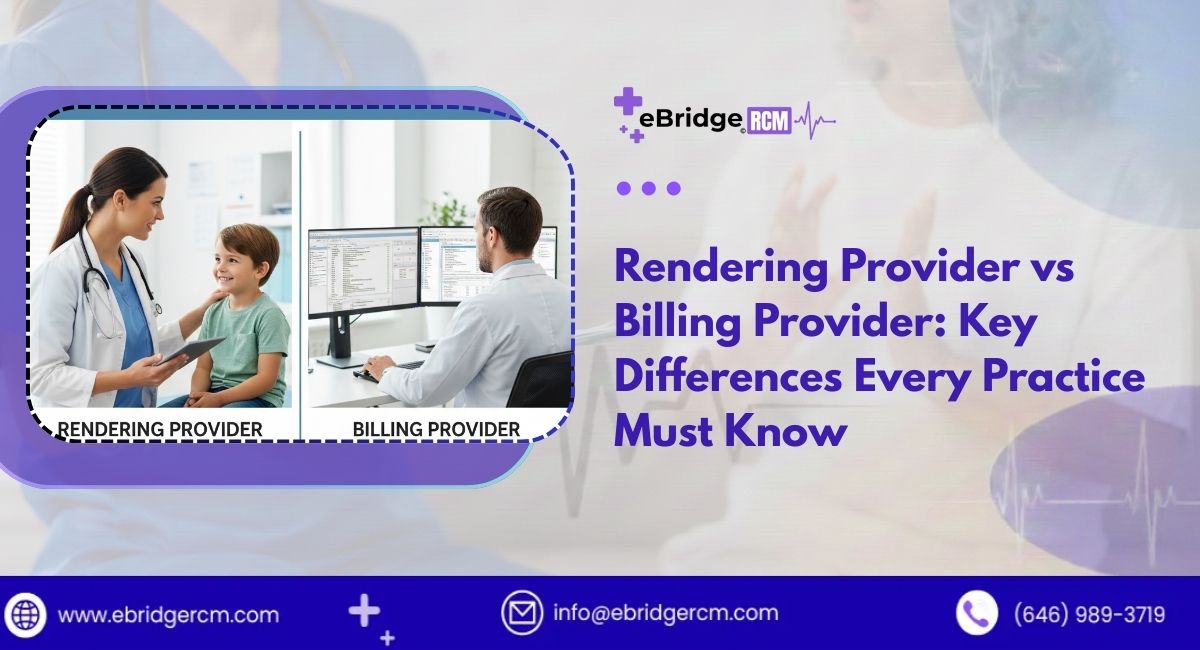
In the medical billing process, a rendering provider is the healthcare professional who delivers the actual care to the patient. This could be a physician, nurse practitioner, or any licensed provider performing clinical services. The billing provider, on the other hand, is the entity responsible for submitting the claim to the payer. Sometimes the rendering and billing provider are the same, but in larger practices or specialty clinics, they are often different. For practices looking for a comprehensive solution, our Credentialing Services for Internal Medicine Providers can assist in ensuring all provider credentials are accurate for claim submissions.
Key Differences Between Rendering and Billing Providers
| Feature | Rendering Provider | Billing Provider |
| Role | Performs the medical service | Submits the claim to the payer |
| NPI | May use individual NPI | May use group NPI or organizational NPI |
| Liability | Responsible for documentation accuracy | Responsible for billing accuracy and compliance |
| Payment | Payment is attributed to rendered service | Payment is processed through the billing entity |
| Examples | Physician, PA, Nurse Practitioner | Clinic, Hospital, Multi-provider Practice |
In a solo practice, the rendering and billing provider may be the same individual, simplifying documentation and claim submission. In larger practices, such as cardiology or neurology clinics, the rendering provider and billing provider are often separate entities. This separation allows billing specialists to manage claims for multiple providers efficiently. For instance, cardiology billing services often involve multiple rendering providers whose claims are submitted under a central billing entity.
Importance of Accurate Provider Information
Medical claims require precise information about both the rendering and billing provider. Some critical elements include:
- National Provider Identifier (NPI)
- Taxonomy code
- Tax identification number (TIN)
- Entity codes
- Service location
Incorrect or mismatched data can result in claim denials. Practices must implement systems that verify both rendering and billing provider information before submission. Our Medical Billing Services provide automated checks to reduce errors and improve claim acceptance rates.
How Different Specialties Manage Rendering and Billing Providers
Different specialties have unique workflows for managing rendering and billing providers. For instance, in mental health practices, multiple therapists may render services, but billing is handled centrally. This requires accurate documentation of each therapist’s NPI for compliance and audit purposes. eBridgeRCM provides behavioral health billing solutions that streamline this process, ensuring all claims are submitted accurately.
Similarly, in surgical or procedural specialties like anesthesiology, the anesthesiologist (rendering provider) may work in a hospital setting where the billing provider is the hospital or surgical center. Detailed coordination ensures claims are submitted correctly and reimbursements are not delayed. Our Cardiology Billing Services include guidance on handling complex multi-provider billing scenarios.
Common Errors and How to Avoid Them
Practices often encounter errors related to rendering and billing providers. The most common include:
- Using the wrong NPI for the service rendered
- Failing to include the rendering provider’s credentials
- Billing services under the incorrect entity
- Duplicate claims due to confusion between rendering and billing providers
To prevent these errors, practices should implement routine audits and staff training. Monthly billing audits can help identify recurring issues before they result in significant claim denials. eBridgeRCM offers monthly billing audit services that help practices detect and correct these issues proactively.
Documentation Best Practices
Accurate documentation is the foundation for successful medical billing. Key best practices include:
- Clearly documenting the rendering provider’s name, credentials, and NPI on all patient records.
- Maintaining a centralized database of provider NPIs and entity codes.
- Ensuring the billing provider’s information aligns with insurance payer requirements.
- Verifying that claims reflect the correct service date and location.
Using software solutions that integrate electronic health records (EHR) with billing systems can significantly reduce errors. For example, EMR integration services ensure that provider information flows from clinical documentation to claim submission, reducing manual entry mistakes.
Tips for Managing Multi-Provider Practices
Large practices with multiple providers face additional challenges. Strategies to manage rendering and billing providers effectively include:
- Assigning a dedicated staff member or team to oversee provider credentialing and claim verification.
- Implementing regular staff training sessions on documentation and claim submission processes.
- Using centralized billing software to manage NPIs, entity codes, and claim status tracking.
- Establishing clear protocols for splitting revenue between providers if applicable.
For practices looking to streamline these processes, Credentialing Services for Internal Medicine Providers help maintain accurate records and reduce the risk of denied claims due to credentialing errors.
Understanding Payer Requirements
Insurance payers have specific requirements regarding rendering and billing providers. Some common guidelines include:
- Medicaid and Medicare often require the rendering provider’s individual NPI for claims verification.
- Commercial insurers may allow billing under a group NPI but still require documentation of the rendering provider.
- Certain procedures may require prior authorization linked to the rendering provider.
Familiarity with these requirements is essential for minimizing claim denials. Practices should periodically review payer guidelines and update internal protocols accordingly. Our best Medical Coding Services in New York and nearby states provide support in ensuring coding aligns with payer rules, improving reimbursement accuracy.
Using Entity Codes Effectively
Entity codes help distinguish between different provider types on claims. Understanding how to use entity codes correctly can improve compliance and payment accuracy. Key considerations include:
- Mapping entity codes to the correct rendering and billing providers.
- Ensuring entity codes match the provider type and service location.
- Regularly updating entity code information to reflect any provider changes.
Practical Example Table
| Scenario | Rendering Provider | Billing Provider | Entity Code | NPI |
| Outpatient Cardiology Visit | Dr. Jane Smith | Cardiology Group LLC | 01 | 1234567890 |
| Mental Health Therapy | Licensed Therapist A | Mental Health Clinic | 02 | 0987654321 |
| Anesthesia for Surgery | Dr. John Doe | Hospital Billing Dept | 03 | 1122334455 |
| Urgent Care Visit | NP B | Urgent Care Center | 04 | 5566778899 |
This table illustrates how different provider types and settings influence claim submission. Ensuring correct NPIs, entity codes, and roles reduces the risk of claim denials.
Impact on Revenue Cycle Management
Accurate management of rendering and billing providers directly affects revenue cycle efficiency. Incorrect data can lead to:
- Claim rejections and delayed payments
- Increased administrative workload to correct errors
- Audit risks and potential compliance penalties
- Frustration for providers and staff
Conversely, practices that maintain clear separation and accurate records between rendering and billing providers experience faster claim approvals, improved cash flow, and reduced administrative costs. Services like AR Recovery can assist practices in resolving delayed claims resulting from provider misalignment.
Manual Checklist for Practices
To maintain clarity between rendering and billing providers, follow this checklist:
- Verify all NPIs for rendering providers
- Ensure billing provider NPI and entity codes are correct
- Update provider information in EHR and billing systems
- Train staff on documentation and claim submission processes
- Conduct monthly audits to detect errors
- Review payer-specific requirements for provider reporting
- Coordinate with external billing or credentialing services if needed
Final Words
Understanding the roles of rendering and billing providers is a foundational aspect of medical billing. Correctly identifying and documenting each provider ensures claims are processed efficiently, reduces the risk of denials, and supports compliance with payer guidelines. Whether your practice is a single-provider clinic or a multi-specialty center, investing in accurate provider management improves revenue cycle outcomes.
For practices seeking expert support in managing rendering and billing provider responsibilities, eBridge RCM LLC offers comprehensive outsource Medical Billing Services in New York, Credentialing Services NYC, and Medical Coding Solutions NY to streamline your revenue cycle and ensure compliance.