Every practice wants the same three things: cleaner claims, faster payments, and fewer billing headaches. But most revenue loss doesn’t start at the coding desk. It starts earlier, at the front desk, before the patient ever sees a provider.
Insurance changes all the time. Patients switch jobs, enroll in new plans, or add and drop coverage for family members. Someone turns 65 and moves to Medicare. If your practice doesn’t catch these changes before the visit, you end up with a denied or rejected claim.
Insurance verification often gets treated like a small administrative task. It isn’t. It’s one of the most important steps in your entire revenue cycle. One wrong subscriber ID, one lapsed policy, or one outdated benefit, and your team is stuck chasing a claim for weeks instead of getting paid.
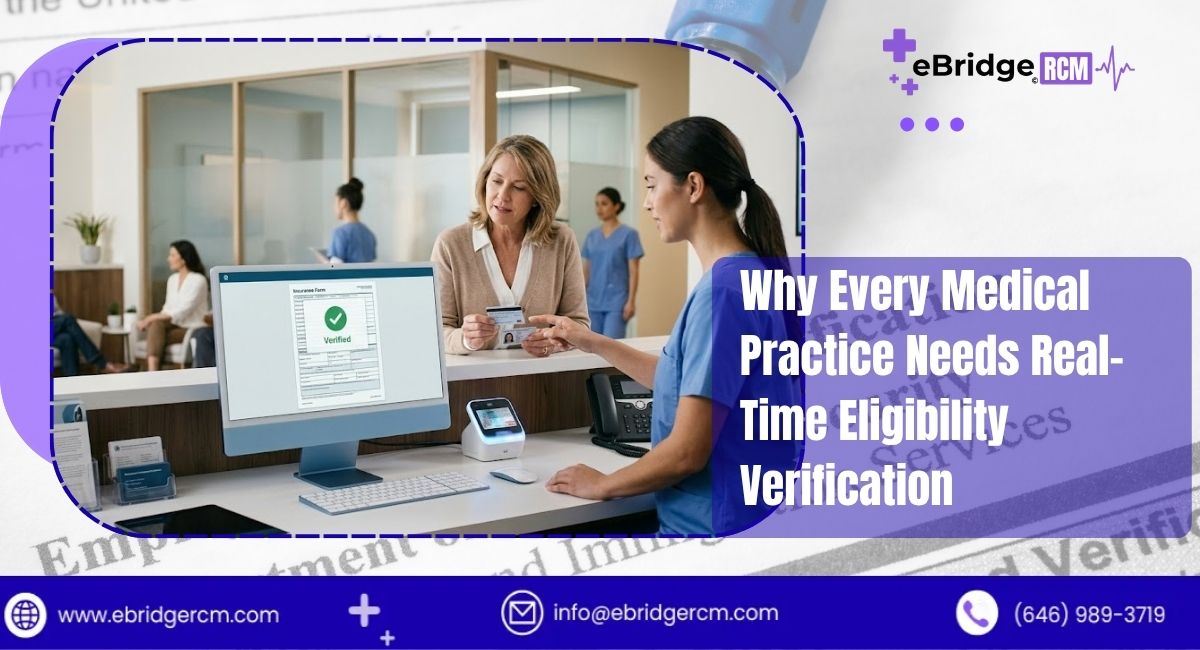
That’s why more practices are switching to real-time eligibility verification. Instead of guessing based on last year’s insurance card, staff can confirm active coverage, copays, deductibles, referral rules, and patient responsibility in seconds, before the appointment even happens.
This guide breaks down what real-time eligibility verification is, why it matters now more than ever, and how to build it into your revenue cycle the right way.
What Is Real-Time Eligibility Verification?
Real-time eligibility verification is an automated check. It confirms a patient’s insurance coverage and benefits directly with the payer, before any service is billed.
There’s no hold music and no outdated payer portal to dig through. Your practice management software or EHR connects straight to the payer’s system through a secure electronic transaction, and the answer comes back in seconds.
In that short window, your staff can see the patient’s active insurance status, effective policy dates, subscriber details, and group number, along with copayment amount, remaining deductible, coinsurance, referral requirements, prior authorization needs, coordination of benefits, and any coverage limits. In short, this covers:
- Coverage status and policy dates
- Copay, deductible, and coinsurance
- Referral and prior authorization needs
Because this data comes straight from the payer, your team is working with facts, not assumptions.
Why Eligibility Verification Matters More Than Ever
Health plans have gotten complicated. Patients now move between coverage types constantly, whether through new jobs and employer plans, annual open enrollment changes, marketplace sign-ups, Medicare eligibility, Medicaid renewals, or new spouses and dependents added to a policy.
If your practice only checks insurance at the first visit, you’re operating on old information. Coverage can shift several times a year without anyone at the front desk knowing.
That’s the gap real-time verification closes. It’s also why a strong insurance eligibility verification process, one that runs before every visit and not just the first, has become standard for practices that want fewer denials. For a deeper look at how this plays out in practice, see our guide on verifying insurance eligibility in internal medicine.
How Real-Time Eligibility Verification Works
The process is simpler than most people expect. A patient books an appointment, and staff enter or confirm their insurance details. The software then sends an electronic eligibility request to the payer, who responds with current coverage data, usually within seconds. Staff review the results before the patient walks in, and any issues get fixed before the claim is ever submitted.
Common issues caught at this stage include inactive coverage, a wrong subscriber ID, an incorrect group number, a missing referral, a prior authorization requirement, or a change in secondary insurance.
Catching these at check-in takes minutes. Catching them after a denial takes weeks.
The Real Cost of Eligibility Verification Errors
Practices tend to underestimate what a single verification mistake costs. Each denied claim usually means research into what went wrong, a phone call or two to the patient, re-verifying insurance, correcting the billing entry, resubmitting the claim, and following up again with the payer.
Add it all up across a month of denials, and you’re looking at:
- Higher accounts receivable and slower cash flow
- More staff hours spent on rework
- Frustrated billing staff and unhappy patients
Preventing an eligibility error is almost always cheaper than fixing one after the fact.
Benefits of Real-Time Eligibility Verification
1. Stronger Revenue Protection
Accurate registration is the foundation of revenue cycle management. Confirm eligibility before the visit, and you cut down on preventable denials right away. Your billing team spends less time firefighting and more time on work that actually grows revenue.
2. Faster Reimbursements
Claims built on accurate eligibility data move through payer systems with fewer hiccups, which means quicker adjudication, faster payments, lower accounts receivable, and healthier cash flow overall. Even a small bump in your first-pass acceptance rate adds up over a year.
3. Fewer Claim Denials
A lot of administrative denials have nothing to do with coding. They come from registration mistakes, and real-time verification flags inactive policies, wrong policyholder details, group number errors, coverage limits, coordination of benefits problems, and missing referrals.
Fixing these before submission is one of the most reliable ways to cut your denial rate. Pair this with a solid claim denial prevention process. Our post on what claims scrubbing is and why it matters covers the next layer of protection after eligibility checks.
4. Better Patient Collections
Patients want to know what they’ll owe before they owe it. Real-time verification lets staff estimate copays, deductibles, coinsurance, and non-covered services ahead of the visit. That transparency makes it easier to collect at the time of service, and it means fewer billing disputes later.
5. A Better Patient Experience
Nobody likes a surprise bill, and most of them trace back to insurance information that was never confirmed. Verifying coverage ahead of time keeps patients confident in your billing process instead of frustrated by it.
6. Better Staff Productivity
Without automation, front desk staff burn hours calling payers, logging into different portals, and writing down benefits by hand. Real-time verification removes most of that grunt work, so your team can actually focus on patients.
A Real-World Example (Case Study)
A patient books an orthopedic consult. Their insurance on file is from last year.
At check-in, real-time verification flags something: the employer switched carriers months ago. Staff catch it immediately, request the new insurance card, and confirm the new plan’s deductible and copay before the visit.
The claim goes out with the correct payer information and gets paid without delay.
Without that check, the practice would have billed an inactive policy, leading to a rejection, a delayed payment, and hours of avoidable rework.
Common Causes of Eligibility Verification Errors
Real-time checks tend to catch the same handful of issues again and again:
- Inactive coverage or expired employer plans
- Incorrect subscriber information or group numbers
- Missing referrals or unmet prior authorization requirements
Every one of these is fixable before a claim goes out, if it’s caught early. For a closer look at how mismatched subscriber data specifically drives denials, see subscriber information mismatch denials.
The Technology Behind Real-Time Eligibility Verification
This process runs on Electronic Data Interchange (EDI) transactions between your practice management system or EHR and the payer, usually through a clearinghouse.
Instead of calling ten different insurance companies, your staff work from one connected platform. It talks to payer databases in seconds and returns accurate benefit details before the patient arrives, typically including active coverage, policy effective dates, member eligibility, deductible balances, copayment amounts, coinsurance, primary and secondary insurance, referral requirements, and prior authorization needs.
Practices with well-integrated billing technology tend to see fewer registration errors overall, simply because the data gets validated automatically instead of by hand.
Best Practices for Implementing Real-Time Eligibility Verification
Software alone won’t fix your denial rate. You need a workflow behind it.
Verify Before Every Visit, Not Just the First
Coverage shifts because of annual benefit renewals, new jobs, marriage or divorce, Medicare enrollment, Medicaid updates, and employer plan changes. Checking eligibility before every single appointment, not just the first one, is what actually moves the needle on denials.
Train Front Desk Staff Regularly
Your front desk is the first checkpoint in the revenue cycle. Ongoing training should cover reading insurance cards correctly, pulling accurate subscriber information, confirming patient demographics, reviewing coordination of benefits, spotting authorization requirements, updating records in the EHR, and explaining what the patient owes.
A well-trained front desk prevents more denials than almost anything else in the revenue cycle.
Standardize the Registration Process
New patient or returning patient, the verification steps should be identical every time. Standardized workflows stop inconsistencies between staff members before they ever become claim problems.
Real Time Eligibility Verification Checklist
| Verification Step | Purpose |
| Confirm patient identity | Prevent demographic mismatches |
| Verify active insurance | Confirm current coverage |
| Validate subscriber information | Reduce member ID errors |
| Review group number | Ensure the correct employer plan |
| Check coordination of benefits | Bill the correct payer first |
| Verify referrals and authorizations | Prevent administrative denials |
| Estimate patient responsibility | Improve point-of-service collections |
| Update patient records | Keep billing information accurate |
Track Your Verification Performance
You can’t fix what you don’t measure. Track your first-pass claim acceptance rate, eligibility-related denial rate, registration error percentage, clean claim rate, average reimbursement time, patient collection rate, and accounts receivable aging on a regular basis.
Watching these numbers helps you catch recurring problems before they eat into revenue.
Common Challenges During Eligibility Verification
Even with strong automation, a few situations still need a human look.
Multiple insurance plans. Patients with more than one policy need careful coordination of benefits. Getting the payer order wrong is a common reason for delayed payment.
Frequent insurance changes. Patients rarely think to tell you when their coverage changes. Without real-time checks, you might not find out until the claim bounces back.
Authorization requirements. Active coverage doesn’t automatically mean the service is authorized. Skipping this step can still result in a denial.
Registration errors. A misspelled name or wrong birth date is a small mistake with a big consequence, an avoidable denial. This is exactly why patient demographic errors show up so often in denial reports, and why front desk training matters as much as the technology itself.
Ready to Improve Collections and Streamline Your Revenue Cycle?
Give your practice the support it needs to thrive. eBridge RCM manages billing, claims, credentialing, and revenue cycle operations so you can prioritize patient care.
How Eligibility Verification Strengthens Revenue Cycle Management
The revenue cycle starts the moment a patient books an appointment, not when the claim goes out. Everything downstream depends on what gets captured at registration.
Real-time eligibility verification improves registration accuracy, charge capture, claim submission, payment posting, accounts receivable management, patient collections, and financial reporting.
Get the front end right, and everything after it runs smoother. If your practice is weighing whether to build this capability in-house or hand it off, our comparison of outsourcing RCM versus in-house billing walks through the trade-offs.
Real Time Verification Vs. Manual Verification
| Manual Verification | Real-Time Verification |
| Requires phone calls | Electronic response in seconds |
| Higher risk of human error | Automated payer validation |
| Time-consuming | Faster registration process |
| Delayed benefit confirmation | Immediate eligibility results |
| Higher administrative cost | Better staff efficiency |
| Higher denial risk | Stronger clean claim rate |
Frequently Asked Questions for Real Time Eligibility Verification
What is real-time eligibility verification?
It’s an automated check that confirms a patient’s insurance coverage and benefits directly with the payer, before any service is provided.
Why does eligibility verification matter?
It prevents claim denials, speeds up reimbursement, improves patient collections, and cuts down on administrative rework.
How often should a practice verify eligibility?
Before every visit. New patient or returning, it doesn’t matter.
Does real-time verification stop every denial?
No. It significantly reduces eligibility-related denials, but claims can still be denied for coding errors, missing documentation, authorization issues, or medical necessity reasons.
Can small practices benefit from this too?
Yes, often more than larger ones. Small practices usually have fewer staff hours to spare for fixing denied claims, so preventing them matters even more.
What should be verified before every appointment?
Active coverage, subscriber information, group number, effective dates, deductibles, copays, coinsurance, referral requirements, prior authorization needs, and coordination of benefits.
Final Thoughts
Real-time eligibility verification isn’t a nice-to-have anymore. It’s become a basic requirement of modern medical billing. Insurance plans keep shifting, and patient coverage changes more often than most practices realize. Every missed check is a chance for a delayed payment, a frustrated patient, or extra hours of admin work.
Verify coverage before every visit, and you catch inactive policies, wrong subscriber details, coordination of benefits issues, and missing authorizations before they ever touch a claim. That’s how you get a higher clean claim rate, faster payments, and a smoother experience for your staff and your patients.
It takes some setup, including standardized workflows, staff training, and the right technology, but the payoff is a stronger, more predictable revenue cycle.
Partner With eBridge RCM LLC
If your practice wants fewer eligibility errors, faster reimbursements, and a stronger revenue cycle overall, eBridge RCM LLC can help.
Our experienced team offers comprehensive Outsource Medical Billing Services in NYC, Medical Coding Services NY, Credentialing Services, Clearing House Solutions USA, and Monthly Billing Audit support to help healthcare providers submit cleaner claims, reduce denials, and improve financial outcomes.
Whether you run a solo practice, a specialty clinic, or a multi-provider group, eBridge RCM LLC delivers revenue cycle solutions built around your practice, so your team can spend less time on billing and more time on patient care.