Internal medicine practices operate in one of the most complex areas of healthcare billing. Physicians treat chronic conditions, manage long-term care, and coordinate with multiple specialists. Each patient encounter generates documentation, coding decisions, and claims that must comply with payer rules and federal regulations. When an internal medicine billing audit occurs, every detail of that process comes under review.
For many practices, audits create anxiety because they expose gaps in documentation, coding, or billing workflows that may have developed over time. A structured preparation process can reduce that risk and help a practice maintain financial stability while staying compliant with healthcare regulations.
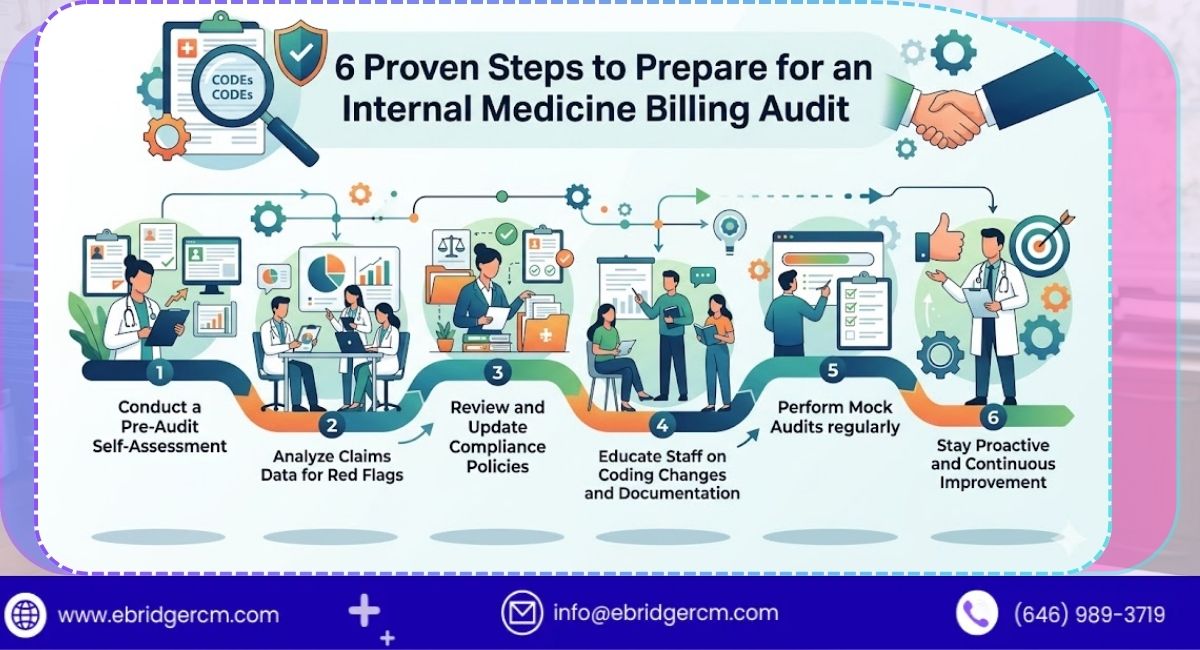
This guide explains six proven steps that internal medicine practices can use to prepare for a billing audit. It covers documentation readiness, coding accuracy, compliance checks, revenue cycle oversight, and the role of internal reviews. The goal is to create a repeatable system that keeps your billing operations organized and defensible when auditors examine claims.
Practices that regularly review their workflows and documentation tend to handle audits with confidence. Many of the best strategies are discussed in resources such as the guide on audit ready practices to stay ahead of payers, which highlights how proactive compliance reduces financial risk. Similarly, a strong understanding of billing processes through an internal medicine billing guide helps physicians and administrators align their workflows with payer expectations.
The sections below explain how to implement an audit preparation framework in an internal medicine practice.
Why Internal Medicine Billing Audits Happen
Before discussing preparation strategies, it helps to understand why audits occur. Payers and regulatory agencies review medical claims to verify that billing practices follow established guidelines. These audits can be triggered by several factors.
Common triggers include:
• A high volume of high-level evaluation and management codes
• Frequent use of specific modifiers or unusual billing patterns
• Patient documentation that does not support billed services
• Billing trends that differ from peers in the same specialty
• Random compliance checks by insurance payers or government programs
Internal medicine providers often manage complex cases that require detailed documentation. However, if records are incomplete or codes are assigned incorrectly, auditors may question whether the claim accurately reflects the services provided.
The purpose of preparing for audits is not just to avoid penalties. It is also to ensure that the practice receives proper reimbursement for services delivered. Strong compliance and accurate billing support a stable revenue cycle while protecting the practice from financial disruptions.
Understanding the Scope of an Internal Medicine Audit
An audit typically focuses on several areas of a practice’s billing and documentation process. These areas include clinical documentation, coding accuracy, claim submission procedures, and compliance with payer policies.
Below is a simplified overview of the elements auditors frequently review.
| Audit Area | What Auditors Evaluate | Why It Matters |
| Clinical Documentation | Progress notes, treatment plans, medical necessity | Ensures services are supported by medical records |
| Coding Accuracy | CPT, ICD-10, and modifier use | Confirms codes match the documented service |
| Billing Process | Claim submission workflow and corrections | Identifies patterns of billing errors |
| Compliance Records | Policies and training documentation | Demonstrates adherence to regulatory standards |
| Credentialing and Enrollment | Provider credentials and payer contracts | Verifies providers are authorized to bill |
Each of these elements is connected to the broader revenue cycle management process. Understanding how they interact allows practices to identify weaknesses before an audit occurs.
Step 1: Strengthen Clinical Documentation Standards
Clinical documentation forms the foundation of every medical claim. Without accurate and complete records, a claim cannot withstand scrutiny during an audit.
Internal medicine physicians document a wide range of patient interactions. These include routine checkups, chronic disease management, preventive care, and complex diagnostic evaluations. Each type of encounter requires detailed notes that justify the services billed.
To strengthen documentation standards, practices should focus on several key elements.
Core Components of Effective Documentation
• Clear description of the patient’s condition and medical history
• Detailed assessment and treatment plan
• Evidence of medical necessity for services performed
• Accurate timestamps and provider signatures
• Consistency between notes and billed codes
Documentation should also align with current evaluation and management guidelines. Changes to E/M coding have shifted the focus toward medical decision making and total time spent with the patient. If documentation does not support the selected level of service, auditors may downgrade the claim or request repayment.
Practices can improve documentation accuracy by using structured templates within electronic health record systems. These templates guide providers through required fields and reduce the likelihood of missing information.
Another useful strategy is to conduct periodic chart reviews. Reviewing records before claims are submitted helps identify inconsistencies between documentation and coding.
Step 2: Verify Coding Accuracy and Compliance
Coding errors remain one of the most common causes of billing audit findings. Internal medicine practices use a broad range of CPT and ICD-10 codes because physicians treat many conditions across multiple organ systems.
Errors can occur when coders select incorrect diagnosis codes, misuse modifiers, or assign procedure codes that do not match the documented service.
A structured coding review process can prevent these issues.
Common Coding Mistakes in Internal Medicine
• Using unspecified diagnosis codes when more precise options exist
• Assigning higher level E/M codes without sufficient documentation
• Missing modifiers required for specific procedures
• Incorrect linking of diagnoses to procedures
• Failing to update codes when guidelines change
Coding errors also impact claim denials and reimbursement delays. Practices that address these issues early often see improvements in both compliance and revenue cycle performance.
For example, many organizations study patterns discussed in resources like ICD-10 coding errors that cost practices to identify recurring mistakes. Addressing those issues reduces the likelihood of future audit findings.
Coding Review Workflow
An effective review process typically includes these steps:
- Pre-submission coding review by experienced coders
- Random sampling of claims for internal audit
- Education sessions for providers when coding changes occur
- Documentation feedback for physicians
By making coding review part of routine operations, practices build a strong defense against audit risks.
Step 3: Review Provider Credentialing and Enrollment Records
Credentialing plays an important role in audit readiness. Auditors often verify that providers were properly enrolled with insurance payers at the time services were rendered.
If a provider is not credentialed or if enrollment records are incomplete, payers may deny claims or request repayment even if the services were medically necessary.
Maintaining updated credentialing records is therefore essential.
Practices should maintain documentation for:
• Provider licenses and board certifications
• National Provider Identifier records
• Insurance payer enrollment approvals
• Participation agreements and contract updates
Credentialing delays can disrupt billing workflows. Some practices experience revenue losses when provider enrollment takes longer than expected. Detailed information about these challenges appears in the article discussing how physician credentialing delays affect practice revenue.
A structured credentialing process reduces audit risks by ensuring that each provider’s billing authority is clearly documented.
Credentialing Checklist for Audit Preparation
| Credentialing Element | Documentation Required |
| Provider License | Current state license copy |
| Board Certification | Certificate or verification record |
| NPI Registration | NPI confirmation details |
| Payer Enrollment | Participation letters or approval emails |
| Revalidation Records | Completed recredentialing forms |
Keeping these records organized allows practices to respond quickly when auditors request proof of provider eligibility.
Step 4: Evaluate the Revenue Cycle Workflow
Billing audits rarely focus on a single claim. Instead, auditors analyze patterns across a practice’s revenue cycle. Understanding that workflow helps identify systemic issues that could trigger compliance concerns.
Revenue cycle management in internal medicine involves multiple steps.
These include:
• Patient registration and insurance verification
• Documentation of services
• Coding and charge entry
• Claim submission and tracking
• Payment posting and denial management
Any breakdown within this sequence can create inconsistencies in billing records.
A practical way to evaluate the workflow is by mapping the entire process from patient scheduling to final payment. This exercise highlights potential vulnerabilities such as incomplete documentation, delayed charge entry, or missing authorization records.
Practices often rely on specialized billing solutions to manage these tasks. Detailed strategies are discussed in resources covering internal medicine RCM best practices, which explain how workflow improvements reduce billing errors.
Revenue Cycle Risk Assessment
| Workflow Stage | Potential Risk | Prevention Method |
| Patient Registration | Incorrect demographic data | Staff training and verification tools |
| Coding | Inaccurate CPT or ICD-10 codes | Internal coding review |
| Claim Submission | Missing modifiers or attachments | Automated claim validation |
| Payment Posting | Incorrect adjustment entries | Reconciliation audits |
| Denial Management | Delayed appeals | Dedicated follow-up staff |
By evaluating each stage, practices gain insight into how operational issues might appear during an audit.
Step 5: Conduct Internal Billing Audits
Internal audits are one of the most effective ways to prepare for external reviews. These reviews allow practices to identify problems before payers or regulatory agencies discover them.
An internal audit typically involves selecting a sample of claims and reviewing them for compliance with documentation and coding standards.
Components of an Internal Billing Audit
• Chart review for documentation accuracy
• Coding verification for CPT and ICD-10 codes
• Comparison between clinical notes and billed services
• Review of claim submission timelines
• Examination of payment adjustments and denials
Internal audits should occur on a regular schedule. Quarterly or semiannual reviews are common in many practices.
The results of these audits should be documented carefully. When issues are discovered, practices should create corrective action plans that address training, workflow adjustments, or system improvements.
Some organizations also rely on specialized audit support through services such as monthly billing audit services to maintain consistent oversight of billing performance.
Internal Audit Sample Tracking Table
| Claim ID | Service Date | Code Billed | Documentation Match | Action Required |
| 00124 | 02-10-2026 | 99214 | Yes | None |
| 00125 | 02-11-2026 | 99215 | Partial | Documentation clarification |
| 00126 | 02-11-2026 | 93000 | Yes | None |
| 00127 | 02-12-2026 | 99213 | No | Coding review |
Maintaining records like these demonstrates proactive compliance during external audits.
Step 6: Train Staff and Maintain Compliance Policies
A billing audit often reveals how well a practice educates its staff about compliance standards. Training programs ensure that physicians, coders, and administrative staff understand their responsibilities within the billing process.
Training should cover several key topics.
Essential Compliance Training Areas
• Evaluation and management coding updates
• Proper use of CPT modifiers
• Documentation requirements for common conditions
• HIPAA privacy and data security procedures
• Claim submission timelines and payer rules
Training should not be limited to new hires. Regular refreshers keep the entire team aligned with current regulations.
Compliance policies should also be documented in a central location. These policies typically describe how the practice handles coding, billing corrections, documentation retention, and reporting of potential errors.
A written compliance plan demonstrates that the practice takes regulatory responsibilities seriously.
Technology and Tools That Support Audit Preparation
Modern internal medicine practices rely heavily on digital tools to manage billing operations. Electronic health record systems, practice management software, and billing platforms provide essential data that supports audit readiness.
However, technology must be configured correctly. If systems are not integrated properly, information gaps can occur between clinical documentation and billing data.
Practices that adopt integrated systems often benefit from better data accuracy and faster claim processing. Articles that explore top leading EHR EMR systems integration with medical billing highlight how integration supports compliance and improves documentation quality.
Technology Checklist for Audit Preparation
| Technology Tool | Role in Audit Readiness |
| Electronic Health Records | Central repository for clinical documentation |
| Practice Management Software | Tracks scheduling, claims, and payments |
| Clearinghouse Systems | Validates claims before submission |
| Analytics Dashboards | Monitor billing trends and performance metrics |
Using these tools effectively helps practices identify unusual billing patterns before auditors detect them.
Common Red Flags That Trigger Internal Medicine Billing Audits
Understanding audit triggers allows practices to address potential problems before they escalate.
Some of the most common red flags include:
• Excessive use of high-level evaluation and management codes
• Billing patterns that differ significantly from specialty averages
• Repeated claims with identical documentation language
• Frequent corrections or claim resubmissions
• Unusual use of certain modifiers
Monitoring these patterns helps identify issues early.
Analytics dashboards within billing systems can highlight anomalies in coding or claim volumes. When unusual trends appear, administrators can investigate and correct them before they attract external attention.
Building a Long-Term Audit Readiness Strategy
Preparing for a billing audit should not be treated as a one-time project. Instead, it should be part of a continuous improvement process that strengthens the practice’s compliance culture.
Long-term audit readiness includes:
• Regular internal audits
• Continuous staff education
• Updated documentation templates
• Clear communication between providers and billing teams
• Periodic workflow reviews
Practices that maintain consistent oversight of these areas tend to experience fewer billing disputes and faster reimbursement cycles.
Another effective strategy is collaboration between physicians, coders, and compliance specialists. When these teams work together, they create a balanced approach to documentation accuracy and financial performance.
The Role of External Billing Experts in Audit Preparation
Many internal medicine practices manage billing in-house. However, some choose to work with external billing specialists who bring additional expertise in compliance and coding accuracy.
External billing teams often provide services such as:
• Coding reviews and documentation analysis
• Claim submission oversight
• Denial management and appeals
• Revenue cycle performance monitoring
• Compliance guidance for audit readiness
Practices exploring these options often review broader strategies discussed in resources about end to end RCM solutions to improve medical practice revenue. These solutions integrate billing, coding, and analytics to maintain consistent financial performance.
Final Thoughts: Creating Confidence Before an Audit
An internal medicine billing audit can feel intimidating, but it does not have to disrupt a practice’s operations. When documentation, coding, and billing workflows are organized and consistent, audits become far less stressful.
The six steps outlined in this guide provide a structured framework for preparation:
- Strengthen clinical documentation
- Verify coding accuracy
- Maintain credentialing records
- Evaluate revenue cycle workflows
- Conduct internal audits
- Train staff and maintain compliance policies
Together, these strategies create a foundation that supports both regulatory compliance and financial stability.
Practices that want deeper support in managing billing operations can explore specialized solutions through eBridge RCM LLC, including services such as medical billing in New York and credentialing. These services help healthcare providers streamline billing workflows, maintain compliance, and prepare confidently for payer reviews.
A well-organized billing system protects the practice’s revenue while supporting accurate patient care documentation.