The Revenue You Are Losing Before You See a Single Patient
A family medicine physician completes her residency, signs a lease on office space, hires two staff members, and schedules her first patients for the following month. She submits her credentialing applications to five insurance payers two weeks before opening day, assuming the process will be wrapped up quickly. Four months later, she is still waiting on three of those payers. Her front desk is collecting self-pay rates from insured patients who expected to use their coverage. She has burned through her startup reserve, and she has not yet received a single insurance payment.
This situation is not rare. It happens to new practices across every specialty, and in almost every case, it was preventable. Credentialing timelines are long, the documentation requirements are specific, and mistakes in the initial application can add weeks or months to the process.
Understanding how credentialing works before a practice opens, not after, is one of the most practical things a new provider can do to protect their revenue from day one.
What Credentialing Actually Means for a New Practice
Medical credentialing is the process by which insurance payers verify a provider’s qualifications before allowing them to bill for services under that payer’s network. It covers license verification, education verification, malpractice history review, board certification confirmation, DEA registration status, and sanction database checks including the OIG List of Excluded Individuals.
For a new practice, credentialing has two distinct components that are often confused.
The first is provider credentialing, which verifies the individual clinician’s qualifications. This must be completed for every provider who will bill under the practice’s tax identification number, whether that is a physician, nurse practitioner, physician assistant, licensed clinical social worker, or any other billable clinician.
The second is payer enrollment, which is the contracting step. Once a payer has verified credentials, they extend a contract to the provider, assigning a fee schedule and formally adding them to their in-network directory. Both steps are required before a claim can be submitted and paid. A provider can be credentialed by a payer and still not be enrolled, meaning they cannot yet bill.
New practices frequently start this process too late. The correct time to begin credentialing is as soon as possible after the business entity is established and the practice address is confirmed, ideally 120 to 150 days before the intended opening date.
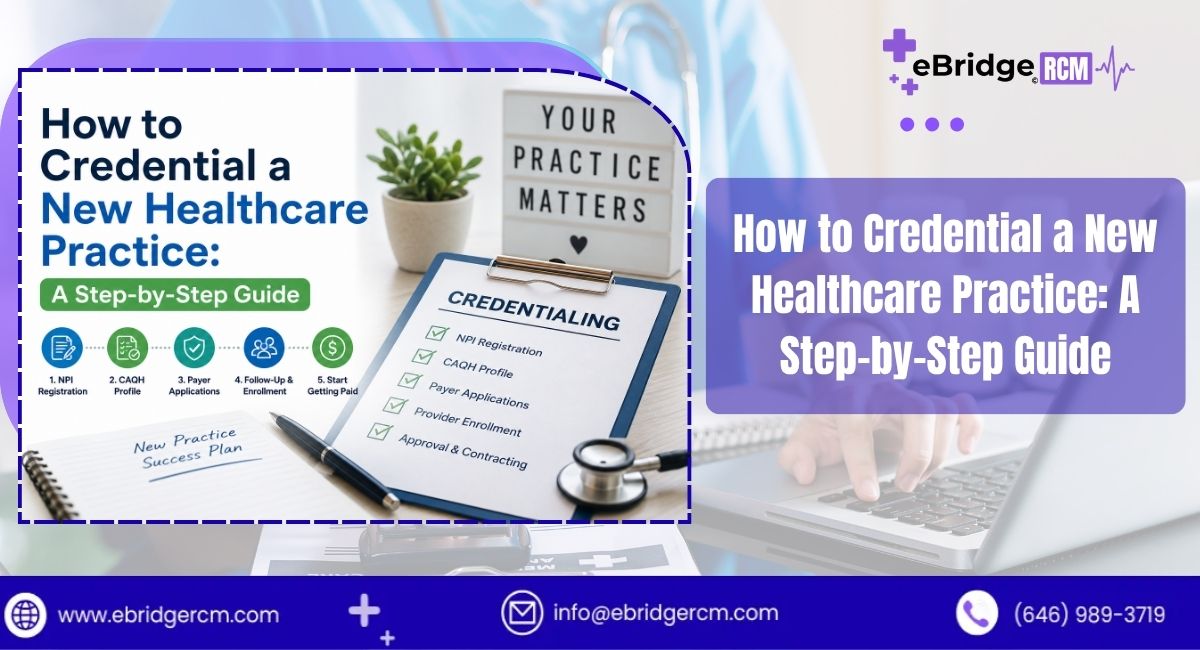
Step 1: Establish Your Business Entity and Obtain a Tax Identification Number
Before any credentialing application can be submitted, the practice must exist as a legal entity. This means filing for an LLC, PLLC, PC, or other appropriate business structure depending on your state’s requirements for professional healthcare entities.
Once the entity is formed, the practice needs a federal Employer Identification Number from the IRS. This EIN will be used on every insurance application, payer contract, and tax document the practice generates. Using a personal Social Security number for business billing purposes is incorrect and will create problems with payer enrollment.
The EIN is also required before applying for a group NPI number, which is the next step.
Step 2: Register for National Provider Identifiers
Every provider who bills insurance needs an NPI, and every practice entity that bills under its own tax ID also needs a separate NPI. These are two distinct identifiers serving different purposes.
An individual NPI (Type 1) is assigned to a specific clinician and stays with them for their entire career regardless of where they practice. It is tied to the person, not the organization.
A group NPI (Type 2) is assigned to the practice entity itself. When a claim is submitted for services rendered at your practice, the claim typically includes both the rendering provider’s individual NPI and the billing entity’s group NPI. Understanding how group NPI and individual NPI work in billing is foundational, because errors in NPI usage are one of the most common reasons new practice claims are rejected immediately upon submission.
Both NPI types are registered through the National Plan and Provider Enumeration System (NPPES), which is the CMS-managed registry. Registration is free and can be completed online. Most NPI numbers are issued within a few days, though the registry should be updated whenever a provider changes their practice address or specialty taxonomy code.
Taxonomy codes within the NPI registry identify the provider’s specialty and license type. Selecting the correct taxonomy code matters because payers reference it when determining coverage and reimbursement. An incorrect taxonomy code can cause claims to route incorrectly or be denied for non-covered services.
Step 3: Set Up Your CAQH ProView Profile
CAQH ProView is a centralized credentialing database used by the majority of commercial payers in the United States. Rather than completing a separate application for every payer from scratch, a provider maintains one comprehensive profile in CAQH that payers can access directly.
CAQH profiles include: professional education and training history, current and past work history, current licenses with expiration dates, malpractice insurance information including coverage amounts, hospital affiliations if applicable, DEA registration, and disclosure questions about malpractice claims and board actions.
For new practices, setting up a complete CAQH profile from the beginning saves significant time. Every payer that references CAQH during credentialing will pull the same data, so accuracy in the CAQH profile matters considerably. Common errors include mismatched dates in education or employment history, incorrect malpractice policy numbers, and missing or expired license information.
CAQH attestation must be renewed every 120 days. After a profile is set up, the provider receives email reminders to attest that the information is still current. Missing an attestation deadline causes the profile to become inactive, which halts credentialing applications at every payer that is in the process of verifying credentials.
Step 4: Obtain Malpractice Insurance Before Applying
Payers require proof of active malpractice insurance as part of the credentialing application. The coverage amounts they require vary, but a common threshold for physicians is $1 million per occurrence and $3 million aggregate. Some specialties and some payers require higher amounts.
Malpractice insurance must be obtained before submitting applications because the insurance certificate is required documentation. The certificate should list the provider’s name exactly as it appears on their license and NPI registration. Name discrepancies between documents are a frequent cause of application delays.
For new practices, occurrence-based coverage is generally preferred over claims-made coverage because it covers incidents that occurred during the policy period regardless of when the claim is filed. Claims-made coverage requires a tail policy when the provider changes insurers or retires, which creates an additional administrative consideration.
Step 5: Determine Which Payers to Credential With First
New practices cannot credential with every payer simultaneously from the start. The enrollment capacity is limited, both administratively and in terms of payer processing volume. Prioritizing payers strategically based on your patient population and local payer market share makes the initial credentialing effort more efficient.
For most practices, the priority order looks like this:
Medicare is almost always the first priority for practices serving patients over 65 or patients with disabilities. Medicare credentialing happens through PECOS (Provider Enrollment, Chain, and Ownership System) and assigns the provider a PTAN (Provider Transaction Access Number). Understanding what a PTAN is and why it matters clarifies how Medicare enrollment integrates with the broader billing setup.
Medicaid is the second priority for practices serving low-income populations. Medicaid credentialing is state-administered, and requirements vary significantly by state. States with managed care Medicaid programs require credentialing with each MCO separately, not just with the state program itself.
Largest commercial payers by market share in your area should follow. In most markets, this means the Blue Cross Blue Shield affiliate, UnitedHealthcare, Aetna, and Cigna. These payers cover the largest share of commercially insured patients and generate the most billing volume for most practice types.
Specialty-specific payers come next. A behavioral health practice would prioritize managed behavioral health organizations like Optum Behavioral Health, Carelon, and Magellan. A workers’ compensation practice would prioritize state fund and managed care organization enrollments.
Step 6: Gather and Organize Required Documentation
Every credentialing application, whether submitted to a payer directly, through CAQH, or via a credentialing service, requires a consistent set of documentation. Having this organized before beginning applications prevents the repeated scramble to locate documents that delays many new practices.
The standard documentation set for provider credentialing includes:
Current state medical license (or applicable professional license for non-physician providers). The license must be active and in good standing with no current restrictions.
DEA registration if the provider prescribes controlled substances. DEA registration requires a state license to be in place first and must be registered to the practice address where prescribing will occur.
Medical school diploma and residency completion documentation. Board certification certificates if applicable.
Current malpractice insurance certificate with coverage dates and amounts clearly stated.
Current curriculum vitae with a complete, chronologically unbroken work history. Gaps in work history of more than 30 days typically require explanation.
Government-issued photo ID.
NPI confirmation letters for both individual and group NPIs.
Hospital privileges documentation if the provider has hospital affiliations.
Completed disclosure forms about prior sanctions, license actions, felony convictions, or malpractice judgments.
Keeping digital copies of all these documents in a single organized folder reduces the time spent preparing applications significantly.
Step 7: Submit Applications and Manage the Process Actively
Application submission is where many new practices make their biggest mistakes. They submit applications and then wait passively, assuming payers will complete the process without follow-up. Payers do not work this way.
Most payers have specific follow-up timelines baked into their credentialing committees’ meeting schedules. Commercial payers typically credential providers on a monthly or quarterly basis depending on committee meeting frequency. An application submitted on the day after a credentialing committee meeting may wait 30 days before it is reviewed for the first time.
During this waiting period, payers may send requests for additional information. These requests have response deadlines, and missing them can cause the application to be closed. Practices that are not actively monitoring their application status miss these requests regularly.
The recommended follow-up cadence is every 10 to 14 days for each active application. Each contact should ask for the current status, whether any additional information has been requested, and the expected timeline for credentialing committee review.
How physician credentialing delays affect practice revenue gives concrete context on the financial cost of passive application management, including the revenue impact of a 30-day versus 90-day delay in a single payer’s credentialing completion.
Step 8: Handle the Payer Enrollment Contract
When credentialing is complete, the payer extends an enrollment contract. This contract specifies the fee schedule, the provider’s participation status, the billing requirements, and the terms of the network relationship. Enrollment is not automatic once credentialing is approved, and the contract must be signed and returned before billing can begin.
Read the contract carefully before signing. Key items to review include: the effective date of participation (this determines from which date retroactive billing may apply), the fee schedule and whether it references a percentage of Medicare rates or a proprietary schedule, any exclusivity clauses that restrict billing certain payers outside of the network, and the terms for contract termination.
Once the contract is returned and processed, the payer will issue a provider ID and add the practice to their in-network directory. Directory listing may take an additional two to four weeks after contract execution. During this period, patients searching for in-network providers may not find the practice, which affects new patient acquisition.
Credentialing Timeline Expectations by Payer Type
| Payer Type | Typical Credentialing Timeline | Notes |
| Medicare (PECOS) | 60 to 90 days | Requires active state license; PTAN issued after approval |
| Medicaid (state-administered) | 45 to 90 days | Varies significantly by state |
| Medicaid MCOs | 60 to 120 days per MCO | Each MCO requires separate application |
| Blue Cross Blue Shield (most affiliates) | 60 to 90 days | CAQH-based; committee review cycles vary |
| UnitedHealthcare | 60 to 90 days | Uses Optum Credential Verification Organization |
| Aetna | 60 to 90 days | Panel may be closed for certain specialties |
| Cigna | 60 to 90 days | Requires active CAQH profile |
| Behavioral health carve-outs | 90 to 120 days | Managed separately from medical benefits |
These timelines assume complete applications with no missing documentation. Incomplete applications typically add 30 to 60 days.
Credentialing Considerations for Specific Practice Types
Solo Practices
Solo providers setting up independent practices face the full credentialing burden without a team to distribute it across. The CAQH profile, NPI registration, Medicare and Medicaid enrollment, and commercial payer applications all require attention simultaneously. Starting early and using a systematic checklist prevents important steps from being missed. For solo practitioners who are also building their practice infrastructure, reviewing the broader private practice insurance credentialing process provides a useful framework for organizing the administrative workload alongside clinical startup tasks.
Group Practices
Group practices credentialing multiple providers simultaneously face a coordination challenge. Each provider needs their own CAQH profile and their own individual NPI. The group must also maintain a group NPI and ensure that the group tax ID is enrolled with each payer separately from the individual provider credentialing. When a group is in formation, the process described in transitioning from solo provider to group practice addresses the specific credentialing and billing setup steps involved in that transition.
Mental Health and Behavioral Health Practices
Behavioral health practices have additional complexity because many commercial payers use behavioral health carve-out organizations that handle mental health and substance use benefits separately from medical benefits. This means a provider credentialed with Aetna for primary care is not automatically credentialed with Aetna’s behavioral health network. Each carve-out requires a separate application. For practices in this space, the mental health practice setup guide outlines the full administrative setup including credentialing across both medical and behavioral health payer structures.
Practices Relocating from Another State
Providers moving a practice across state lines face a particular credentialing challenge because state licensure requirements differ, and many payers require re-enrollment when a provider’s practice address changes states. The credentialing process essentially restarts in the new state, with new state license applications, potential DEA re-registration, and new payer enrollment applications. The timeline implications of medical credentialing during relocation are significant enough that providers should begin the process as soon as a move is decided.
Common Credentialing Mistakes That New Practices Make
Even with the right intentions, new practices frequently make mistakes in the credentialing process that cost them weeks or months. The most common ones are worth reviewing explicitly.
Starting too late. The single most costly mistake is beginning credentialing after the practice has already opened. Credentialing should begin four to five months before the first intended billing date. Practices that start at opening typically face three to four months of cash flow pressure before insurance payments begin.
Incomplete CAQH profiles. A CAQH profile with missing work history, incorrect dates, or unsigned disclosure sections will be flagged during payer review. Payers do not fix these errors for you. They send a request for correction that, if not addressed promptly, stalls the entire application.
Not verifying panel status before applying. Payers close panels when their network capacity for a given specialty is full. Applying to a closed panel wastes time and can delay the overall credentialing effort if staff resources are spent following up on applications that will never result in enrollment. Calling the payer’s provider relations line to verify open panel status before submitting takes five minutes and saves weeks.
Mismatched information across documents. If a provider’s name appears differently on their license versus their malpractice certificate versus their NPI registration, payers will flag the discrepancy. Name variations, middle name inclusion or exclusion, and credential suffixes must be consistent across all credentialing documents.
Forgetting re-credentialing cycles. Most payers require re-credentialing every two to three years. New practices that set up their initial credentialing successfully and then fail to track renewal dates risk losing panel status when re-credentialing deadlines pass without action. An automated tracking system or a credentialing service that monitors these dates is important.
For a comprehensive review of what goes wrong during credentialing and how to prevent it, common medical credentialing mistakes covers the full list with specific scenarios and solutions.
Should New Practices Handle Credentialing In-House or Outsource It?
This is a practical question that depends on the practice’s administrative capacity and the complexity of its payer mix.
Handling credentialing in-house requires at least one staff member who is dedicated to the process, trained in CAQH management and payer-specific requirements, and available to follow up with payers consistently. For a solo practice with no administrative staff, handling it in-house means the provider is spending time on administrative tasks rather than clinical work, which has both an opportunity cost and a burnout risk.
Outsourcing to a specialized credentialing service removes the administrative burden from the practice, provides access to people who do this work daily and know each payer’s specific requirements, and typically results in faster timelines because credentialing companies have established relationships with payer provider relations teams.
The cost of outsourcing credentialing is generally a fraction of the revenue that delays cost. A single month of delayed credentialing with one major commercial payer can represent thousands of dollars in unbilled claims depending on the practice’s volume and payer mix. For practices that want credentialing services handled by specialists from day one, outsourcing is almost always the more financially sound choice.
How Credentialing Integrates with Your Billing Setup
Credentialing and billing are not parallel tracks that merge later. They are interdependent from the start. Without completed credentialing, claims submitted to a payer will be denied immediately as a non-participating provider. Without accurate billing setup that reflects the correct NPI, tax ID, and taxonomy codes, claims that would otherwise be paid can be misrouted or rejected.
The billing setup for a new practice includes: choosing a practice management system or billing software, setting up a clearinghouse connection for electronic claim submission, configuring provider information including NPIs and fee schedules, establishing ERA and EFT enrollment with each payer, and building claim scrubbing rules that catch common errors before submission.
These setup steps should run parallel to credentialing, not after it. By the time the first payer approval arrives, the billing system should be fully configured and ready to submit clean claims immediately. Medical billing services that integrate with credentialing processes eliminate the gap between approval and first claim submission.
What Happens After Credentialing: Staying In-Network
Getting credentialed is not a one-time task. Staying credentialed requires ongoing attention to several items.
License renewals: State licenses have renewal cycles, typically every one to two years depending on the state and provider type. Expired licenses result in automatic suspension of billing privileges with most payers.
CAQH attestations: Every 120 days, the provider must log in to CAQH and attest that their profile information is current. Failing to do this deactivates the profile and can trigger payer notifications of credential expiration.
Malpractice insurance renewals: When a malpractice policy renews, the new certificate must be updated in CAQH and potentially re-submitted to individual payers. Some payers require notification of malpractice changes within 30 days.
Re-credentialing applications: Payers initiate re-credentialing on their own schedule, but providers must respond to information requests promptly. Some payers allow self-service re-credentialing through a portal, while others require full application resubmission.
Payer contract renegotiation: As a practice grows, the original fee schedules established during initial enrollment may be worth renegotiating, particularly after a practice demonstrates volume and quality metrics that justify higher rates.
FAQ: Credentialing a New Healthcare Practice
How long does it take to credential a new practice?
The full credentialing process, from initial CAQH setup and NPI registration to first approved payer enrollment, typically takes 90 to 150 days for the primary payers. Medicare and Medicaid often move in the 60 to 90 day range with complete applications. Commercial payers vary, with some completing in 60 days and others taking up to 120 days or more.
Can I see patients and bill before credentialing is complete?
Some payers allow retroactive billing to the application date once credentialing is approved, but this is not universal and cannot be relied upon as a business strategy. A safer approach is to offer self-pay rates for insured patients during the credentialing period and then bill retroactively for those who are willing to wait for reimbursement, only with payers that explicitly support retroactive billing.
Do I need separate credentialing or each payer?
Yes. Every payer requires its own enrollment application. CAQH simplifies this by providing a single profile that most payers can access during the verification process, but the enrollment contract with each payer must still be completed individually.
What is the difference between in-network and out-of-network billing?
In-network providers have a contractual fee schedule with the payer and are listed in the payer’s provider directory. Out-of-network providers can still bill for services but at higher cost-sharing for the patient, and payment is based on the payer’s out-of-network reimbursement policy rather than a contracted rate. For practices building a patient base, in-network status is usually necessary to be competitive.
What happens if a payer denies my credentialing application?
Payers can decline to credential a provider based on malpractice history, license actions, sanction history, or closed panels. If a panel is closed, the decision is administrative rather than about the provider’s qualifications, and the practice can request to be notified when the panel reopens. For denials related to history disclosures, the provider typically has a right to appeal and explain circumstances. Working with an experienced credentialing company is particularly valuable in these situations.
Can a non-physician provider credential independently?
In most cases, yes. Nurse practitioners, physician assistants, licensed clinical social workers, and other non-physician providers can credential independently with most payers, though some payers require a supervising physician attestation for certain provider types. Medicaid in particular has varying rules by state about which non-physician provider types are eligible for direct enrollment.
What is the CAQH number and where is it used?
The CAQH ProView number is a unique identifier assigned when a provider registers with the CAQH database. Payers that use CAQH request access to the provider’s profile using this number. It appears on many payer applications and is also used when a practice submits a credentialing application through a third-party credentialing service.
Start Credentialing Before You Think You Need To
The most consistent advice from practices that navigated their opening without revenue disruption is to start credentialing earlier than feels necessary. The process is bureaucratic, slow in some cases, and entirely outside the provider’s control once an application is submitted. The only variables a new practice can control are the quality and completeness of the initial application and how consistently they follow up during the review period.
Every week of delayed credentialing is a week of claims that cannot be submitted to insurance. For a practice seeing 20 to 30 patients per day, that adds up quickly. Planning the credentialing timeline as carefully as the clinical setup plan is one of the most practical things any new practice can do.
eBridge RCM LLC offers dedicated credentialing services in New York for new practices, handling everything from initial CAQH setup and NPI registration to payer enrollment, contract management, and ongoing re-credentialing tracking. Their team manages the process so providers can focus on building their practice rather than chasing payer portals.