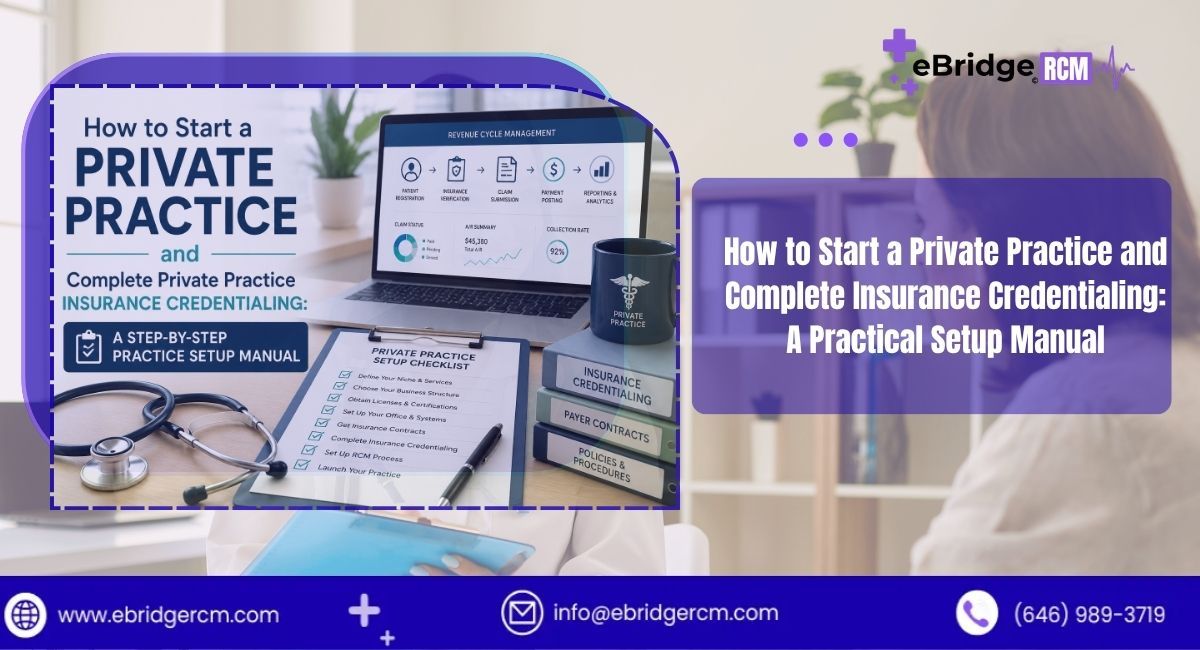
Building a clinical private practice today is not only about patient care. It is equally about structuring a business that can work smoothly with insurance systems, billing rules, compliance checks, and payer enrollment processes. At the center of this journey is private practice insurance credentialing, which decides whether a provider can legally and financially participate in insurance networks.
This guide breaks the entire process into a clear, practical roadmap for clinicians starting a solo or group practice, including setup, documentation, enrollment, and post-approval operations. It also connects credentialing with billing readiness and long-term revenue cycle planning.
Throughout the article, you will find references to supporting resources such as
Credentialing Services and related operational systems like
Medical Billing Services which often run in parallel with credentialing workflows.
Setting the Foundation of a Private Practice Before Credentialing Begins
Before insurance applications even start, a practice must be structured as a valid business entity. Payers do not credential individuals in isolation; they credential fully formed provider setups with legal, financial, and administrative consistency.
A private practice setup generally includes business registration, NPI creation, licensing alignment, and defining specialty scope. These elements are not optional because insurance companies validate every detail across multiple databases.
One overlooked detail is how early practice structure decisions affect revenue cycle efficiency later. For example, solo versus group configuration impacts billing pathways and payer contracting flexibility. A deeper explanation of this transition is available in
Transitioning from Solo Provider to Group Practice
Step 1: Establishing Legal and Administrative Structure
The first real step in private practice setup is choosing the legal structure and registering the business. This determines how payers recognize the provider and how payments flow once credentialing is complete.
Common structures include PLLC, LLC, and professional corporations depending on jurisdiction and specialty requirements. Along with this, an EIN is required for tax and billing purposes.
At this stage, consistency across all identifiers becomes critical because payer systems cross-check every detail during enrollment.
A simplified breakdown:
| Component | Purpose | Why It Matters in Credentialing |
| Legal Entity | Business registration | Defines billing identity |
| EIN | Tax identification | Required for payer contracts |
| Practice Address | Physical location | Used for payer verification |
| Ownership Details | Provider structure | Impacts group enrollment |
Mistakes at this stage often create downstream delays in credentialing approvals.
Step 2: Understanding Provider Identification Systems
Insurance credentialing depends heavily on accurate identification systems. These include NPI numbers, taxonomy codes, and state licenses.
The National Provider Identifier (NPI) is the backbone of all insurance interactions. Without it, no claims or enrollments can proceed. Providers must also ensure taxonomy codes correctly match their specialty, as mismatches can trigger rejection.
More detail on how these identifiers connect to billing systems can be found here:
What is NPI and Why It Matters
Key identifiers include:
| Identifier | Description | Role in Credentialing |
| Type 1 NPI | Individual provider ID | Used for personal enrollment |
| Type 2 NPI | Group/practice ID | Used for organization billing |
| Taxonomy Code | Specialty classification | Determines payer eligibility |
| State License | Legal permission to practice | Verified during enrollment |
Even a minor mismatch between NPI taxonomy and CAQH profile can delay insurance approval significantly.
Step 3: Preparing for Private Practice Insurance Credentialing
Once the practice structure is stable, the credentialing process begins. This stage is where providers apply to insurance networks to become in-network participants.
Private practice insurance credentialing involves verification of education, licensing, malpractice coverage, training history, and professional background. Insurance companies use this process to confirm provider legitimacy before allowing billing privileges.
A major part of this stage is CAQH profile setup, which acts as a centralized database used by most payers in the United States.
For a broader understanding of payer expectations, this resource provides additional clarity:
Insurance Credentialing for US Healthcare Providers.
Step 4: CAQH Profile and Its Role in Credentialing Accuracy
CAQH is a required system for most insurance enrollments. It stores provider data in a standardized format used by multiple payers.
The importance of CAQH lies in consistency. If CAQH data does not match licensing or NPI records, applications may be delayed or rejected.
| CAQH Section | Required Information |
| Personal Data | Name, DOB, SSN |
| Education | Medical school, residency |
| Work History | Full employment timeline |
| Licenses | State licenses, DEA |
| Insurance | Malpractice coverage |
| References | Professional contacts |
CAQH must be re-attested every 120 days to remain active, making ongoing maintenance a requirement, not a one-time task.
More context for mental health providers is explained here:
CAQH Credentialing for Mental Health Providers
Step 5: Insurance Enrollment Workflow and Approval Stages
Insurance enrollment is the phase where providers formally apply to payer networks. Each insurance company has its own application system, but the overall structure remains similar.
The process typically includes submission, verification, contracting, and activation. Delays are common when documentation is inconsistent or incomplete.
| Stage | What Happens | Average Duration |
| Application Submission | Forms submitted to payer | 1–2 weeks |
| Verification | Background and license checks | 30–90 days |
| Contracting | Agreement negotiation | 2–4 weeks |
| Activation | Network access granted | 1–2 weeks |
Credentialing timelines vary by specialty and payer type. For example, cardiology practices often experience longer verification cycles due to complex service structures, as explained here:
Cardiology Credentialing Timeline
Step 6: Documentation Required for Credentialing Approval
Credentialing requires precise documentation. Missing or inconsistent paperwork is one of the most common causes of delays.
| Category | Required Documents |
| Identity | Government-issued ID |
| Education | Degrees and training certificates |
| Licensing | Active state license |
| Insurance | Malpractice certificate |
| Practice | EIN, W-9 form |
| Work History | Full CV without gaps |
| References | Professional references |
Accuracy is more important than volume. Even small mismatches in employment dates or address history can trigger additional payer review.
Step 7: Common Errors That Delay Credentialing
Credentialing delays usually come from avoidable administrative mistakes rather than payer complexity.
Common issues include inconsistent CAQH updates, outdated licenses, missing malpractice insurance, and incorrect taxonomy codes.
These patterns are discussed in detail here:
Medical Credentialing Mistakes
Some frequent problems include:
- Outdated CAQH attestation
- Missing or expired license uploads
- Inconsistent NPI and taxonomy alignment
- Gaps in professional history documentation
- Delayed responses to payer requests
Step 8: Connecting Credentialing with Revenue Cycle Readiness
Credentialing is not separate from billing. It directly determines how revenue flows into a practice. Without proper billing readiness, even approved providers can face claim rejections or payment delays.
Before activation, practices should ensure billing systems are aligned with payer rules, eligibility verification processes, and claim submission workflows.
| Revenue Cycle Area | Setup Requirement |
| Eligibility Checks | Insurance verification system |
| Claims Submission | Billing software configuration |
| Denial Management | Appeals workflow |
| Payment Posting | ERA/EFT setup |
A structured revenue cycle setup is often supported through
AR Recovery Services
especially in early-stage practices managing delayed reimbursements.
Step 9: Billing Integration After Credentialing Setup
Once credentialing is in motion, billing systems must be aligned with payer requirements. This ensures claims are processed correctly once approvals are active.
Integration includes linking NPIs, configuring payer-specific rules, and setting up clearinghouse workflows. Practices that delay this step often face early-stage denial spikes.
More insight on billing integration challenges is available through
Revenue Cycle Management Insights
Step 10: Long-Term Maintenance After Credentialing Approval
Credentialing does not end once approval is granted. Providers must maintain compliance, update records, and monitor payer requirements continuously.
| Maintenance Area | Frequency |
| CAQH Updates | Every 120 days |
| License Renewal | Annual or biannual |
| Payer Updates | Ongoing |
| Credential Revalidation | Every 2–3 years |
Long-term stability depends on consistent administrative tracking and proactive updates.
For providers planning growth, structured support through
Revenue Cycle Management Solutions helps maintain operational consistency.
Building a Stable Credentialed Practice with Structured Planning
Starting a private practice and completing private practice insurance credentialing is a structured process that combines business setup, documentation accuracy, payer enrollment, and billing readiness. Each stage depends on the one before it, and delays often come from small inconsistencies rather than major system failures.
Providers who approach credentialing as part of a broader revenue cycle strategy tend to achieve faster approvals and more stable reimbursement flows.
For end-to-end support, structured services like New York Credentialing Services
help reduce administrative burden and improve payer onboarding accuracy.