The Checklist That Prevents Four Months of Lost Revenue
A licensed professional counselor opens an outpatient therapy practice. She has her state license, her malpractice insurance, an office, and a waitlist of patients ready to start. What she does not have is a credentialing plan. She submits applications to three insurance companies during her first week of seeing patients, assuming the process takes a few weeks.
Eleven weeks later, she receives approval from one payer. The other two are still pending because one application had an incomplete CAQH attestation and the other was missing a current malpractice certificate with matching name format. She has been collecting self-pay rates from insured patients, some of whom have stopped coming because they cannot afford the out-of-pocket cost.
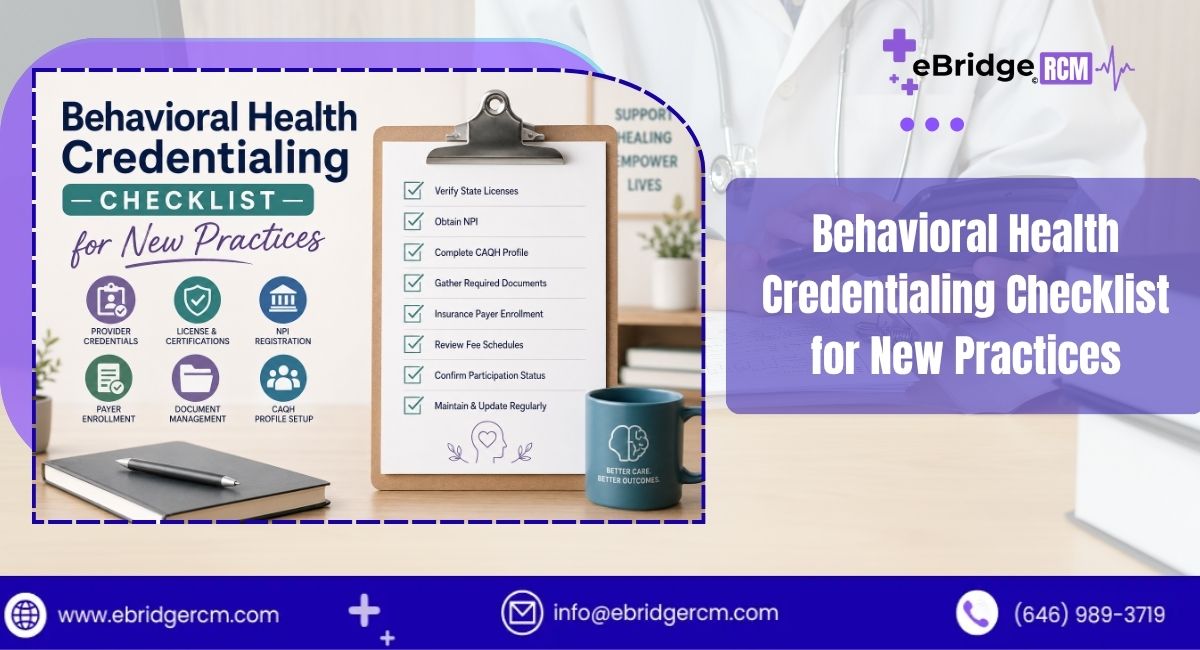
The financial damage is real, and the administrative fix is straightforward: a credentialing checklist applied before the practice opens.
Behavioral health credentialing has specific layers that general medical credentialing does not always account for, including managed behavioral health organization enrollments, carve-out payer structures, and non-physician provider pathways that vary by license type. This checklist is built around those realities.
Why Behavioral Health Credentialing Requires Its Own Approach
Behavioral health is not simply a specialty within a payer’s medical network. Most major insurance carriers in the United States manage mental health and substance use disorder benefits through separate administrative structures. This separation, often called a behavioral health carve-out, means that credentialing with a payer’s medical network does not automatically include credentialing with its behavioral health network.
A psychiatrist credentialed with UnitedHealthcare for general medicine must separately credential with Optum Behavioral Health, which manages United’s mental health benefits for most commercial plans. The same separation applies with Aetna and its behavioral health administration, Cigna Behavioral Health, and Anthem’s behavioral health arm. Each of these entities has its own application process, its own credentialing committee timeline, and its own enrollment contract.
For a new behavioral health practice, this means the payer list for credentialing is longer than it first appears. A practice targeting five commercial payers might actually need to complete eight to twelve separate applications once managed behavioral health organizations are counted separately from their parent insurance companies.
This is the primary reason behavioral health credentialing takes longer and requires more organized tracking than most new practice owners anticipate. Having a structured checklist from the start prevents items from falling through the cracks.
Phase 1: Business and Legal Prerequisites
Before any credentialing application can be submitted, the practice must have its foundational legal and administrative structure in place. Without these elements, applications either cannot be submitted or will be rejected on intake.
Business Entity Formation
The practice must be established as a legal entity. Depending on the state, this means filing as an LLC, PLLC, PC, or another structure recognized for professional healthcare providers. Operating as a sole proprietor under a personal name is possible in some circumstances, but most payers require a business entity with its own federal tax identification number for group billing purposes.
The entity formation documents, including the articles of organization or incorporation, must be finalized before applying for an employer identification number (EIN).
Employer Identification Number (EIN)
The EIN from the IRS identifies the practice as a taxpaying entity separate from the individual provider. It appears on all payer applications and contracts, all tax documents, and in the billing system as the billing tax ID. Using a personal Social Security number in place of an EIN for group or business billing creates problems with payer enrollment that are difficult to correct retroactively.
Practice Address Confirmation
Most payers will not begin processing a credentialing application for a practice address that is not yet operational. The address entered on applications must be the actual service location where patients will be seen. Virtual or administrative addresses are generally not accepted as service locations.
For telehealth-only practices, the rules vary by payer. Some payers accept a home state business address for providers delivering exclusively telehealth services, but this must be verified with each payer individually before application submission.
Phase 2: Provider Identifiers and Licensing
Individual NPI (Type 1)
Every licensed provider who will bill insurance needs an individual National Provider Identifier. This is a 10-digit number assigned through the National Plan and Provider Enumeration System (NPPES), administered by the Centers for Medicare and Medicaid Services. An individual NPI is tied to the provider as a person, not to the practice, and it carries with them throughout their career regardless of where they work.
The NPI application requires the provider’s legal name, date of birth, state of residence, primary license information, and specialty taxonomy code. The taxonomy code is critically important. It identifies the provider’s discipline and license type to payers, and selecting the wrong code can result in claims being routed to the wrong benefit structure or denied as a non-covered service type.
For behavioral health providers, common taxonomy codes include 101YM0800X for mental health counselors, 1041C0700X for clinical social workers, 103T00000X for psychologists, and 2084P0800X for psychiatrists. Each state has its own licensing designations that map to these federal taxonomy codes.
Group NPI (Type 2)
If the practice is billing under a business entity, it also needs a group NPI. This Type 2 NPI identifies the organization rather than the individual. Claims submitted by the practice typically include both the rendering provider’s individual NPI and the billing organization’s group NPI.
The relationship between these two identifier types and when each one is used in claim submission is something that affects every claim the practice submits. How group NPI and individual NPI work in billing explains the distinction in practical billing terms and clarifies the scenarios where each type appears on a claim form.
State Professional License
The provider’s active state license is the foundation of the entire credentialing process. No payer will credential a provider without a valid, unrestricted license in the state where services are being provided. The license must be:
In good standing with no current disciplinary actions, restrictions, or probationary conditions. Even minor notations on a license can delay credentialing while payers investigate.
Registered at an address that is consistent with the practice location. Some states tie the license to a principal address, and inconsistencies with the payer application can trigger additional verification steps.
Not within 90 days of expiration at the time of application submission. Payers typically will not start a credentialing cycle that would expire before it completes.
For non-physician behavioral health providers, including licensed clinical social workers, licensed professional counselors, licensed marriage and family therapists, and certified alcohol and drug counselors, the specific license requirements vary by state and by payer. Some payers credential all of these license types independently, while others require group practice affiliation or supervising physician attestation for certain disciplines.
DEA Registration
For psychiatrists and other providers with prescribing authority, an active DEA registration is required by most payers. The DEA number must be registered to the practice address where controlled substances will be prescribed. A DEA number registered to a previous address will cause discrepancies in the credentialing application.
Non-prescribing behavioral health providers such as therapists, counselors, and social workers do not need DEA registration.
Phase 3: CAQH ProView Setup and Maintenance
CAQH ProView is the centralized credentialing database used by most commercial payers in the United States. Rather than completing a full application for each payer from scratch, a provider maintains one CAQH profile that payers access during their credentialing review.
Getting the CAQH profile right is one of the most important early steps in the credentialing process. Errors or omissions in CAQH propagate to every payer that references the profile, multiplying the impact of a single mistake.
Creating the CAQH Profile
Registration is completed at proview.caqh.org. A provider needs their NPI, state license number, and basic professional information to begin. Once registered, the system walks through a series of sections covering work history, education and training, professional references, malpractice insurance, hospital affiliations, and disclosure questions.
Key items to complete carefully in CAQH:
Work history must be continuous and account for any gaps of 30 days or more with an explanation. Unexplained gaps in employment or practice history are a common reason payers request additional information.
Education and training dates must match the dates on the supporting documentation exactly. If a residency completion certificate shows a specific graduation date, the CAQH entry must reflect that date to the day.
Malpractice information must include the policy number, carrier name, coverage dates, and coverage amounts exactly as they appear on the insurance certificate. The name on the certificate must match the name on the CAQH profile.
Disclosure questions must be answered accurately. Questions about malpractice claims, license actions, and criminal history require yes or no answers with explanations where applicable. Leaving these blank or answering incorrectly is a serious credentialing error.
For a detailed walkthrough of how CAQH applies specifically to behavioral health providers, the CAQH credentialing guide for mental health providers covers the profile sections most relevant to this provider type.
CAQH Attestation Cycle
After the initial profile is complete, the provider must authorize each payer to access it. This authorization is renewed every 120 days through CAQH’s attestation process. Missing an attestation deadline causes the profile to become inactive, which pauses any in-progress credentialing applications with every payer currently reviewing it.
New practices should set a calendar reminder for day 90 after initial attestation to allow 30 days of buffer before the 120-day deadline.
Phase 4: Malpractice Insurance
All payers require proof of active malpractice coverage as part of the credentialing application. For behavioral health providers, coverage requirements vary by provider type and payer.
Typical minimum coverage for psychiatrists is $1 million per occurrence and $3 million aggregate. For non-physician behavioral health providers, many payers accept lower minimum thresholds, often $1 million per occurrence and $1 million aggregate, though some commercial payers require the same amounts as physicians.
The malpractice certificate must show:
The insured’s name exactly as it appears on the license and CAQH profile. Any variation in name format, including middle name presence or absence, credential suffix differences, or spelling variations, will cause a verification mismatch.
The policy effective and expiration dates. Applications submitted when a policy has fewer than 90 days remaining before expiration may be flagged for additional review.
The coverage type (occurrence or claims-made) and the coverage amounts.
Occurrence-based coverage is generally straightforward because it covers incidents during the policy period regardless of when a claim is filed. Claims-made coverage requires a tail policy when the provider changes carriers or stops practicing, which is an important consideration for new practice owners who may change insurers as their practice grows.
Phase 5: Medicare and Medicaid Enrollment
Medicare Enrollment via PECOS
Medicare enrollment for behavioral health providers happens through the Provider Enrollment, Chain, and Ownership System (PECOS), which is the CMS online enrollment platform. After Medicare enrollment is approved, the provider receives a Provider Transaction Access Number (PTAN). The PTAN is the identifier used when submitting claims to Medicare and must be on file in the billing system before any Medicare claims can process correctly.
Behavioral health services covered under Medicare Part B include psychiatric services, psychotherapy, and certain testing services. Understanding what a PTAN is and how it functions in billing is useful context for new practices setting up their Medicare billing configuration.
Medicare credentialing for behavioral health providers typically takes 60 to 90 days from application submission to PTAN issuance, assuming no application errors or additional documentation requests.
Medicaid Enrollment
Medicaid enrollment is state-administered, and the requirements vary significantly. Practices in states with managed care Medicaid programs must credential with each Medicaid MCO separately, not just with the state Medicaid program directly.
For behavioral health specifically, many state Medicaid programs have a separate behavioral health benefit administered through a carved-out managed care organization. New practices must identify which MCOs administer behavioral health benefits in their state and submit applications to each one.
Phase 6: Commercial Payer Applications
Commercial payer applications represent the bulk of the credentialing workload for most behavioral health practices. The application strategy should be prioritized by payer market share in the practice’s geographic area, with the highest-volume payers addressed first.
Managed Behavioral Health Organizations (MBHOs)
For every major commercial payer, there is typically a corresponding managed behavioral health organization that administers mental health and substance use benefits. Applications to the parent insurance company do not automatically credential the provider with the MBHO. The following are the most commonly encountered:
Optum Behavioral Health manages UnitedHealthcare’s mental health benefits for most commercial and Medicare Advantage plans. Optum uses its own credentialing database and has its own application and review process.
Carelon Behavioral Health (formerly Beacon Health Options) manages behavioral health benefits for multiple commercial payers including some Anthem subsidiaries, Centene plans, and others depending on the state.
Magellan Health manages behavioral health benefits for several commercial and government payers, with state-specific contracts that vary in scope.
Cigna Behavioral Health and Aetna’s internal behavioral health administration both require applications separate from general medical enrollment with those carriers.
Panel Status Verification
Before submitting a commercial payer application, verify that the provider panel is open for the practice’s specialty and zip code. Behavioral health panels in high-density urban areas are frequently closed to new providers, particularly for certain license types such as psychologists and psychiatrists.
Submitting an application to a closed panel wastes administrative time and can consume credentialing follow-up capacity that is better directed at payers who will actually enroll the provider. Calling the payer’s provider relations line before application submission takes a few minutes and prevents weeks of wasted effort.
Application Submission and Tracking
Each payer application requires tracking from submission through approval. A simple spreadsheet tracking the following information for each application is sufficient for most new practices: payer name, MBHO name if separate, application submission date, assigned application reference number or contact, last follow-up date, current status, any pending information requests, and estimated committee review date.
Follow-up with each payer should happen every 10 to 14 days. The goal of each follow-up call is to confirm the application is in process, ask whether any additional documentation has been requested, and get an estimate of the credentialing committee review date. Passive waiting is the most common reason credentialing takes longer than it needs to.
Phase 7: Payer Enrollment Contracts
Credentialing approval is not the final step. After a payer verifies the provider’s credentials, they extend an enrollment contract that must be signed and returned before billing can begin. The contract specifies the fee schedule, the effective date of participation, and the terms of the network relationship.
New practices should review enrollment contracts carefully before signing. Key items to examine:
The participation effective date determines from which service date claims can be billed as in-network. Some contracts allow retroactive effective dates back to the application date, which enables billing for services rendered during the credentialing period if the payer approves retroactive claims. This is not available with all payers and should not be assumed.
The fee schedule reference, whether it is a percentage of Medicare rates or a proprietary payer schedule, determines reimbursement for every service the practice bills to that payer for the duration of the contract.
Provider directory listing timelines are worth noting. After contract execution, the payer may take two to four additional weeks to add the practice to their online directory, which affects patient-facing visibility as an in-network provider.
Phase 8: Ongoing Credentialing Maintenance
Getting credentialed is the start, not the end. Maintaining active credentialing status requires consistent attention to several items throughout the life of the practice.
Re-Credentialing Cycles
Most payers require re-credentialing every two to three years. Medicaid programs may require annual revalidation. The re-credentialing process involves submitting updated information, completing new disclosure questions, and providing current documentation including an updated malpractice certificate and license renewal confirmation.
The consequences of missing a re-credentialing deadline vary by payer. Some payers send advance notices and allow a grace period for completion. Others terminate network participation automatically when the re-credentialing deadline passes without a completed application.
Building a tracking system that records each payer’s re-credentialing schedule and sends alerts 90 days before each deadline is a standard practice for established practices managing multiple provider panels. Re-credentialing and revalidation requirements for mental health providers breaks down what each major payer type requires in the re-credentialing process.
License and DEA Renewal Tracking
State licenses have renewal cycles ranging from one to three years depending on the state and license type. DEA registrations renew every three years. Both must be renewed before expiration to maintain uninterrupted credentialing status with payers.
Payers monitor license and DEA expiration dates in their credentialing databases and in sanction monitoring systems. A license that lapses even briefly can result in a payer suspending network participation and clawing back payments made during the lapse period in some cases.
Malpractice Certificate Updates
When a malpractice policy renews, the new certificate must be updated in CAQH and, in some cases, submitted directly to individual payers. The update timeline matters because a gap between the old certificate expiration and the new certificate effective date, even if only technical, can trigger a credentialing hold.
CAQH Attestation Renewal
The 120-day CAQH attestation cycle does not slow down after initial setup. It continues for the life of the provider’s participation with any payer that uses CAQH. Missing this renewal is one of the most preventable causes of credentialing disruption for established practices.
Credentialing Checklist Summary
| Phase | Key Tasks | Common Errors to Avoid |
| Business setup | Entity formation, EIN, practice address | Using personal SSN instead of EIN |
| Provider identifiers | Individual NPI, group NPI, taxonomy codes | Wrong taxonomy code selection |
| State licensing | Active license, no restrictions | License expiring during credentialing process |
| CAQH setup | Complete profile, accurate dates, attestation | Missing work history gaps, mismatched names |
| Malpractice insurance | Current certificate, correct coverage amounts | Name format mismatch between documents |
| Medicare/Medicaid | PECOS enrollment, state Medicaid, MCO applications | Confusing state Medicaid with MCO enrollment |
| Commercial payers | MBHO applications, panel status verification | Applying to closed panels |
| Payer contracts | Contract review, signature, effective date | Assuming auto-participation after credentialing |
| Ongoing maintenance | Re-credentialing tracking, license renewals, CAQH attestation | Missing re-credentialing deadlines |
Behavioral Health License Types and Credentialing Pathways
Different behavioral health license types follow different credentialing pathways with payers, and new practices often encounter confusion about which license types are credentialed independently versus those requiring additional documentation.
Psychiatrists (MD, DO)
Psychiatrists follow standard physician credentialing pathways and are generally credentialed independently with all major payers. They require DEA registration and board certification documentation in addition to the standard provider documentation set.
Psychologists (PhD, PsyD)
Psychologists are credentialed independently with most major payers. Some Medicare Advantage plans and certain state Medicaid programs have specific enrollment pathways for psychologists that differ from physician enrollment. Board certification through the American Board of Professional Psychology is not universally required for credentialing but is required by some payers.
Licensed Clinical Social Workers (LCSW)
LCSWs are credentialed independently with most commercial payers and Medicaid. Some payers require documentation of post-licensure supervised practice hours. The LCSW credentialing documents guide details the specific documentation requirements that come up most frequently in LCSW applications.
Licensed Professional Counselors (LPC) and Licensed Mental Health Counselors (LMHC)
LPCs and LMHCs (the latter designation used in some states including New York) are credentialed by most major commercial payers but the coverage varies more widely than for LCSWs. Some payers in some states do not credential these provider types independently, instead requiring them to bill under a supervising physician or agency.
Licensed Marriage and Family Therapists (LMFT)
LMFTs face the most variability in payer credentialing acceptance. Many commercial payers credential LMFTs in all states, but some payers have geographic limitations on which states they credential this license type in. Checking individual payer credentialing policies for LMFT applicants before beginning applications prevents submission to payers that do not enroll this license type.
Certified Alcohol and Drug Counselors (CADC)
Most major commercial payers do not credential individual CADCs for independent billing. They typically bill under a credentialed supervisor or through a licensed facility. However, Medicaid programs in many states do credential CADCs directly for substance use disorder treatment services, which makes Medicaid enrollment often the primary focus for counselors in this category.
Setting Up the Billing Infrastructure Alongside Credentialing
Credentialing approval and billing capability must be ready simultaneously. A practice that receives payer approval but has not configured its billing system to accept that payer’s claims, process remittance advice, and submit electronic claims correctly will still face delayed payments.
The billing setup steps that should run parallel to credentialing include: selecting and configuring a practice management system, establishing a clearinghouse connection for electronic claim submission and ERA receipt, entering all provider NPIs and tax IDs correctly into the billing system, verifying that the taxonomy codes in the billing system match the CAQH profile, and setting up eligibility verification access with priority payers.
For a new behavioral health practice, having all of these components ready before the first payer approval arrives means claims can be submitted the same week approval is received rather than a month later. Revenue cycle tips for mental health providers covers how the credentialing and billing setup phases interact in practice and what happens to cash flow when either component lags behind.
When to Consider Outsourcing Behavioral Health Credentialing
Managing the full credentialing process in-house is feasible for some practices, particularly those with a dedicated administrative staff member who has prior credentialing experience. For most new behavioral health practices, especially solo providers and small groups, the time and expertise requirements make outsourcing to a specialized credentialing company a practical choice.
The factors that most commonly push practices toward outsourcing include: no prior credentialing experience among current staff, a payer mix that includes multiple MBHOs requiring separate applications, a target opening timeline that does not allow for the learning curve of first-time credentialing, and the need to add new providers to existing panels frequently as the practice grows.
A specialized credentialing service handles CAQH setup and maintenance, payer-specific applications, follow-up with provider relations contacts, contract review and submission, and re-credentialing tracking. For practices that also want to pair credentialing with billing from the start, behavioral health credentialing services that integrate with revenue cycle management avoid the gap between credentialing approval and first clean claim submission.
For practices setting up their full administrative infrastructure, reviewing mental health practice setup guidance clarifies how credentialing fits within the broader list of operational tasks that need to happen before a practice can function at full billing capacity.
FAQ: Behavioral Health Credentialing for New Practices
How far in advance should a new behavioral health practice begin credentialing?
The minimum recommended lead time is 120 days before the first intended billing date, and 150 days is safer given the variability in payer timelines. Managed behavioral health organizations and Medicaid MCOs in particular can take 90 to 120 days or longer to complete enrollment. Starting the process before the practice is fully operational is necessary to avoid a gap between opening day and first insurance payment.
Can a therapist see patients while credentialing is pending?
Yes, but billing implications need to be managed carefully. Most payers do not allow billing for services rendered before the credentialing effective date. Some payers allow retroactive billing to the application date, but this is not universal. During the pending period, the options are collecting self-pay rates, informing patients of the pending in-network status and requesting that they wait to submit claims, or accepting that some early claims may not be billable to insurance.
Do behavioral health practices need to credential with every payer separately?
Yes. Each payer, including each managed behavioral health organization, requires its own enrollment application and issues its own contract. CAQH simplifies the documentation step by providing a shared profile that payers access, but it does not eliminate the need for individual applications with each payer.
What happens if a CAQH attestation is missed?
Missing the 120-day attestation deadline causes the CAQH profile to become inactive. Payers that are actively reviewing an application for that provider will be notified that the profile has expired and will typically pause the credentialing review until the profile is reactivated and attested. Reactivation requires logging into CAQH, confirming the information is current, and completing the attestation. The reactivation process itself is quick, but the delay it causes in pending applications can add weeks depending on where those applications are in the payer’s review cycle.
Can a behavioral health practice lose in-network status after being credentialed?
Yes. Network participation can be terminated for several reasons: missing a re-credentialing deadline, allowing a state license to lapse, failing to maintain adequate malpractice coverage, being added to an exclusion database such as the OIG List of Excluded Individuals, or failing to respond to a payer’s request for updated information. Maintaining an active tracking system for all renewal and re-credentialing dates prevents most of these situations.
Do telehealth-only behavioral health practices credential differently?
The credentialing process is largely the same, but there are a few telehealth-specific considerations. The practice address used on applications must be a verifiable business address in the state where services are provided. Telehealth policy coverage varies by payer and changed significantly during and after the COVID-19 public health emergency, so providers should verify current telehealth coverage policies with each payer before and during the credentialing process.
Use the Checklist, Start Early, Track Everything
The behavioral health credentialing process is longer and more layered than most new practice owners expect. The managed behavioral health organization structure, the non-physician provider pathway variations, and the multiple separate applications required across a single payer’s ecosystem all add complexity that a general credentialing checklist does not address fully.
Using a checklist that accounts for these specifics, starting 120 to 150 days before opening, maintaining CAQH proactively, and following up with payers every two weeks rather than waiting for responses are the practices that consistently produce faster credentialing timelines with fewer gaps.
For behavioral health practices that want to move through credentialing without managing every step in-house, eBridge RCM LLC provides dedicated credentialing services in NYC for mental health and behavioral health providers. Their team handles the full process from initial CAQH setup and payer applications through contract management and ongoing re-credentialing tracking, paired with NY mental health billing services that are ready to submit claims as soon as each payer approval arrives.