
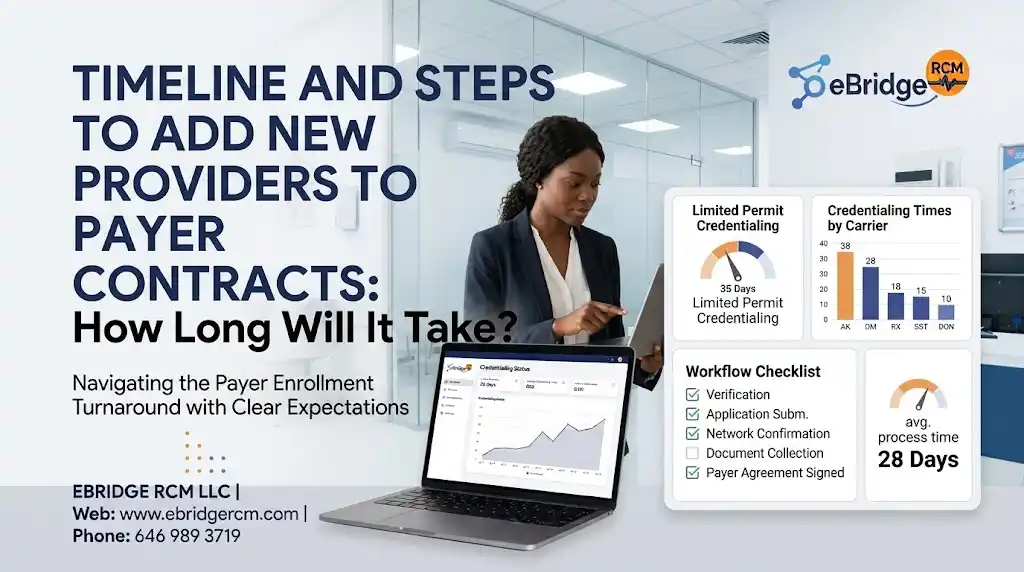
A group practice hires a new physician. The practice already has active contracts with every major payer in the region. The office manager tells the new hire they will be billable within a few weeks. Two months later, the provider is still pending with two payers, and the practice is covering their salary without matching revenue from those specific plans.
This gap between expectation and reality is one of the most common frustrations in provider enrollment. Practices assume that because they already have a relationship with a payer, adding a new provider will move quickly across the board. Sometimes it does. Often it does not, and the difference depends heavily on which payer, which state, and how complete the application was on first submission.
This guide breaks down realistic enrollment timelines for the payers practices deal with most often: Aetna, Cigna, UnitedHealthcare and Optum, Blue Cross Blue Shield, and Medicare. It also covers what actually causes delays and how to plan around them instead of getting caught by surprise.
Why Timelines Vary So Much Between Payers
Every payer runs its own credentialing and enrollment operation. Some use centralized national processing centers. Others process applications at the regional or state level, which means the same national payer can move at different speeds depending on where the provider is located.
A few structural factors explain most of the variation:
- Whether the payer uses CAQH as its primary data source, or requires additional payer specific forms
- Whether the application goes through a credentialing committee that meets on a fixed schedule, rather than processing continuously
- Current application volume, which spikes during certain times of year, particularly around open enrollment periods
- Whether the provider is joining an existing group contract or establishing a brand new one
- State specific requirements, which affect Medicaid managed care plans and some regional Blue Cross Blue Shield plans more than national commercial payers
Understanding these factors helps explain why two providers joining the same group, applying to the same payer, can sometimes see different timelines depending on when they applied and how complete their paperwork was.
Aetna
Aetna generally processes provider enrollment applications within 30 to 45 days once a complete application, including a fully attested CAQH profile, has been received. This is on the faster end compared to some other national payers, though timelines can extend if the application is missing information or if the provider’s CAQH profile has not been updated recently.
Aetna relies heavily on CAQH for primary source verification, so keeping that profile current before submitting an application tends to shorten the process rather than starting from a blank or outdated file. Providers joining an existing group contract that is already active with Aetna sometimes see a faster path, since the payer already has verified data on the group itself.
Cigna
Cigna’s provider enrollment timeline typically runs 45 to 60 days for a complete application. Cigna, like most major commercial payers, pulls primary source data from CAQH, and incomplete profiles are one of the most common reasons applications take longer than the standard range.
Cigna also distinguishes between adding a provider to an existing group agreement and establishing a completely new provider contract. Group additions tend to move somewhat faster, since Cigna does not need to reverify the practice’s tax ID, billing structure, or facility information that it already has on file.
UnitedHealthcare and Optum
UnitedHealthcare, along with its Optum network, generally takes 45 to 90 days for provider enrollment, with the wider range reflecting the fact that UnitedHealthcare processes an extremely high volume of applications nationally. Optum, which handles behavioral health credentialing for many UnitedHealthcare plans, sometimes runs on a separate track from the medical network, which means a provider offering both physical and behavioral health services may see two different timelines within the same overall UnitedHealthcare relationship.
Providers should confirm early on which specific network their application falls under, since UnitedHealthcare’s structure is more layered than some other national payers. A behavioral health clinician applying through Optum should not assume the same timeline as a primary care physician applying through UnitedHealthcare’s core medical network.
Blue Cross Blue Shield
Blue Cross Blue Shield is a unique case because it operates as a federation of separate, independently operated regional plans rather than a single national entity. This means timelines vary more with BCBS than with most other payers, depending on which state’s plan the provider is applying to.
Generally, BCBS plans process complete applications within 60 to 90 days, though some regional plans move faster and others, particularly in states with higher application volume or more complex regulatory requirements, can extend closer to 120 days. Because of this variation, it is worth confirming the specific timeline directly with the regional BCBS plan involved, rather than assuming a single national standard applies.
Medicare
Medicare enrollment runs through PECOS, the Provider Enrollment, Chain, and Ownership System, and follows a different structure than commercial payer enrollment. For a new individual provider enrollment, Medicare typically takes 60 to 90 days from submission of a complete application, known as Form CMS 855I for individual providers or CMS 855B for organizations.
Medicare does not offer a true rostering shortcut the way many commercial payers do for providers joining an established group. Each individual provider generally needs their own completed enrollment, even if the group itself has been enrolled with Medicare for years. Errors on the CMS 855 forms, including mismatched practice location information or incomplete ownership disclosure, are a common cause of processing delays beyond the standard range.
Table: Typical Provider Enrollment Timelines by Payer
| Payer | Typical Timeline (Complete Application) | Notes |
| Aetna | 30 to 45 days | Relies heavily on CAQH data |
| Cigna | 45 to 60 days | Group additions often faster than new contracts |
| UnitedHealthcare/ Optum | 45 to 90 days | Optum behavioral health may run separately |
| Blue Cross Blue Shield | 60 to 90 days, up to 120 in some states | Varies by regional plan |
| Medicare | 60 to 90 days | Processed through PECOS, no rostering shortcut |
What Actually Slows Enrollment Down
The published timelines above assume a complete, accurate application submitted the first time. In practice, several recurring issues push timelines past these ranges.
Incomplete or Outdated CAQH Profiles
Most commercial payers pull primary source verification data directly from CAQH. If the provider’s profile is missing documents, has an expired malpractice certificate on file, or has not been reattested within the required window, typically every 120 days, the payer’s review stalls until the profile is corrected. This is consistently one of the single biggest causes of enrollment delays across nearly every payer.
Mismatched Practice or Provider Information
If the address, tax ID, or NPI listed on the application does not match what is on file elsewhere, whether with the payer, with CAQH, or with NPPES, it triggers a manual review. Manual reviews take longer than automated processing and sometimes require the practice to submit corrected documentation before the application moves forward.
Missing Malpractice or Licensure Documentation
Applications submitted without current malpractice insurance certificates, or with a license verification that has not yet cleared with the state board, get held until the missing piece is resolved. This is particularly common when a provider is newly licensed or has recently relocated to a new state.
Application Backlogs During High Volume Periods
Payers process higher application volumes during certain periods of the year, particularly late in the calendar year ahead of new plan years. Applications submitted during these windows sometimes take longer simply due to volume, even when the paperwork itself is complete and accurate.
Provider Joining a New Group vs an Established One
A provider joining a practice with no prior contract with a specific payer faces the full new provider enrollment timeline. A provider joining an existing group that already holds an active contract sometimes moves faster, since the payer does not need to reverify the practice itself. This distinction is significant enough that it is worth understanding in more depth, and this guide on individual versus group credentialing explains how the two paths differ.
How State Location Affects Enrollment Timing
Practice location plays a bigger role in enrollment timing than many providers expect, particularly for New York based practices navigating Medicaid managed care plans and regional BCBS requirements.
New York Medicaid managed care plans, administered through several different managed care organizations, each run their own credentialing intake process layered on top of the state’s base Medicaid provider enrollment requirement. A provider may need to complete New York State Medicaid enrollment first, then separately apply to each individual managed care plan they want to join, such as Fidelis, Healthfirst, or MetroPlus. This layered structure means Medicaid enrollment in states like New York often takes longer than commercial payer enrollment, sometimes extending past 120 days when multiple managed care plans are involved.
Regional BCBS plans operating in the New York market follow their own internal review timelines as well, separate from BCBS plans in other states. A provider relocating from another state, or a group practice expanding into New York for the first time, should treat each state’s Medicaid and BCBS requirements as a distinct enrollment project rather than assuming national consistency.
Turn Billing Complexity Into Revenue Opportunity.
eBridge RCM takes the complexity out of billing, claims, credentialing, and revenue cycle management, so your practice can stay focused on delivering exceptional patient care.
Provider Type and Its Effect on Timeline
The type of provider being enrolled also influences how long the process takes, beyond just the payer involved.
Physicians and other independently licensed providers, such as nurse practitioners and physician assistants operating under their own NPI, generally follow the standard timelines outlined above. Providers working under supervision, including certain licensed clinical social workers or associate level clinicians, sometimes face additional documentation requirements, including supervisor attestations, which can add time to the review if that paperwork is not submitted alongside the initial application.
Specialists ordering or performing higher cost procedures, such as cardiologists or those in imaging heavy specialties, occasionally undergo a more detailed review of their malpractice claims history and procedural volume, since payers weigh risk differently across specialties. This does not always extend the timeline significantly, but it is worth building in a small buffer when planning start dates for specialists in higher risk categories.
Consider an internal medicine group adding a new physician who has never been credentialed with any payer before. The group submits applications to Aetna, Cigna, UnitedHealthcare, a regional BCBS plan, and Medicare, all within the same week.
Aetna clears the application in five weeks. Cigna takes closer to eight weeks. UnitedHealthcare, due to a higher volume period, takes eleven weeks. The regional BCBS plan, which has a smaller processing team and a stricter documentation review, takes just over fourteen weeks. Medicare, processed through PECOS with a minor correction needed on the initial submission, clears in ten weeks after resubmission.
The physician is billable with Aetna within a month and a half, but not fully in network across all five payers until roughly three and a half months after the initial applications were submitted. A practice that assumed a single, uniform timeline across all payers would have significantly underestimated how long full enrollment actually takes. Anticipating this kind of variation matters enough on its own that many practices reference resources like this breakdown of how physician credentialing delays affect practice revenue when setting expectations with new hires and referral sources.
How to Shorten the Timeline Where Possible
While practices cannot control a payer’s internal processing speed, a few steps consistently reduce the chance of unnecessary delay.
Start the CAQH profile update well before submission. Reattesting an existing profile, or completing a new one, before applications go out avoids the single most common cause of stalled review.
Submit complete applications the first time. Missing signatures, outdated malpractice certificates, or mismatched addresses are avoidable errors that add weeks to processing when they trigger a request for corrected documentation.
Apply to the highest priority payers first. If a practice’s patient base is concentrated with one or two payers, prioritizing those applications ensures the provider becomes billable for the largest share of the patient population as early as possible, even while other applications are still pending.
Track each application individually rather than assuming a blanket status. A tracking sheet noting the submission date, payer, current status, and any outstanding requests keeps the practice from losing visibility into where each application stands.
Follow up proactively. Most payers do not send unsolicited status updates. A check in every two to three weeks, through the payer’s provider portal or by phone, catches missing document requests early rather than after they have already caused a delay.
Confirm effective dates in writing. Once approved, get written confirmation of the effective date from each payer, since this determines when the provider can actually begin billing that plan.
Table: Common Delay Causes and How to Avoid Them
| Delay Cause | Typical Impact | Prevention Step |
| Outdated CAQH profile | Adds 2 to 4 weeks or more | Reattest before submission |
| Mismatched provider or practice data | Triggers manual review | Confirm consistency across CAQH, NPPES, and payer records |
| Missing malpractice documentation | Application held until resolved | Submit current certificate with application |
| High volume processing periods | Extends standard timeline | Submit early, avoid year end filing when possible |
| New group with no prior payer contract | Full new enrollment required | Plan for the longer timeline in hiring decisions |
Why This Timeline Matters for Practice Revenue
The financial impact of enrollment delays is straightforward but easy to underestimate. A provider who cannot bill a specific payer for two or three extra months, while still seeing patients covered by that plan, generates clinical work without matching reimbursement. If those sessions cannot be billed retroactively, and not every payer allows this, that revenue is effectively lost.
This is why enrollment timing needs to be part of hiring and onboarding planning, not an afterthought handled after the provider’s start date. Practices that begin the credentialing process 90 days or more before a new provider’s start date give themselves a much better chance of having enrollment cleared, or close to cleared, by the time clinical work begins.
For practices managing this across several providers or expanding into new markets, a structured payer credentialing process, tracked payer by payer rather than treated as a single blanket task, makes a measurable difference in how quickly new hires become fully revenue generating.
When to Consider Outsourcing Provider Enrollment
Managing enrollment across five or more payers for a single new hire is time consuming even when everything goes smoothly. For practices adding multiple providers across a year, or expanding into new states with different regional Blue Cross Blue Shield requirements, the administrative load multiplies quickly.
Dedicated credentialing services handle this work as a specialized function, tracking application status across payers, catching CAQH attestation lapses before they cause delays, and following up consistently rather than waiting for a provider to notice a stalled application weeks after submission. This tends to reduce both the average enrollment timeline and the number of applications that stall due to avoidable documentation errors.
Practical Next Steps
If your practice is planning to add a provider soon, start the CAQH profile review immediately, ideally 90 days before the anticipated start date. Confirm which specific payer plans and regional networks apply, particularly for Blue Cross Blue Shield and Optum behavioral health, since assuming a single national timeline across these payers often leads to inaccurate expectations. Build a payer specific tracking sheet rather than a single status line for the provider, and set calendar reminders to follow up with each payer every two to three weeks until approval is confirmed in writing.
Frequently Asked Questions
Which payer typically processes provider enrollment the fastest?
Aetna generally moves faster than most other national commercial payers, often clearing complete applications within 30 to 45 days. Actual timelines still depend on how complete the application and CAQH profile are at submission.
Does Medicare enrollment take longer than commercial payer enrollment?
Medicare enrollment through PECOS typically takes 60 to 90 days, which is comparable to or sometimes faster than several commercial payers, but it does not offer a rostering shortcut for providers joining an established group, so every individual provider needs their own completed enrollment.
Can enrollment be backdated once a provider is approved?
Some payers allow retroactive billing back to the application date, but this is not universal and depends on the specific payer’s policy. It should not be assumed as a guaranteed fallback when planning a provider’s start date.
Why does Blue Cross Blue Shield have such a wide timeline range?
BCBS operates as a group of independently run regional plans rather than one national organization. Each regional plan sets its own processing standards, which is why timelines can range from about 60 days in some states to 120 days in others.
Does joining an existing group contract always speed up enrollment?
Often, but not always. If the provider has no prior credentialing history with that specific payer, most payers still require a version of full verification even when joining an established group, though the group’s existing relationship can sometimes streamline parts of the process.
What is the single most effective step to avoid enrollment delays?
Keeping the CAQH profile complete, accurate, and recently attested before submitting any application. This single factor affects processing speed across nearly every major commercial payer.
Bringing It Together
Provider enrollment timelines are not one size fits all. Aetna, Cigna, UnitedHealthcare, Blue Cross Blue Shield, and Medicare each run their own process, on their own schedule, and the actual timeline for any given provider depends on completeness of documentation, current application volume, and whether the provider is joining an established group or starting fresh with that payer.
Planning around this variation, rather than assuming a single uniform timeline, keeps new hires from sitting in limbo and protects the practice from the revenue gap that comes with unbillable clinical work. Starting early, keeping CAQH current, and tracking each payer individually are the most reliable ways to keep enrollment on schedule.
If your practice needs help managing enrollment timelines across multiple payers, eBridge RCM LLC works with practices to handle credentialing and provider enrollment as part of a complete medical billing and revenue cycle approach, so new providers become billable as close to their start date as each payer allows.