A denied claim rarely starts with bad coding. It usually starts at the front desk, before the visit even happens, with a policy number nobody double-checked or an eligibility status nobody confirmed. Many healthcare practices still lose revenue to the same avoidable mistakes at patient registration and front-desk check-in.
A missed eligibility check. An outdated policy number. A subscriber name that doesn’t match the payer’s file. Any one of these can stop a claim before it ever reaches adjudication.
This problem doesn’t discriminate by practice size. Solo providers, group practices, and multi-specialty organizations all lose time and money to it. The clinical care may be appropriate. The medical coding may be flawless. The documentation may meet every payer requirement. And the claim still gets rejected, because nobody confirmed the patient’s insurance was active and accurate before the visit.
Most payers, including Medicare, Medicaid, and commercial carriers like Aetna, Cigna, and UnitedHealthcare, run submitted claims through automated systems that check them against member eligibility files in real time. A small mismatch, an inactive policy, a wrong group number, an incorrect policyholder name, and the claim bounces back before a human ever reviews it.
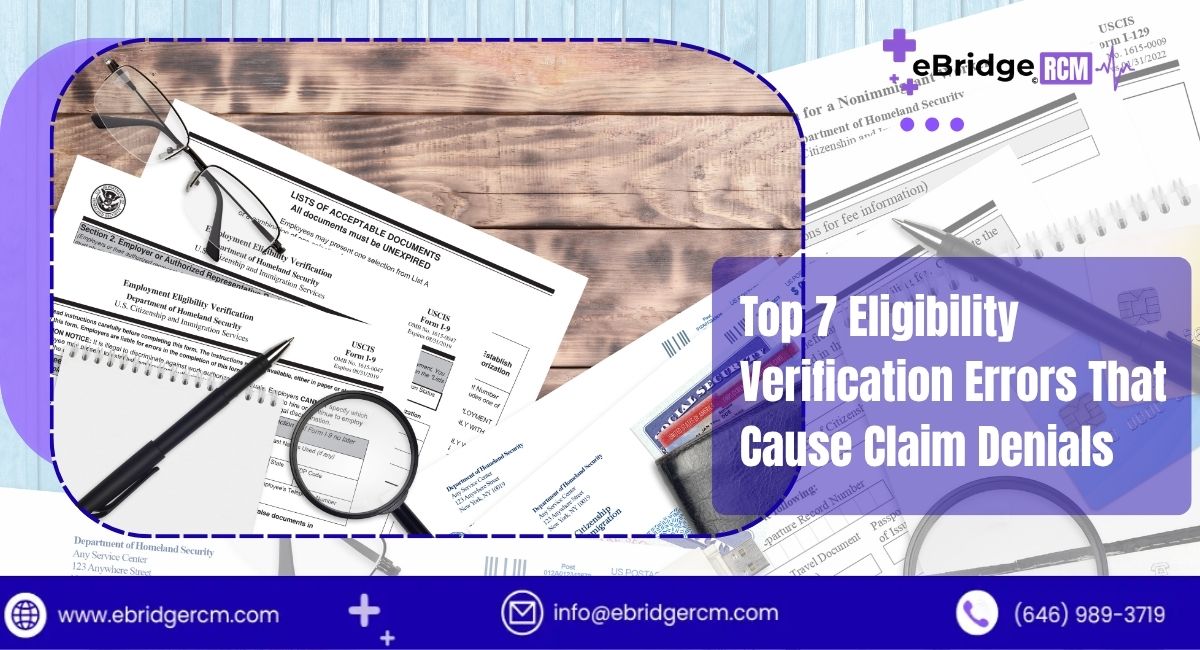
Cutting down eligibility verification errors is one of the fastest ways to raise your first-pass claim acceptance rate and strengthen overall revenue cycle management. Below, we break down the seven most common verification mistakes, why they keep happening, what they cost, and how to prevent them.
Why Eligibility Verification Matters
Eligibility verification confirms that a patient’s insurance coverage is active. It also validates the specific details a payer needs to process the claim correctly.
A thorough verification check typically confirms active coverage and effective dates, subscriber and patient demographic details, group number and plan information, and the patient’s copayment, deductible, and coinsurance amounts. It also confirms referral and prior authorization requirements, along with coordination of benefits when a patient has more than one payer.
Skip any of these steps, and the odds of a rejected claim go up.
Many practices assume returning patients still have the same coverage they had last visit. That assumption causes more denials than almost anything else. People change jobs. They age into Medicare. Their employer switches carriers during open enrollment. Insurance that was valid three months ago may not be valid today.
That’s why eligibility should be checked before every visit, not just for new patients. For a closer look at building this into your intake workflow, see our insurance eligibility verification guide.
How Eligibility Errors Ripple Through the Revenue Cycle
Insurance verification touches nearly every stage of the revenue cycle, from patient scheduling to final payment posting.
When verification is done right, practices see faster reimbursement, higher clean claim rates, fewer denials, and better cash flow. Patients also have a smoother experience, since they aren’t surprised by unexpected bills later.
When it’s done poorly, billing teams end up doing the same job twice. They contact patients to update records, correct and resubmit rejected claims, appeal denials, and chase payers for answers. None of that work generates new revenue. It just delays revenue that should have come in the first time.
The 7 Most Common Eligibility Verification Errors
1. Inactive Insurance Coverage
This is the single most common cause of administrative claim denials.
Coverage lapses happen for ordinary reasons: a new job, an employer benefits change, Medicare enrollment, a Medicaid redetermination, COBRA running out, or a marketplace plan renewal.
A real example: A patient comes in for a routine follow-up. The front desk assumes the insurance on file is still active, since the patient was seen six months ago. What nobody catches is that the employer switched carriers during open enrollment. The claim goes to the old payer and bounces immediately, since coverage ended before the date of service. A two-minute eligibility check would have caught this before the appointment even started.
How to prevent it: Verify eligibility before every appointment, not just new-patient visits. Ask for an updated insurance card at least once a year. Confirm effective and termination dates during check-in, and use real-time eligibility verification software (an EDI 270/271 transaction) instead of relying on what’s already saved in the chart.
2. Incorrect Policyholder Information
A lot of patients are covered under someone else’s policy, a spouse, a parent, an employer plan, or a legal guardian. When that subscriber’s details are entered wrong, the claim fails.
Typical errors include the wrong subscriber name, a mistyped member ID, an incorrect relationship to the subscriber, or an outdated employer name. Because payers validate subscriber data electronically, even one wrong character can trigger a rejection.
A real example: A child is covered under a parent’s policy. Registration staff accidentally lists the child as the subscriber instead of the parent. The visit is fully covered, but the claim still gets rejected, because the subscriber information doesn’t match what the payer has on file.
How to prevent it: Always compare subscriber details against the physical insurance card, not the patient’s memory. Confirm the policyholder relationship at every visit, and don’t rely solely on data pulled from a previous encounter. For more on this specific failure point, see our article on subscriber mismatch denials.
3. Group Number Errors
The group number tells the payer which employer or plan a patient’s benefits belong to. It looks like a minor detail, but it causes real payment delays.
Common causes include a missing group number, a simple typo, an outdated employer reference, or the wrong plan selected from a list of similarly named options. Some insurers use nearly identical plan names with different group numbers attached, which makes manual entry risky.
A real example: A patient changes employers but stays with the same insurance carrier. Both the member ID and the group number change. Registration only updates the member ID. The claim later fails, because the old group number doesn’t match the new employer’s plan.
How to prevent it: Scan insurance cards instead of hand-keying the numbers. Cross-check both the subscriber ID and the group number, and confirm plan details through the payer’s eligibility portal when something looks unfamiliar.
4. Coordination of Benefits Issues
Patients with more than one insurance plan need accurate coordination of benefits, meaning the correct primary and secondary payer order.
Mistakes here include billing the secondary payer first, forgetting that Medicare is primary in certain situations, misassigning employer coverage, or billing an accident-related claim to health insurance instead of auto or liability coverage. These errors almost always trigger an automatic rejection.
A real example: A patient has both Medicare and an employer-sponsored plan. Billing staff send the claim to the employer plan first. The payer rejects it, since Medicare rules require Medicare to process the claim first in this scenario. The whole billing cycle has to start over, and reimbursement is delayed by weeks.
How to prevent it: Ask every patient about additional coverage at every visit, not just at intake. Confirm primary and secondary payer order, and update coordination of benefits information annually or whenever a patient mentions a life change.
Why Front Desk Verification Is the First Line of Defense
The registration desk is the earliest point where a billing error can be caught, or missed entirely.
Front desk teams work under real pressure. Appointments run late. Patients forget their insurance cards. Phones don’t stop ringing. New patient paperwork stacks up. Under that kind of pressure, shortcuts start to feel reasonable, even though they rarely are.
Common front desk shortcuts that cause denials include accepting verbal insurance details instead of checking the card, skipping eligibility checks for returning patients, and assuming coverage from the last visit is still valid. Each of these small oversights raises the risk of an administrative denial down the line.
Investing in front desk training pays off across the entire revenue cycle, since a well-run registration desk prevents far more denials than any downstream fix.
The Hidden Financial Cost of Verification Errors
Most practices track denied claim totals. Fewer track the hidden labor cost behind each one.
A single rejected claim usually requires manual investigation, a call or message to the patient, a fresh eligibility check, a correction, resubmission, and follow-up on payment status. Even when the payer eventually pays, staff have already spent time fixing something that didn’t need to be broken in the first place.
As denial rates climb, practices typically see higher accounts receivable, slower cash flow, higher labor costs, lower staff productivity, and a worse patient experience. Practices sitting on a growing pile of unpaid claims often turn to dedicated AR recovery services in Texas to work down aging balances instead of letting them stall out. Preventing these errors up front is almost always cheaper than correcting them after the fact.
5. Incorrect Patient Demographic Information
Demographic errors seem small, but they’re a major reason claims fail to match a payer’s member record. Most payer systems require an exact match between the claim and their enrollment database.
Common mistakes include a misspelled name, a wrong date of birth, an incorrect gender marker, an outdated address, or a missing suffix like Jr. or III. One wrong character is enough to trigger a rejection before the claim reaches adjudication.
A real example: A patient recently got married and changed her last name. Her insurance company already updated its records, but the provider’s system still shows her maiden name. The claim goes out under the old name. Even though coverage is active, the payer rejects it, since the member information doesn’t match.
How to prevent it: Confirm demographic details at every visit and ask patients directly whether anything has changed. When appropriate, compare the insurance card against a government-issued ID, and update the EHR immediately once a change is confirmed. Our breakdown of demographic claim denials walks through more of these scenarios in detail.
6. Missing Referral or Prior Authorization Verification
Checking active coverage isn’t the whole job. Staff also need to confirm whether the scheduled service requires a referral or prior authorization. This step gets skipped more often than any other.
Services that commonly require prior authorization include specialist referrals, imaging studies, outpatient surgery, physical therapy, and durable medical equipment. A patient can have perfectly active insurance and still get a denied claim if the authorization was never obtained.
A real example: A patient is scheduled for an MRI. Eligibility confirms active coverage, so the visit goes ahead as planned. After the claim is submitted, the payer denies it, because prior authorization was never requested. The service was performed correctly. Payment is delayed anyway, because of one missed administrative step.
Learn more in our guide on prior authorization billing guide.
7. Failure to Verify Payer-Specific Requirements
Insurance companies don’t all play by the same rulebook. Two patients with similar-looking coverage can still need different documentation, referral steps, or claim formatting.
This includes different authorization thresholds, plan-specific filing instructions, telehealth coverage limits, and network participation rules. Submitting a claim without checking these payer-specific policies is a common and preventable source of denials.
A real example: A practice bills a preventive visit using the correct CPT code. The patient’s specific plan requires an extra modifier for reimbursement. Because the modifier is missing, the claim is rejected, even though the patient has active coverage.
How to prevent it: Keep payer guidelines current and accessible to your team. Check benefits before every appointment through payer portals, and train billing staff regularly on the major commercial and government plans you see most often.
Best Practices for Reducing Eligibility Verification Errors
Cutting down on these errors takes consistency across scheduling, registration, billing, and revenue cycle management. Everyone on the team should follow the same standard, every time.
Verify coverage before every visit. Don’t assume insurance is unchanged, even for a patient you saw last week. Check eligibility before new appointments, before follow-ups, before procedures, at the start of each calendar year, and whenever a patient mentions a job or insurance change. Real-time eligibility verification cuts down denials caused by inactive coverage more than almost any other single fix.
Standardize your registration process. New patients and returning patients should go through the same verification steps. A standardized workflow reduces the variation between staff members and improves data accuracy across the board.
Eligibility Verification Checklist
| Verification Item | Purpose |
| Confirm patient identity | Prevent demographic mismatches |
| Verify active insurance | Ensure coverage is valid |
| Confirm subscriber information | Reduce member ID errors |
| Verify group number | Prevent employer plan mismatches |
| Review coordination of benefits | Bill the correct payer first |
| Check referrals and authorizations | Avoid administrative denials |
| Confirm patient financial responsibility | Improve collections |
Use integrated technology. Modern practice management software, EHR systems, eligibility verification portals, clearinghouse validation, and automated claim scrubbing all reduce manual error. Practices with integrated billing systems consistently post higher clean claim rates than those relying on manual lookups. Working with a partner that offers dedicated clearinghouse solutions in USA gives your team real-time eligibility checks and claim scrubbing without building that infrastructure in-house.
Train front desk and billing teams together. Eligibility verification isn’t only a front-desk job. Receptionists, registration staff, medical billers, coders, practice managers, and revenue cycle specialists all need to understand how a small front-end mistake turns into a downstream denial. Cross-functional training closes that gap.
Are You Ready to Simplify Eligibility Verification?
Verify patient coverage accurately and reduce delays, denials, and unexpected billing issues.
Monitor eligibility-related denials. Review denial reports regularly to catch recurring issues before they become expensive. Useful metrics include your eligibility denial rate, first-pass claim acceptance rate, registration error percentage, clean claim rate, average payment turnaround, and total rejected claim volume. Tracking these key performance indicators helps you fix small problems before they turn into real revenue leaks.
Common Eligibility Verification Errors and Solutions
| Error | Impact | Best Solution |
| Inactive insurance | Claim rejection | Verify eligibility before every visit |
| Incorrect policyholder | Member mismatch | Confirm subscriber details from insurance card |
| Group number error | Incorrect plan validation | Verify employer information and group number |
| Coordination of benefits issue | Wrong payer billed | Review primary and secondary insurance |
| Demographic error | Member identification failure | Update patient information every visit |
| Missing authorization | Administrative denial | Verify referral and authorization requirements |
| Payer-specific rule missed | Claim rejection | Review payer policies before submission |
Frequently Asked Eligibility Verification Errors Questions
1. What are eligibility verification errors?
Eligibility verification errors occur when patient insurance information is inaccurate, incomplete, or not verified before services are provided, often leading to claim denials or payment delays.
2. Why is inactive insurance one of the most common denial reasons?
Patients change coverage more often than practices expect, through new jobs, annual renewals, Medicare enrollment, or Medicaid eligibility updates. Without a fresh check before each visit, it’s easy to bill a plan that’s no longer active.
3. How often should insurance eligibility be verified?
Before every appointment, for every patient, whether they’re new or established.
4. Can incorrect group numbers cause claim denials?
Yes. A wrong or outdated group number can prevent the payer from locating the correct employer-sponsored plan, which results in a rejected claim.
5. What is coordination of benefits?
It’s the process that determines which insurance plan pays first when a patient has more than one active policy. Getting the payer order wrong is a common cause of administrative denials.
6. Does technology eliminate eligibility verification errors?
No. Technology cuts down on manual mistakes significantly, but accurate registration and well-trained staff are still what keep claims clean.
Final Words
Eligibility verification is one of the most important steps in medical billing, and one of the easiest to underestimate. A small oversight at registration can delay reimbursement, add hours of rework for your billing team, and frustrate patients who end up with unexpected bills.
The errors covered here, inactive coverage, incorrect policyholder details, group number mistakes, coordination of benefits issues, demographic errors, and missed authorizations, are almost all preventable with the right process in place.
Standardized verification workflows, real-time eligibility checks, front desk training, integrated billing technology, and regular denial monitoring all move the needle. Practices that invest here see higher clean claim rates and a lighter administrative burden across the entire revenue cycle.
Partner with eBridge RCM LLC
If your practice keeps running into eligibility verification errors, delayed reimbursements, or rising denial rates, eBridge RCM LLC can help. Our certified professional team of medical billing services in Georgia , New York, California across USA, works alongside Credentialing Services, Medical Coding Services, Clearinghouse Solutions, and Monthly Billing Audits, all built to improve claim accuracy and strengthen revenue cycle performance.
Whether you run a single-provider office or a growing multi-specialty group, we help simplify eligibility verification, reduce denials, and get you paid faster.