
Why Billing Has Become the Breaking Point for Mental Health Practices
Running a mental health practice today is not just about patient care. It is also about surviving the administrative complexity that comes with insurance-driven healthcare systems. Many providers enter private practice expecting clinical work to be the primary focus, only to discover that billing, coding, credentialing, claim submissions, and denial management consume a large portion of their time and revenue stability.
For mental health practices, this challenge is even more pronounced. Reimbursement cycles are often longer, payer rules change frequently, and documentation requirements continue to tighten. A single error in coding or eligibility verification can delay payments for weeks or result in full claim rejections.
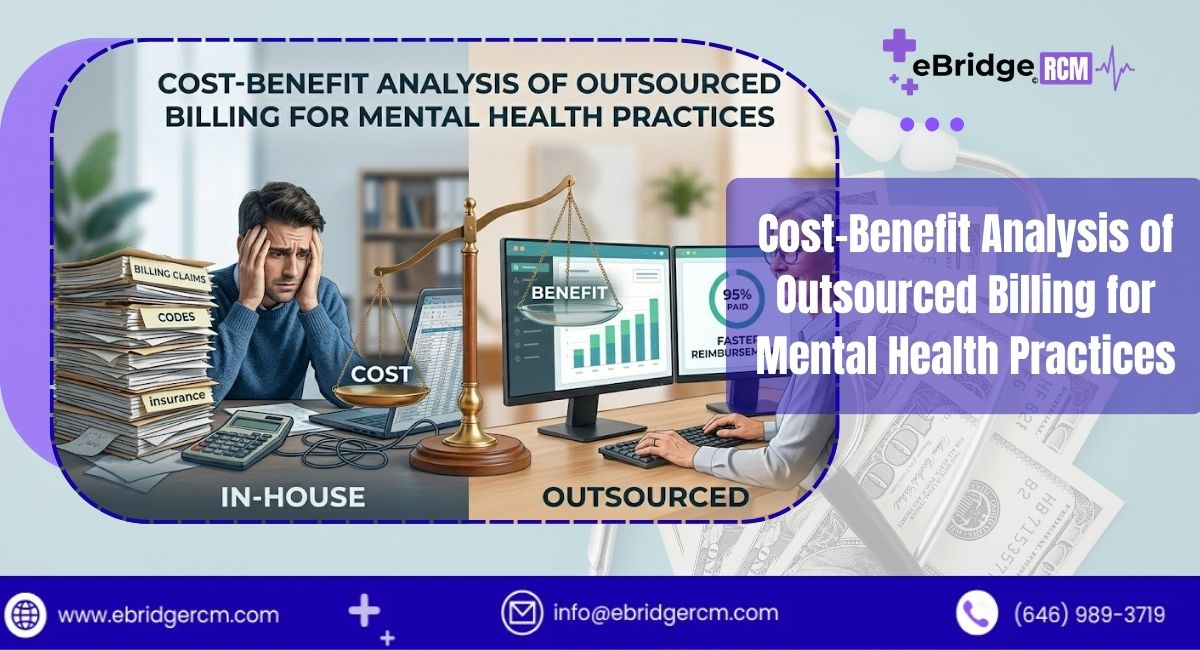
This is where the debate around outsourced billing becomes critical. Should a mental health practice maintain an in-house billing team or shift to outsourced revenue cycle management services?
The answer is not purely operational. It is financial, strategic, and deeply tied to long-term practice sustainability.
Outsourced billing is not just a convenience. It is a structured financial model that can significantly affect profitability, denial rates, compliance risk, and administrative workload. At the same time, it introduces service fees and dependency on external partners.
This article provides a detailed cost-benefit analysis of outsourced billing for mental health practices, helping you understand whether it improves or reduces overall financial performance.
The Financial Reality of Mental Health Billing Today
Mental health billing operates in a uniquely complex reimbursement environment. Unlike many other specialties, behavioral health claims often involve:
- Session-based billing with strict time documentation
- Frequent payer authorization requirements
- Variable reimbursement rates across insurance plans
- High claim rejection rates due to coding errors or missing documentation
These factors create a billing ecosystem where revenue leakage is common.
Many practices struggle with:
- Delayed reimbursements due to prior authorization bottlenecks
- High Accounts Receivable (AR) days
- Denials linked to incorrect CPT coding such as psychotherapy time-based codes
- Inefficient eligibility verification processes
- Understaffed billing departments
A useful reference point is the broader revenue optimization strategies discussed in revenue cycle tips for mental health providers, which highlights how small inefficiencies compound into major revenue losses over time.
Understanding this baseline is essential before evaluating outsourcing.
What Outsourced Billing Actually Means in Mental Health Practices
Outsourced billing refers to delegating all or part of the revenue cycle management process to a specialized external company. These companies manage:
- Medical coding and charge entry
- Claims submission
- Payment posting
- Denial management
- Insurance follow-ups
- Patient billing and statements
- Reporting and analytics
In mental health practices, outsourcing often extends to specialty workflows such as:
- Behavioral health CPT coding
- Telehealth billing compliance
- Insurance credentialing support
- Prior authorization tracking
Many practices also combine billing outsourcing with medical billing services and AR recovery services to ensure end-to-end revenue optimization.
The key distinction is that outsourced billing is not just administrative support. It is a structured revenue engine managed externally with defined performance metrics.
Cost Structure Comparison: In-House vs Outsourced Billing
To understand the financial implications clearly, it is necessary to break down both models.
In-House Billing Cost Breakdown
| Cost Component | Estimated Monthly Cost Range | Notes |
| Billing staff salary | High | Depends on experience |
| Training and onboarding | Medium | Ongoing requirement |
| Billing software (EHR/RCM tools) | Medium | Subscription-based |
| Claim clearinghouse fees | Low to Medium | Transaction-based |
| HR overhead | Medium | Benefits, taxes, compliance |
| Turnover cost | High | Frequent in billing roles |
In-house billing often appears cheaper at first glance. However, hidden costs such as turnover, training, and denied claim recovery inefficiencies significantly increase the total burden.
A deeper breakdown of staffing transitions is available in transitioning from solo provider to group practice, which highlights how administrative complexity increases with scale.
Outsourced Billing Cost Structure
Outsourced billing typically follows a percentage-based or hybrid pricing model:
- Percentage of monthly collections (commonly 4 percent to 9 percent)
- Flat fee per claim or per provider
- Hybrid models combining base fee plus performance incentives
While this appears like an added expense, it replaces multiple internal costs.
Outsourcing eliminates:
- Payroll burden for billing staff
- Software licensing fees in many cases
- Training and compliance costs
- Infrastructure overhead
It also introduces performance accountability, since billing companies are incentivized to improve collections.
The Real Cost-Benefit Equation
A meaningful cost-benefit analysis must go beyond surface-level expenses.
Key Financial Metrics Impacted by Outsourcing
- Clean claim rate
- Days in Accounts Receivable (AR)
- Denial rate
- Collection percentage
- Cost to collect per dollar
- Revenue leakage reduction
Outsourcing typically improves all six metrics due to specialization and process automation.
Below is a simplified ROI comparison.
Table 2: ROI Impact Comparison
| Metric | In-House Billing | Outsourced Billing |
| Clean claim rate | Moderate | High |
| Denial rate | Higher variability | Lower due to scrubbing |
| AR days | 40 to 70 days | 20 to 40 days |
| Revenue leakage | Moderate to high | Low |
| Cost predictability | Low | High |
These improvements directly affect cash flow stability, which is critical for mental health practices operating on insurance reimbursements.
For broader context, see benefits of outsourcing RCM vs in-house billing.
Hidden Costs Most Practices Overlook
Many mental health providers underestimate the hidden financial burden of in-house billing.
1. Claim Rework and Denial Management
Denied claims require additional staff time, follow-ups, and resubmissions. Without specialized denial workflows, practices lose revenue silently.
A strong denial prevention strategy is outlined in proven strategies to reduce denials.
2. Staff Turnover Costs
Billing staff turnover is common due to workload pressure and complexity. Every replacement cycle introduces:
- Training costs
- Productivity loss
- Temporary claim backlog
3. Technology Fragmentation
Many practices use disconnected systems:
- EHR platforms
- Billing software
- Clearinghouses
Integration gaps lead to errors and delays. This issue is further explained in integration mistakes in EHR billing.
4. Compliance Risks
Mental health billing must comply with HIPAA, payer rules, and documentation standards. Errors can lead to audits or penalties.
A compliance-focused approach is detailed in medical billing compliance checklist.
Why Outsourced Billing Works Better for Mental Health Practices
Outsourced billing companies specialize in high-volume claim processing and payer-specific rules. This specialization creates efficiency advantages.
1. Behavioral Health Coding Expertise
Mental health billing involves nuanced CPT codes such as:
- 90832 (30-minute psychotherapy)
- 90834 (45-minute psychotherapy)
- 90837 (60-minute psychotherapy)
Incorrect usage leads to immediate rejections.
Specialized billing teams reduce these errors significantly.
2. Faster Insurance Credentialing and Enrollment
Credentialing delays often block revenue before services even begin. Outsourced teams streamline this process.
Related insights are available in insurance credentialing for mental health providers.
3. Improved Revenue Cycle Visibility
Outsourced billing platforms often include dashboards that track:
- Claims status
- Payment timelines
- Denial patterns
- Payer behavior trends
This level of visibility is difficult to maintain in-house without advanced systems.
Role of Technology in Outsourced Billing Efficiency
Modern outsourced billing is powered by integrated technology systems, including:
- Electronic Health Records (EHRs)
- Revenue Cycle Management (RCM) platforms
- Clearinghouses for claim validation
- Automated eligibility verification tools
Cloud-based infrastructure improves scalability and reduces operational friction.
A detailed explanation of this transformation is available in benefits of migrating to cloud RCM solutions.
These systems also reduce manual intervention, which directly lowers error rates.
Strategic Benefits Beyond Cost Savings
While cost is important, outsourced billing also delivers strategic advantages.
1. Scalability for Growing Practices
As patient volume increases, billing complexity rises. Outsourced teams scale instantly without hiring delays.
2. Focus on Clinical Care
Providers spend less time on administrative follow-ups and more time on patient outcomes.
3. Predictable Revenue Flow
Consistent billing cycles reduce financial uncertainty, making budgeting easier.
4. Data-Driven Decision Making
Billing partners provide analytics that help identify:
- High-performing services
- Underpaid insurance contracts
- Operational bottlenecks
When Outsourcing May Not Be Ideal
Outsourced billing is not always the right choice.
Situations where in-house billing may still work:
- Very small solo practices with low claim volume
- Practices with highly specialized internal billing expertise
- Organizations requiring full operational control over billing workflows
However, even in these cases, hybrid models are increasingly common.
Decision Framework for Mental Health Practices
To decide whether outsourcing makes sense, evaluate the following:
- Monthly claim volume
- Current denial rate
- AR aging trends
- Staffing stability
- Technology maturity
- Compliance risk exposure
If two or more of these areas show inefficiency, outsourcing typically delivers measurable improvement.
A related operational guide is outsourcing RCM for small and mid practices.
Real-World Scenario: Before and After Outsourcing
A mid-sized mental health practice managing 5 providers faced:
- 65-day AR cycle
- 12 percent denial rate
- One full-time billing staff member overwhelmed with rework
After outsourcing billing:
- AR reduced to 32 days
- Denial rate dropped to 5 percent
- Monthly collections stabilized
- Staff reallocated to patient coordination
The financial improvement was not only in revenue increase but also in operational stability.
Implementation Steps for Outsourcing Billing
Transitioning to outsourced billing requires structured execution:
- Audit current billing performance
- Identify payer mix and denial patterns
- Select a specialized mental health billing partner
- Migrate data from EHR and billing systems
- Set KPIs such as AR days and clean claim rate
- Monitor monthly performance reports
For best practices, refer to end-to-end RCM solutions revenue.
FAQs
1. Is outsourced billing cost-effective for small mental health practices?
Yes, especially when denial rates or AR delays are high. Even small practices often recover revenue lost due to billing inefficiencies.
2. What percentage do billing companies usually charge?
Most charge between 4 percent and 9 percent of monthly collections depending on services included.
3. Does outsourcing reduce control over billing?
Operational control decreases, but financial visibility often improves through reporting dashboards.
4. How quickly can outsourced billing improve revenue cycle performance?
Many practices see improvements within 60 to 90 days after full implementation.
5. Can outsourced billing integrate with existing EHR systems?
Yes, most modern billing companies integrate with major EHR platforms and clearinghouses.
The Financial Logic Behind Outsourced Billing
Outsourced billing for mental health practices is not simply an administrative decision. It is a financial strategy that directly affects revenue stability, operational efficiency, and long-term scalability.
When evaluated through a cost-benefit lens, outsourcing often reduces hidden inefficiencies, improves cash flow, and strengthens compliance performance. While it introduces service fees, these costs are typically offset by reduced denial rates, faster reimbursements, and lower internal overhead.
For practices aiming to optimize revenue cycles and reduce administrative burden, structured support from specialized providers becomes essential.
Organizations like eBridge RCM LLC offer end-to-end revenue cycle solutions tailored for mental health practices, including billing, credentialing, coding, and AR recovery support.
For practices looking to improve billing efficiency, strengthen compliance, and stabilize revenue, outsourcing is not just a cost decision. It is an operational upgrade that reshapes financial performance.