
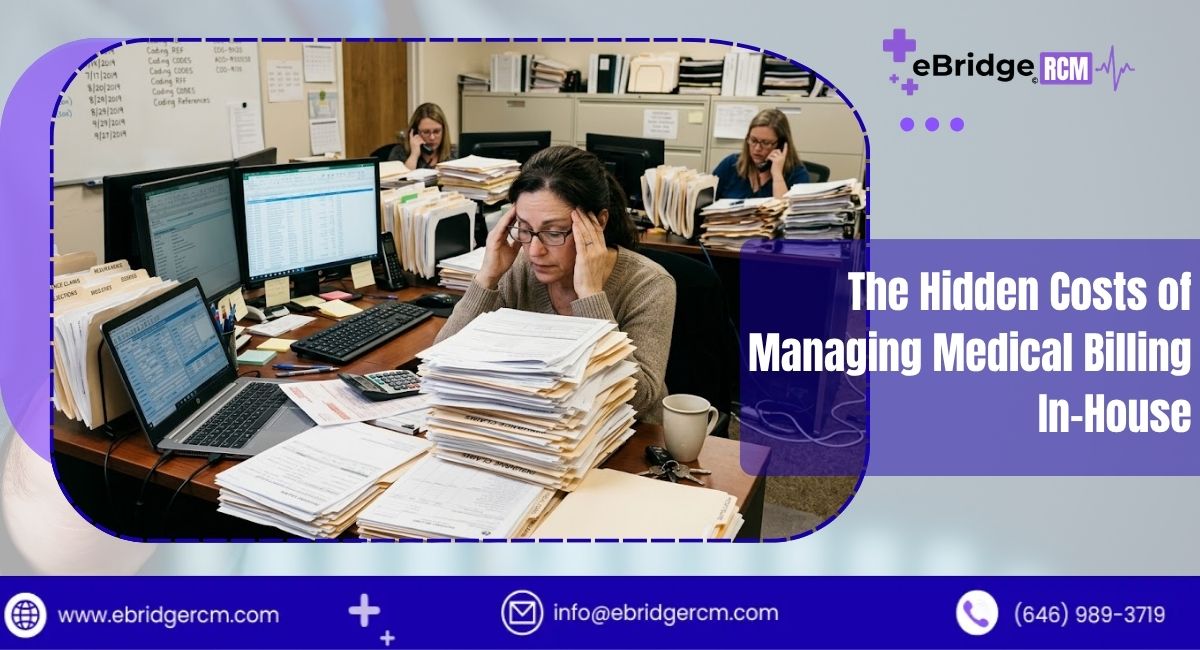
When “Keeping Billing In-House” Quietly Becomes Expensive
On the surface, managing medical billing in-house feels like control. You have your own staff, your own process, and direct oversight of claims, payments, and patient accounts. Many practices assume it is the most cost-efficient model because there is no third-party billing fee.
But in real healthcare operations, the actual cost of in-house billing rarely shows up in one place. It is scattered across staffing inefficiencies, denied claims, compliance risks, software expenses, and delayed reimbursements. Over time, these hidden costs can quietly reduce revenue far more than outsourcing ever would.
For many clinics and private practices, especially those navigating complex payer rules, ICD-10 coding updates, and evolving compliance standards under CMS guidelines, the real issue is not billing itself. It is the infrastructure required to do it correctly every single day.
This article breaks down those hidden costs in detail, showing where money is lost, why it happens, and what practices can do to regain control of their revenue cycle without increasing operational burden.
Why In-House Medical Billing Still Looks Attractive
Many practices initially prefer in-house billing for reasons that feel logical:
- Direct control over billing operations
- Immediate access to billing staff
- Perception of lower long-term cost
- Easier communication between providers and billers
However, these advantages only hold true in ideal conditions. In real practice environments, especially where patient volume fluctuates and payer rules change frequently, the model starts to strain.
Revenue cycle management is not just claim submission. It includes eligibility checks, coding accuracy, claim scrubbing, denial management, payment posting, and AR follow-up. Each layer requires specialized knowledge and constant updating.
When these responsibilities sit inside a small in-house team, the system becomes fragile.
This is where many practices begin to experience inefficiencies that are not immediately visible on financial statements.
The True Cost Structure of In-House Medical Billing
To understand the hidden burden, it helps to break down the real cost categories that practices often underestimate.
Staffing and Salary Costs
Hiring a medical biller is only the beginning. A fully functional in-house billing setup often requires:
- Certified medical coders
- Billing specialists
- AR follow-up staff
- Credentialing support
- Billing manager or supervisor
Each role carries salary, benefits, training, and replacement costs.
Technology and Software Costs
Modern billing requires multiple systems working together:
- Electronic Health Record systems like Epic, Cerner, or Athenahealth
- Practice Management Systems
- Clearinghouses for claim transmission
- Scrubbing tools for coding validation
- Compliance and reporting dashboards
Integration errors between these tools are common and often lead to revenue leakage.
Training and Compliance Costs
Healthcare regulations change frequently. ICD-10 updates, CPT revisions, and payer policy shifts require constant training. HIPAA compliance also demands security infrastructure and periodic audits.
Without ongoing training, coding accuracy declines, and denial rates increase.
Administrative Overhead
Time spent on billing administration, coordination, and internal corrections does not directly generate revenue but still consumes significant resources.
Hidden Operational Inefficiencies That Drain Revenue
Even when staffing and systems are in place, in-house billing often suffers from structural inefficiencies.
One of the most common issues is workflow fragmentation. Front desk teams, providers, and billing staff often operate in silos. This creates gaps in:
- Patient eligibility verification
- Charge capture accuracy
- Documentation completeness
- Claim submission timing
Over time, these inefficiencies create backlogs in accounts receivable and increase Days in AR.
For deeper insight into how billing structures impact financial flow, practices often benefit from reviewing concepts like revenue cycle management vs medical billing, which explains how fragmented workflows impact overall revenue performance.
Denials, Errors, and the Cost of Rework
Claim denials are one of the most expensive hidden costs in in-house billing systems. Every denied claim requires:
- Staff time for investigation
- Documentation review
- Resubmission or appeal
- Follow-up with payers
Common denial triggers include:
- Incorrect CPT or ICD-10 coding
- Missing prior authorization
- Eligibility issues
- Timely filing failures
- Incomplete documentation
A high denial rate does not just delay payments, it multiplies labor costs.
Many practices try to fix this internally, but without structured systems like top medical billing denial prevention strategies, the cycle repeats.
Even a small increase in denial rate can significantly reduce annual revenue without being immediately visible.
Technology Gaps and Integration Costs
Modern healthcare billing depends heavily on integrated systems. When EHR and billing systems are not properly aligned, errors multiply.
Common integration challenges include:
- Duplicate data entry
- Mismatched patient demographics
- Delayed charge posting
- Incomplete claim transmission
- Lack of real-time eligibility validation
Many practices underestimate how costly these integration issues become over time.
A deeper breakdown of this problem can be seen in discussions about EHR billing integration mistakes, which highlight how system misalignment leads to financial leakage.
Without proper integration, even the best billing staff cannot prevent revenue delays.
Turnover, Training, and Knowledge Loss
One of the most overlooked costs in in-house billing is employee turnover.
Medical billing is a high-pressure role. Staff deal with:
- Denied claims
- Complex payer rules
- Tight deadlines
- Constant policy updates
Turnover leads to:
- Hiring and onboarding costs
- Training time loss
- Temporary productivity drops
- Increased error rates during transitions
When experienced billing staff leave, institutional knowledge leaves with them. This creates a cycle where new employees repeat past mistakes.
For small and mid-sized practices, this instability directly affects revenue consistency.
Cash Flow Disruption and Accounts Receivable Delays
Cash flow is the backbone of any medical practice. In-house billing often struggles with maintaining consistent AR performance.
Delays occur due to:
- Late claim submissions
- Inefficient follow-up processes
- Denial backlog
- Understaffed billing teams
Even a 10 to 15 day increase in AR cycle time can significantly impact payroll planning and operational budgeting.
Practices focusing on revenue cycle challenges and solutions often identify AR inefficiency as one of the most critical bottlenecks in in-house billing models.
Cost Breakdown Snapshot: In-House Billing Reality
Below is a simplified view of how hidden costs accumulate in a typical in-house billing setup.
Table 1: Estimated Annual Hidden Costs in In-House Billing
| Cost Category | Description | Impact on Revenue |
| Staffing Costs | Salaries, benefits, turnover | High |
| Training & Compliance | ICD-10 updates, HIPAA training | Medium to High |
| Software & Integration | EHR, PMS, clearinghouse tools | High |
| Claim Denials | Rework, appeals, lost revenue | Very High |
| AR Delays | Slow reimbursement cycles | High |
| Administrative Overhead | Non-billable operational tasks | Medium |
This structure shows that the visible cost of staff is only a fraction of the total financial impact.
In-House Billing vs Outsourced RCM Model
To understand the difference clearly, it helps to compare operational outcomes rather than just cost perception.
Table 2: In-House Billing vs Outsourced Revenue Cycle Management
| Factor | In-House Billing | Outsourced RCM |
| Control | High but fragmented | Structured and centralized |
| Cost Transparency | Low visibility of hidden costs | Predictable pricing model |
| Denial Management | Reactive | Proactive |
| Scalability | Limited by staffing | Easily scalable |
| Compliance Updates | Manual tracking | Continuously managed |
| Technology Integration | Often inconsistent | Standardized systems |
Many practices transition after realizing that outsourcing aligns better with long-term financial stability.
For example, practices evaluating benefits of outsourcing RCM vs in-house billing often find that outsourcing reduces variability in revenue cycles.
Credentialing Delays and Their Financial Impact
Credentialing is another hidden cost center. When providers are not properly credentialed with payers, claims are delayed or rejected entirely.
This includes:
- Enrollment with insurance networks
- CAQH profile maintenance
- NPI validation
- Re-credentialing cycles
Delays in credentialing directly translate into delayed revenue generation.
Practices using structured credentialing services for healthcare providers often reduce onboarding delays and improve cash flow predictability.
Denial Prevention as a Revenue Protection Strategy
Preventing denials is more cost-effective than fixing them.
Effective denial prevention requires:
- Real-time eligibility checks
- Accurate coding workflows
- Prior authorization tracking
- Clean claim submission processes
Many practices rely on internal staff without structured denial frameworks, leading to recurring revenue leakage.
This is why structured medical billing denial prevention services are increasingly used as a corrective strategy rather than a reactive one.
How In-House Billing Affects Practice Growth
Growth requires scalability. In-house billing often becomes a bottleneck when:
- Patient volume increases
- New providers are added
- Additional specialties are introduced
Instead of scaling revenue, billing teams become overwhelmed, resulting in slower collections.
Practices transitioning from solo to group models often struggle with this shift, as explained in discussions like transitioning from solo provider to group practice billing structures.
Without scalable billing infrastructure, growth increases operational stress instead of revenue efficiency.
Real-World Scenario: A Small Practice Billing Breakdown
Consider a small internal medicine practice handling billing in-house.
At first, the system works smoothly with one billing staff member. As patient volume increases:
- Claims begin to backlog
- Denials increase due to missed follow-ups
- AR days extend beyond 60 days
- Staff burnout leads to turnover
Within a year, the practice realizes that “saving on outsourcing fees” has resulted in far greater revenue loss through inefficiency.
This is a common pattern across many small and mid-sized practices.
Why Hidden Costs Are Often Ignored
The biggest challenge is visibility.
Most practices track:
- Revenue collected
- Staff salaries
- Software subscriptions
But they do not track:
- Time lost per denied claim
- Revenue delayed due to AR backlog
- Cost of retraining new staff
- Lost income from coding errors
Without full visibility, decision-making becomes incomplete.
Moving Toward a More Efficient Billing Model
Improving billing performance does not always require complete outsourcing. Some practices adopt hybrid models that combine internal oversight with external RCM support.
Key improvements include:
- Automated claim scrubbing tools
- Integrated EHR and billing systems
- Dedicated denial management workflows
- Periodic billing audits
- Outsourced AR recovery support
Practices using AR recovery services for healthcare providers often see faster improvement in cash flow cycles.
Practical Steps to Reduce Hidden Billing Costs
- Audit your current billing workflow for inefficiencies
- Measure denial rates and AR days monthly
- Evaluate staff workload and turnover trends
- Upgrade or integrate billing software systems
- Consider partial outsourcing for high-volume tasks
- Implement structured compliance and coding reviews
Small operational improvements can significantly reduce revenue leakage over time.
Frequently Asked Questions
1. Why is in-house medical billing more expensive than it appears?
Because it includes hidden costs like staffing turnover, training, denied claims, and delayed reimbursements that are not directly visible in monthly expenses.
2. What is the biggest hidden cost in medical billing?
Claim denials and rework are often the most expensive due to repeated administrative effort and lost revenue delays.
3. Can small practices manage billing in-house effectively?
Yes, but only with strong systems, trained staff, and continuous compliance monitoring. Otherwise, inefficiencies build quickly.
4. How does outsourcing reduce billing costs?
It reduces staffing burden, improves denial management, and provides structured revenue cycle processes that are harder to maintain internally.
5. What role does technology play in billing costs?
Poor integration between EHR and billing systems leads to errors, duplication, and revenue leakage.
6. When should a practice consider switching from in-house billing?
When denial rates increase, AR days rise consistently, or staffing turnover begins affecting revenue stability.
The Real Cost Is Not Obvious Until It Accumulates
In-house medical billing often appears cost-effective at first glance, but the real financial impact comes from hidden inefficiencies that build over time. Staffing instability, claim denials, technology gaps, and delayed reimbursements all contribute to silent revenue loss.
The goal is not just to reduce billing expenses, but to create a stable, predictable revenue cycle that supports long-term practice growth.
Many healthcare organizations eventually transition to structured support systems like medical billing services, credentialing services, and AR recovery solutions offered by eBridge RCM LLC. These services are designed to reduce operational friction and improve financial consistency without overwhelming internal teams.
For practices aiming to strengthen their revenue cycle, exploring professional support such as medical billing outsourcing services and integrated RCM solutions from eBridge RCM LLC can be a practical next step toward stability and efficiency.