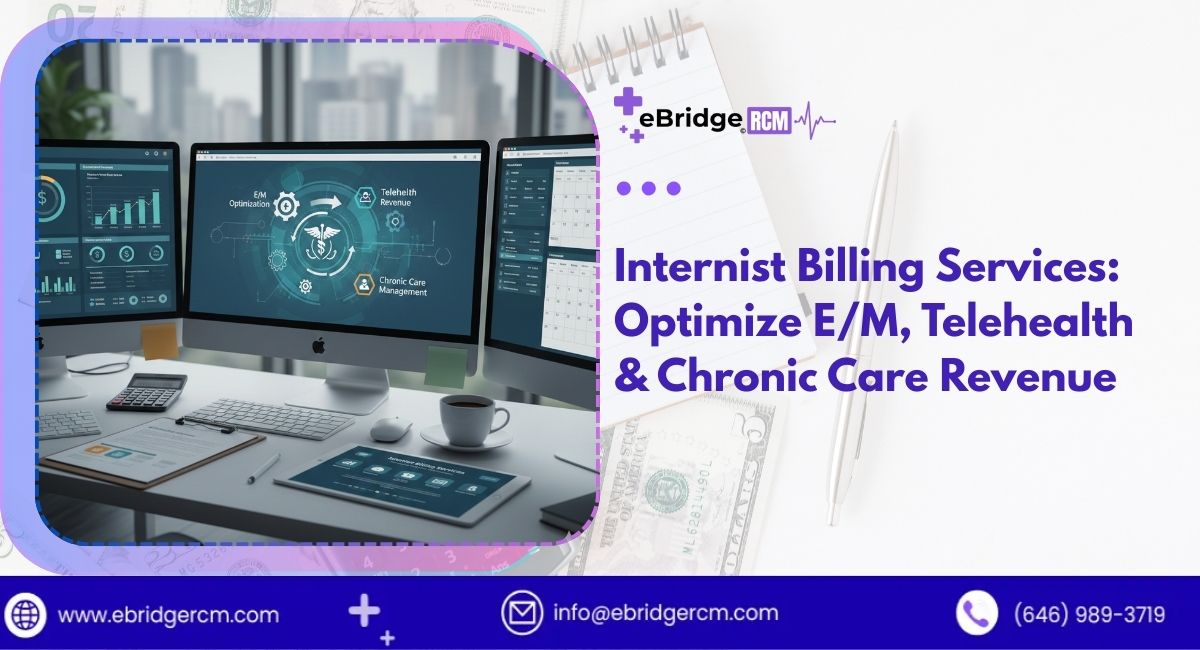
Effective revenue cycle management (RCM) for internal medicine practices depends on accurate documentation, coding, proper charge capture, and intentional workflows. Optimizing revenue for internal medicine providers involves a deep understanding of Evaluation and Management (E/M) services, telehealth visits, and chronic care management (CCM). These areas require not only correct coding but also strategic documentation and payer compliance. Practices that master these processes can significantly improve cash flow while maintaining high standards of patient care. For more insights on credentialing and its impact on revenue, our Credentialing Services for Internal Medicine Providers help ensure faster payer enrollment and smoother claims processing.
Whether you are just starting with internal medicine billing or aiming to refine your existing systems, this guide provides a comprehensive approach to enhancing revenue, minimizing claim denials, and maintaining compliance.
Understanding Internist Billing Fundamentals
Billing for internal medicine is complex due to the variety of services provided, including preventive care, management of chronic conditions, and telehealth encounters. Each service must be documented and coded accurately to reflect the medical necessity and complexity of the encounter. Revenue optimization relies on three core pillars:
- Documentation Accuracy: Ensuring the patient record fully supports billed services.
- Coding Precision: Translating clinical notes into correct CPT and ICD-10 codes.
- Efficient Claim Submission: Timely filing and active follow-up to reduce delays and denials.
Familiarity with payer-specific rules, such as insurance credentialing for US healthcare providers, and proper use of identifiers like group NPI vs individual NPI is essential for successful revenue capture.
Evaluation and Management (E/M) Services
E/M services account for a significant portion of an internist’s revenue. These codes are used for office visits, consultations, and other patient interactions where assessment, diagnosis, and management decisions are made. Correct coding requires careful attention to history, physical examination, and medical decision making (MDM).
Errors in E/M coding are common and can include:
- Using a higher-level code without adequate documentation
- Failing to capture non-face-to-face time for time-based coding
- Incomplete or unclear MDM documentation
A structured approach involves using documentation checklists aligned with CMS and payer guidelines. Templates that capture the key elements of each visit not only support accurate billing but also simplify audits.
Telehealth Billing
Telehealth has become an integral component of internal medicine, providing convenient access for follow-ups, chronic condition monitoring, and preventive care. However, telehealth billing presents unique challenges, as different payers may require specific modifiers, place of service codes, or documentation standards.
Best practices for telehealth billing include:
- Applying the correct telehealth modifier (e.g., 95) and place of service
- Documenting the technology used and patient consent
- Ensuring payer coverage for telehealth visits
- Capturing time and clinical decisions when billing time-based codes
Accurate telehealth documentation mitigates the risk of claim denials and ensures compliance with Medicare and commercial insurance guidelines. For guidance on integrating telehealth services into billing workflows, top outsourced medical billing companies in New York can provide specialized support.
Chronic Care Management (CCM) Billing
CCM services allow internists to be reimbursed for ongoing patient care beyond face-to-face visits, particularly for patients with multiple chronic conditions. Billing for CCM requires meticulous documentation of care coordination, medication management, and patient engagement.
Key requirements include:
- Eligibility verification (patients with two or more chronic conditions)
- Obtaining informed consent
- Maintaining structured care plans
- Documenting time spent on non-face-to-face activities
Since CCM often involves repeated monthly engagement, tracking total clinical time and providing detailed notes are critical. Proper billing for CCM can significantly increase revenue while improving patient outcomes.
Documentation Standards
Accurate documentation underpins all billing activities. Internists should capture:
- Chief complaint, history, and objective findings
- Assessment and clinical reasoning
- Medical decision making, including risk stratification
- Time spent when using time-based codes
Telehealth and remote services require additional documentation, including the platform used, patient consent, and clinical interventions provided. Practices can benefit from creating internal guides that consolidate payer-specific telehealth requirements.
Coding Table for Internal Medicine Billing
| Service Category | Common Codes | Documentation Focus |
| E/M Office Visits | 99202‑99215 | History, MDM, Time |
| Telehealth Visits | 99201‑99215 + Modifier 95 | Technology, Time, Consent |
| Chronic Care Management | 99490, 99439 | Care Plan, Time, Consent |
| Preventive Visits | 99381‑99397 | Preventive history, screenings |
| Prolonged Services | 99417 | Time beyond E/M level |
This table serves as a reference to ensure correct code selection and documentation focus.
Denial Management and Rebilling
Denied claims can substantially impact revenue if not addressed promptly. Common denial reasons include:
- Incorrect modifiers or place of service codes
- Insufficient documentation to support medical necessity
- Timely filing limits exceeded
- Errors in patient demographic information
Tracking denials by payer and reason allows practices to implement corrective measures. Re-educating staff and revising internal workflows reduces repeated errors. Practices can leverage resources like the medical billing compliance checklist to audit and standardize documentation and submission processes.
Credentialing and Its Impact on Revenue
Credentialing ensures that providers are authorized to bill specific payers and receive accurate reimbursement. Delays in credentialing can lead to denied claims or reduced payment rates. Partnering with experts in credentialing services for internal medicine providers can accelerate payer enrollment, manage re-credentialing, and maintain compliance, directly affecting practice revenue.
Staff Training and Workflow Optimization
A coordinated effort between providers and billing staff improves both accuracy and efficiency. Internal medicine practices should prioritize:
- Regular training on E/M, telehealth, and CCM documentation
- Updating coding guides and templates according to current CPT and ICD-10 standards
- Continuous feedback loops between coders and clinicians
Effective staff communication reduces errors, speeds up claim submission, and ensures coding compliance.
Technology Integration
EHR and practice management systems are essential for streamlined billing. Integrating documentation with billing modules ensures claims are clean before submission.
Key technology considerations:
- Use EHR templates aligned with billing requirements
- Automate claim scrubbing to reduce errors
- Track claims through dashboards for timely follow-up
- Leverage analytics to monitor revenue trends and service utilization
For practices looking to optimize EHR integration, EMR integration services ensure seamless data flow between clinical documentation and billing.
Contract Awareness and Reimbursement Optimization
Understanding managed care contracts is critical for maximizing revenue. Providers should monitor:
- Fee schedules for E/M, telehealth, and CCM codes
- Reimbursement rules for complex patients
- Timely filing limits
- Modifiers required for telehealth or remote services
Regular review and negotiation of contracts prevent underpayment and help align reimbursement with resource use.
Legal Compliance and Audit Readiness
Compliance reduces regulatory risk and prevents revenue loss. Internal audits focusing on E/M, telehealth, and CCM documentation help identify issues before external reviews. Common audit areas include:
- Correct E/M code levels
- Modifier application
- Telehealth documentation
- CCM consent and care plan records
Corrective action plans and staff training following audits ensure compliance continuity.
Patient Communication and Transparency
Transparent communication improves patient satisfaction and reduces delayed payments. Practices should clearly outline:
- Copays, deductibles, and coverage for telehealth visits
- Potential costs associated with chronic care management
- Billing expectations during follow-up care
Patient portals can facilitate access to statements, cost estimates, and reminders, enhancing the overall experience.
Revenue Sustainability Strategies
Internists should adopt a forward-looking approach to revenue:
- Monitor updates to CPT codes and telehealth reimbursement policies
- Explore remote monitoring opportunities
- Participate in quality reporting programs that offer financial incentives
Operational efficiency, such as optimized scheduling and workflow, also contributes to sustainable revenue growth.
Internist Billing Checklist
| Step | Action |
| Eligibility verification | Confirm insurance before encounters |
| Documentation | Capture clinical details supporting billed codes |
| Code selection | Apply appropriate CPT/HCPCS codes |
| Modifiers & POS | Correctly use telehealth or time-based modifiers |
| Claim submission | File promptly and monitor status |
| Denial analysis | Track trends and implement corrections |
| Staff training | Keep coding and documentation knowledge updated |
Final Words
Billing for internal medicine is a multi-layered process requiring precise documentation, accurate coding, and compliance with payer policies. Optimizing revenue from E/M, telehealth, and CCM services depends on effective workflows, staff training, technology integration, and credentialing. Leveraging credentialing services for internal medicine providers and expert RCM solutions can help reduce denials and improve cash flow.
For practices seeking professional support, eBridge RCM LLC offers comprehensive medical billing, credentialing, and revenue cycle management services designed specifically for internal medicine practices. Explore our medical billing services to enhance your practice revenue and streamline workflows.
Also Check : Best medical coding outsourcing companies in New York