
A three-clinician psychiatry practice already serves patients in three states. Referral requests keep coming from others. A patient in Ohio asks if the group can take her. A hospital contact in Georgia wants help with a waitlist. A former colleague in Colorado says his state has almost no psychiatric access. Each request sounds like a good reason to expand. The practice manager has one question: which state do we do next?
Most groups answer that question with instinct. They pick the state where the latest request came from, or the state that looks largest on a map. Then they spend four months on licensing and payer paperwork and discover the state pays poorly, requires an in-state address, or has a Medicaid program that will not enroll them.
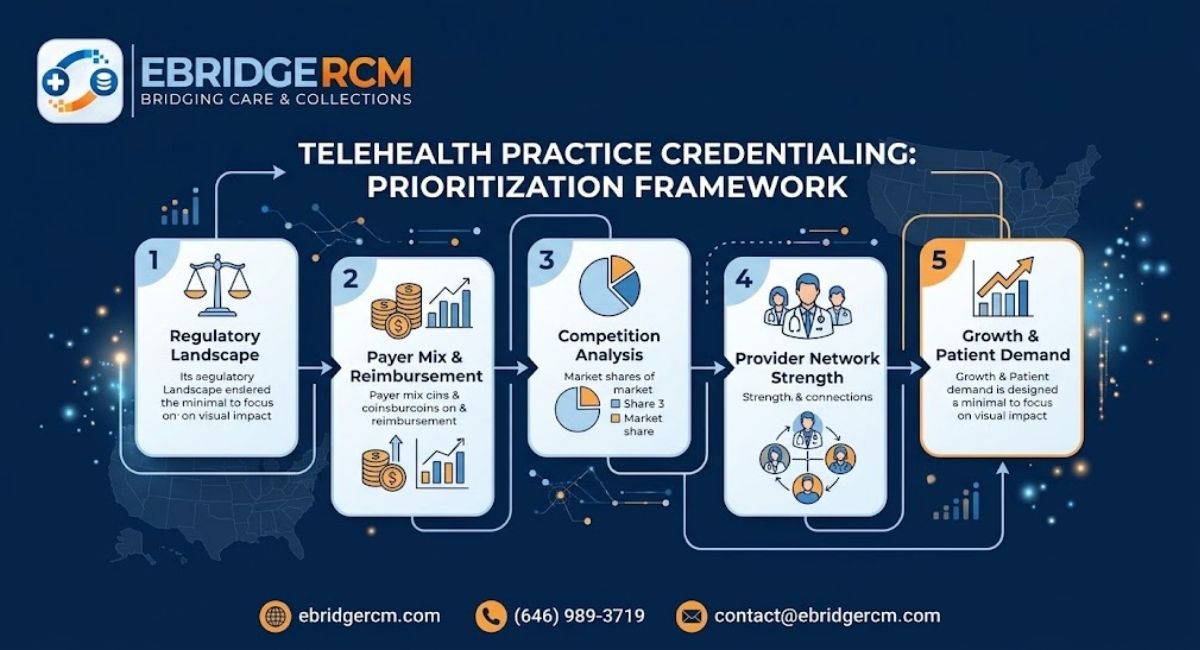
Every new state costs money and staff time before it earns a dollar. That makes state selection a capital allocation decision. This guide gives you a scoring framework built on six factors: licensure friction, compact membership, Medicaid openness, payer mix, reimbursement, and population demand. It includes a worked example of a three-clinician psychiatry practice choosing states four through eight.
Why State Selection Deserves a Framework
Credentialing is slow and uneven. One state may take six weeks to license a clinician. Another may take six months. One Blue plan may accept your actual clinician location. Another may require an in-state address. You pay for these differences in lost revenue, staff hours, and delayed starts.
A checklist tells you what to do in a state. A framework tells you whether the state is worth doing at all, and in what order. That is the question this article answers.
Think of each state as a small project with upfront costs, a ramp period, and a payback timeline. Some states pay back in a few months. Some never do, given your specialty and volume. The goal is to rank them honestly before you commit.
What a Credentialing Project Actually Costs
The direct costs are easy to see: licensing fees, application fees, background checks, and any fingerprint processing. The indirect costs are larger and often missed.
Staff time is the biggest one. Someone must prepare applications, track follow-ups, correct returned forms, and keep CAQH data current. If the practice has an in-house person, that time competes with other work. If an outside partner handles it, there is a service fee.
Delay is the second cost. Every month between your first patient request and your effective date is revenue you do not collect. Slow states stretch that gap.
Compliance and maintenance are the third. Each state means renewals, continuing education tracking, revalidation dates, and separate payer recredentialing cycles. A state you add today creates paperwork for years.
Because costs differ by state, you cannot compare states by market size alone. You need to weigh friction against reward.
The Six Factors That Drive the Score
The framework scores each candidate state on six factors. Each factor gets a rating from one to five, where five is most favorable. You can weight them to match your practice, which the worked example shows later.
Factor 1: Licensure Friction
Licensure is the gate. If a clinician cannot practice in a state, nothing else matters. State licensing boards set the timeline, the fees, the documents required, and the examination or jurisdiction rules.
Friction varies widely. Some boards process complete applications in weeks and offer expedited paths for clinicians already licensed elsewhere. Others require notarized documents, in-person elements, or long verification steps. Boards also differ on whether they accept licenses by endorsement or require you to restart parts of the process.
When scoring licensure friction, consider three things. How long does the board typically take? How many documents and verifications are required? Does the board offer a fast track for clinicians in good standing elsewhere?
A state that takes eight months to license a physician scores a one. A state with a streamlined endorsement path scores a four or five. For the legal basics of why this matters, see whether telehealth providers need a license in every state.
Factor 2: Compact Membership
Interstate licensure compacts reduce friction for clinicians in participating professions. Examples include the Interstate Medical Licensure Compact (IMLC) for physicians and the Psychology Interjurisdictional Compact (PSYPACT) for psychologists. Other compacts exist for nursing, counseling, social work, and additional professions, though their implementation status differs.
A compact does not create a license in the strict sense. It creates a pathway or a privilege to practice that is faster than a full application. For a practice with physicians or psychologists, a state that belongs to the relevant compact can move up your list quickly.
Two cautions apply. First, a state may belong to a compact on paper while operations lag, so confirm that the compact is active and accepting applications. Second, a compact privilege and payer credentialing are different steps. A clinician may be allowed to treat patients in a state and still need to be credentialed with each payer before billing. The distinction is covered in compact privilege vs insurance credentialing.
Score a state higher if it belongs to the compact your clinicians can use, and if the compact path is active in practice. Score it lower if the clinicians in your group are in professions without a workable compact.
Factor 3: Medicaid Openness
Medicaid often represents a large share of demand, especially for behavioral health. It is also where many telehealth practices stall. State Medicaid agencies set their own rules for out-of-state providers, and managed care organizations (MCOs) add a second layer of credentialing after fee-for-service enrollment.
Some states accept out-of-state providers who hold the right license. Some require an in-state address. Some allow enrollment only for border-state providers. These categories are explained in the guide to Medicaid enrollment for telehealth providers.
Score Medicaid openness by asking three questions. Does the state accept out-of-state telehealth providers? How many MCOs operate there, and how long does their credentialing take? Does the state cover the telehealth services and modalities you plan to offer, including audio-only visits if relevant?
A state with open enrollment and clear telehealth coverage scores high. A state that requires a local office scores low unless your volume justifies the investment.
Factor 4: Payer Mix
Payer mix describes which insurers cover the population and how much of the market each one holds. It shapes both your credentialing workload and your revenue.
A state dominated by one or two large payers is easier to cover. If you can credential with two or three plans and reach most patients, the effort per dollar is lower. A fragmented market with many regional plans means more applications and more follow-up.
Blue Cross Blue Shield plans often hold large market share in their home states, which makes them a priority target. How a Blue plan handles out-of-state telehealth providers differs from plan to plan, and the details are covered in the guide to BCBS multi-state telehealth credentialing.
Also consider the balance between commercial, Medicare, Medicaid, and self-pay. A state with high commercial coverage may pay better per visit. A state with a larger Medicaid share may offer volume but lower rates. Neither is wrong. They suit different practice goals.
Score payer mix by asking how many payers you must credential to reach most of the market, and whether the plans there match your service type.
Factor 5: Reimbursement Rate
Reimbursement determines how much each visit earns. Rates differ by state, by payer, and by service. Medicare rates follow the CMS fee schedule, which adjusts by geographic area. Commercial and Medicaid rates vary far more.
Compare rates for the codes your practice uses most. For a behavioral health group, that might be psychotherapy and evaluation codes. For a primary care group, it might be evaluation and management visits. A state that pays ten percent more per visit for your top codes can change the economics of the whole project.
Do not rely on a single average. Look at the real fee schedules you can obtain from payers, and check how telehealth rates compare to in-person rates. Some payers pay parity. Others pay a reduced rate for telehealth. That difference matters at scale.
Score reimbursement by comparing expected revenue per visit against other candidate states. A state with strong rates and payment parity scores high. A state with low rates and telehealth discounts scores low. Understanding how payers handle claim timing also helps, and timely filing limits for insurance claims can affect cash flow in states with short windows.
Factor 6: Population Demand
Demand is the reason to expand at all. It covers how many patients need your service, how many providers already serve them, and how likely they are to use telehealth.
For behavioral health, demand often tracks workforce shortage areas. A state with few psychiatrists per capita and long wait times creates room for telehealth providers. For other specialties, demand may follow chronic disease prevalence, rural population share, or the age of the population.
Telehealth adoption also matters. A large rural population with limited local access may favor virtual care. Broadband coverage can limit it. Look at both need and ability to use the service.
Score demand by estimating patient volume you could realistically reach, and by checking whether competitors already saturate the market. A high-need state with few telehealth providers scores high.
Putting the Factors Together
Once you rate each state from one to five on every factor, you can calculate a weighted score. Weighting lets you adjust for your practice’s strategy.
A practice that wants fast revenue should weight licensure friction and Medicaid openness more heavily, because they control how soon you can bill. A practice that wants long-term margin might weight reimbursement and payer mix more heavily. A practice with limited staff should weight friction highly, since heavy administrative work strains small teams.
| Factor | What to measure | Common weight range |
| Licensure friction | Board timeline, document load, endorsement paths | 20 to 25 percent |
| Compact membership | Active participation in your clinicians’ compacts | 10 to 15 percent |
| Medicaid openness | Out-of-state enrollment, MCO count, telehealth coverage | 15 to 20 percent |
| Payer mix | Concentration of major plans, commercial share | 15 percent |
| Reimbursement rate | Fee schedule for your top codes, telehealth parity | 15 to 20 percent |
| Population demand | Provider shortages, patient volume, telehealth use | 15 to 20 percent |
The ranges are starting points. Adjust them, write the weights down, and apply them consistently to every state. The value of the framework is not the exact number. It is that every state gets judged by the same rules.
Worked Example: A Three-Clinician Psychiatry Practice Choosing States Four Through Eight
Here is how the framework works in practice. The practice has one psychiatrist, one psychiatric nurse practitioner, and one psychologist. They already hold licenses and payer contracts in three states. They want to add five more, and they will do it in waves.
Step One: Build the Candidate List
The group starts with ten candidate states. They came from patient requests, referral partners, and a review of states with strong behavioral health demand. The group does not research all ten in depth. It runs a quick screen to remove states with clear blockers, such as a licensure process that takes more than nine months or a Medicaid program that requires a local office with no exceptions.
After the screen, six states remain. The group calls them State A through State F.
Step Two: Score Each State
The group scores each state on the six factors. Here is a simplified version of their scoring, using their chosen weights.
| State | Licensure friction | Compact | Medicaid openness | Payer mix | Reimbursement | Demand | Weighted result |
| State A | 5 | 5 | 4 | 4 | 3 | 4 | High |
| State B | 4 | 5 | 3 | 5 | 4 | 3 | High |
| State C | 3 | 4 | 4 | 3 | 4 | 5 | Medium high |
| State D | 4 | 2 | 2 | 4 | 5 | 4 | Medium |
| State E | 2 | 3 | 5 | 3 | 3 | 5 | Medium |
| State F | 2 | 1 | 1 | 2 | 3 | 3 | Low |
The weights they used were 25 percent for licensure friction, 10 percent for compact membership, 20 percent for Medicaid openness, 15 percent for payer mix, 15 percent for reimbursement, and 15 percent for demand. They gave extra weight to friction and Medicaid because their volume depends on speed and on Medicaid behavioral health demand.
Step Three: Read the Results Carefully
State A ranks first. The psychiatrist and the psychologist can use compacts. The licensure path is quick, and Medicaid accepts out-of-state telehealth providers. Reimbursement is average, but speed makes up for it.
State B ranks second. It has strong payer concentration, good rates, and compact access. Medicaid enrollment is more complicated, so the group plans to start with commercial payers there.
State C ranks third. Demand is very high, and Medicaid is fairly open. Licensure takes longer, so the group plans an earlier application date.
State D has the best rates, but it has no usable compact for their clinicians and its Medicaid program requires an in-state presence. The group places it in a later wave.
State E has open Medicaid and strong demand, but licensure friction is high. The group moves it to the end of the first phase, since the long timeline means early action pays off.
State F falls to the bottom. Low scores on four factors make the investment hard to justify. The group removes it from the plan for now.
Step Four: Sequence the Rollout
The group picks States A, B, and C for the first wave, and State E as a longer-term project that begins its licensing paperwork early. State D waits until the group has volume to justify a local presence. The result is five new states chosen through a structured process, in an order that matches how fast each one can generate revenue.
The group also notes that scores can change. If State F joins a compact or changes Medicaid rules, the group can rescore it.
Step Five: Check the Math
Before final commitment, the group runs a simple payback estimate for each target state. They estimate the total cost of licensure, applications, staff time, and any outside support. They estimate monthly visit volume after a ramp period, multiply by expected reimbursement, and compare the two figures.
If the payback period is longer than the group’s tolerance, which they set at twelve months, they reconsider or delay that state. Numbers will be rough, but even rough numbers prevent the most expensive mistakes.
Sequencing Within Each State
Choosing the state is only half the work. The order of tasks within each state also affects speed.
Start with licensure, since nothing else can proceed without it. While licensure is pending, prepare payer applications, update your CAQH profile, and align your NPI data. Your NPI record anchors every application, and a quick review of what an NPI is and why it matters can prevent mismatches that return paperwork.
Apply to the most valuable payers first. In most states, that means the dominant commercial plan and the largest Medicaid MCOs. Then add smaller payers as volume grows.
Group practices should also decide whether to credential clinicians individually or under the group. That choice affects billing, contracts, and roster management. The tradeoffs are covered in individual vs group credentialing.
Handle Address and Location Rules Early
Many payers tie network participation to a service location. If your clinicians do not sit in the target state, the address rules can block the application. Check this before you commit to a state. An in-state office requirement can change the cost of entry and push a state lower on your list.
Avoid shortcuts such as mailboxes or registered agent addresses. They tend to fail and can create compliance problems. Legitimate alternatives are covered in the guide to telehealth service location and credentialing.
Common Mistakes in State Selection
Several patterns lead groups to poor decisions.
- Choosing a state because one patient or referral source asked, without scoring the market
- Ignoring Medicaid rules until after licensure is complete
- Assuming a compact removes the need for payer credentialing
- Comparing states by population size alone, without checking reimbursement and payer mix
- Expanding too many states at once and overloading staff
Beyond these, many groups underestimate the maintenance burden. Every new state adds renewals, revalidation dates, and recredentialing cycles. Review common medical credentialing mistakes to see how data errors and missed deadlines create avoidable losses.
Managing Risk as You Scale
Expansion brings risk along with revenue. A few points deserve attention.
Cash flow gaps. Credentialing delays create months of work without payment. Keep a cash buffer, and avoid scheduling patients as in network before you have an effective date in writing.
Compliance exposure. Clinicians must be licensed where the patient is located during the visit. Document patient location at each session, and set clear policies for patients who travel.
Staff overload. Spreading attention across many states can lead to missed follow-ups. Limit the number of active applications at any one time.
Audit readiness. More states and payers mean more audit exposure. Strong documentation and internal checks help, and audit-ready practices to stay ahead of payers offers a useful starting point.
When Outside Support Pays Off
A small group can handle one or two states on its own. Past that point, the workload grows quickly. Five states can mean dozens of payer applications, multiple state boards, and many renewal dates.
Outside support is most useful in three situations. The first is when the group lacks staff to chase applications. The second is when the group wants payer-specific answers before it commits to a state. The third is when the group wants one owner for tracking and renewals.
A credentialing partner can screen states, contact payers, prepare clean applications, and monitor timelines. eBridge RCM offers credentialing services for multi-payer and multi-state growth, and a New York based team for medical credentialing in New York. Once clinicians are active, accurate medical billing helps convert new approvals into steady revenue.
Frequently Asked Questions
Which state should a telehealth practice credential in first?
There is no single best state. The right choice depends on your clinicians, your specialty, and your goals. Score each candidate on licensure friction, compact membership, Medicaid openness, payer mix, reimbursement, and demand. Start with the state that scores highest, especially if it allows a fast path to billing.
How much does it cost to credential in a new state?
Costs vary. Direct costs include licensing fees, application fees, and background checks. Indirect costs include staff time, delay before billing, and ongoing renewals. Build an estimate for each state, and compare it with expected monthly revenue to see the payback timeline.
Do interstate compacts replace payer credentialing?
No. A compact such as the IMLC or PSYPACT can speed up your ability to practice in a state, but you still need to credential with each payer before billing in network. Licensure and payer enrollment are separate steps.
Is Medicaid worth pursuing when expanding into a new state?
It can be, especially in behavioral health where demand is high. Medicaid enrollment is slower and more variable than commercial enrollment, so check whether the state accepts out-of-state providers and how its MCOs handle credentialing before you commit.
How many states should a practice add at once?
Most small groups do best with two or three at a time. Each state adds licensing, payer applications, and renewals. Adding too many at once spreads staff thin and increases the chance of errors and delays.
Can I rescore a state later if conditions change?
Yes. Rules change. A state may join a compact, change its Medicaid policy, or update its telehealth coverage. Revisit your scores once or twice a year, and move states up or down your list as needed.
Rank States Before You Commit
State expansion is a series of small investments, and not every state earns its cost. The practices that grow well treat selection as a decision with numbers behind it. They score each state on the same six factors, weight them to fit their goals, and sequence the rollout so early states fund later ones.
Start by listing candidate states and screening out clear blockers. Score the remaining states on licensure friction, compact membership, Medicaid openness, payer mix, reimbursement, and demand. Run a rough payback estimate. Begin with the top one or two states, build a repeatable process, and add the next wave once the first is producing revenue.
If your practice is planning multi-state growth and wants help with state selection, applications, and follow-up, eBridge RCM, a medical billing company in the USA, supports providers with credentialing, enrollment, and billing. Visit our credentialing services in New York page to talk with a team that handles these projects every day