A therapist in Brooklyn has been seeing the same client every Tuesday for two years. The client takes a job in North Carolina and moves in June. Nothing about the session changes. Same clinician, same platform, same treatment plan, same insurance card.
Legally, almost everything changed. The therapist is now practicing in North Carolina, and North Carolina has an opinion about that.
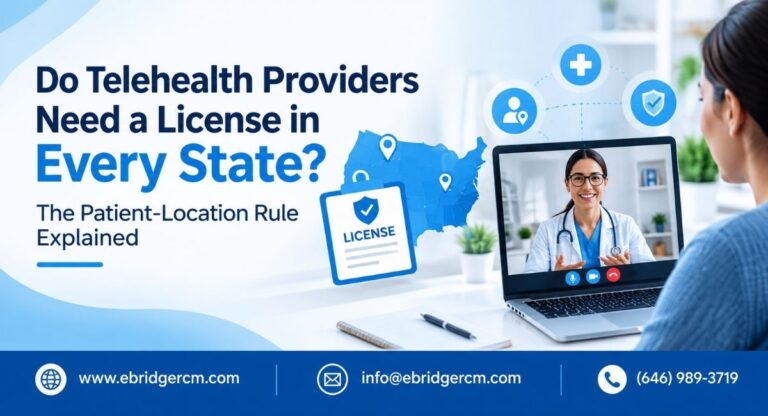
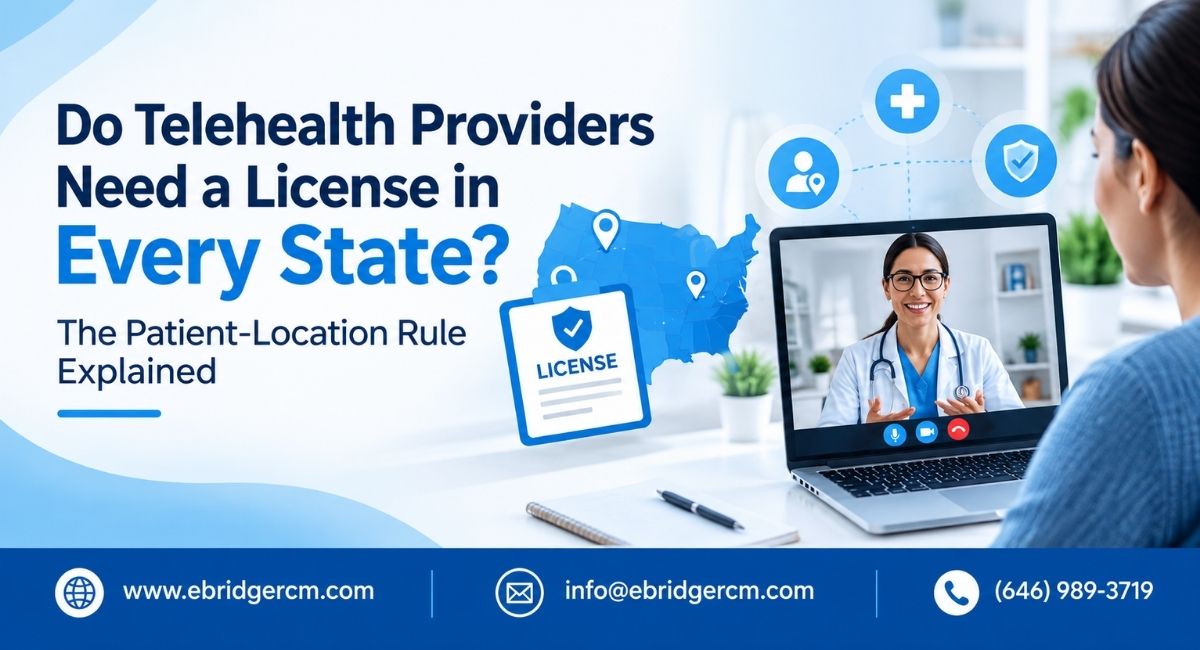
This scenario plays out thousands of times a week across the country, and it is the reason the most common question in telehealth has a frustrating answer. Do you need a license in every state where your patients are? Usually yes. The exceptions are real, but they are narrower than most providers hope, and they rarely cover ongoing care.
The Rule in One Sentence
The practice of medicine, therapy, or nursing is deemed to occur where the patient is physically located at the time of the visit. Your own location does not determine which board has authority over the encounter.
State medical boards have held this position consistently, and the Federation of State Medical Boards has reinforced it in model policy for years. The reasoning is straightforward. Licensing exists to protect residents of a state. If a resident of Ohio is harmed during a video visit, Ohio’s board needs authority to act, and it only has that authority if the encounter counts as occurring in Ohio.
So the working question is not where you sit. It is where your patient sits when the camera turns on.
Why Providers Get This Backwards
The confusion is understandable. Almost every other professional service follows the provider. An accountant in New Jersey can prepare returns for clients in twelve states. A software consultant can work with anyone.
Healthcare is regulated differently because the harm is different. States built licensure around the idea that the person receiving care deserves a local body that can investigate complaints and revoke a credential. Telehealth did not change that structure. It just made the distance visible.
There is a second source of confusion, and it is more expensive. Providers often assume that if a payer pays the claim, the practice was authorized. Payment is not authorization. A claim can process cleanly for a service that a licensing board would consider unlicensed practice. The payer checks its own rules. The board applies its own.
What “Physically Located” Actually Means
The rule sounds simple until you apply it to real schedules.
A patient who lives in Pennsylvania but is visiting family in Florida during the appointment is in Florida for licensure purposes. A college student whose permanent address is in Connecticut but who attends school in Massachusetts is in Massachusetts during term time. A patient traveling for work who joins from a hotel in Georgia is in Georgia.
Home address is not the test. Location at the moment of service is the test.
This has an operational consequence that most practices underestimate. You need to ask, at every visit, where the patient is. Not once at intake. Every visit.
The practical version of this is a single question at the start of each session, documented in the note. Many telehealth platforms now prompt for it automatically. If yours does not, build it into your intake script and your progress note template. The documentation matters as much as the question, because it is the evidence you have if a board or payer asks later.
Some practices go further and set a policy for travel. A common approach is to reschedule any session where the patient will be in a state the clinician is not authorized in, with a short explanation given at the start of care so it does not feel arbitrary later. It is less disruptive than it sounds. Patients generally accept it once they understand it is a legal constraint rather than a practice preference.
The Authorization Pathways That Exist
Full licensure in every state is the default answer, but it is not the only answer. Depending on your profession, several routes exist, and they differ in speed, cost, and payer acceptance.
| Pathway | Who it covers | What it grants | Practical speed |
|---|---|---|---|
| Full state license | Every profession | Complete authority to practice in that state | 4 to 16 weeks, varies by board |
| Interstate Medical Licensure Compact | Physicians in participating states | An expedited route to a full license in each state, not a single national license | 2 to 8 weeks once qualified |
| PSYPACT | Licensed psychologists | Authority to provide telepsychology in participating states | 2 to 6 weeks after E.Passport is issued |
| Counseling Compact | LPC, LPCC, LMHC and equivalent | A privilege to practice in member states that are live | Weeks, but only between operational states |
| Nurse Licensure Compact | RNs and LPNs in member states | A multistate license valid in all member states | Immediate for qualifying licensees |
| Social Work Licensure Compact | Regulated social workers | A multistate license, once operational | Not yet issuing as of 2026 |
| Telehealth registration or special purpose license | Varies by state and profession | Limited cross-border telehealth authority, usually with conditions | Weeks, where available |
Two cautions apply to this table.
First, enacted is not the same as operational. A state legislature can pass a compact years before the compact can actually issue anything there. The Social Work Licensure Compact has been enacted in roughly 35 states and has issued zero multistate licenses so far. The Counseling Compact has been enacted in around 40 jurisdictions but is issuing privileges in only a handful. Check current operational status before you build a hiring plan on it.
Second, a compact privilege does not automatically make you billable. That is a separate approval from a separate organization, and we will come back to it.
Physicians and the IMLC
The Interstate Medical Licensure Compact is often described as a multistate license. It is not. It is an expedited pathway that lets qualifying physicians obtain full licenses in member states faster and with less duplicated paperwork. You still receive a separate license from each state, pay each state’s fee, and renew with each state.
For a physician planning to practice in five member states, the IMLC usually cuts months off the timeline. For a physician planning to practice in one, it may not be worth the eligibility process.
Psychologists and PSYPACT
PSYPACT is the most mature of the behavioral health arrangements. A psychologist obtains an E.Passport from ASPPB and then an Authority to Practice Interjurisdictional Telepsychology, which permits telepsychology in participating states. Temporary in person practice runs through a separate authorization.
PSYPACT works well for its intended purpose. Its limits are worth noting. It covers licensed psychologists only. It does not extend to counselors, social workers, or marriage and family therapists, no matter how similar the clinical work looks.
Counselors, Social Workers, and MFTs
Counselors have the Counseling Compact, which grants a privilege to practice in each remote member state that has gone live. The privilege is per state and requires a separate application through the compact system.
Clinical social workers have a compact that is activated but not yet issuing. Until it does, licensure by endorsement in each state remains the working path.
Marriage and family therapists have no compact at all. Every state requires its own license.
For behavioral health groups building a multi-state roster, this asymmetry drives hiring. A psychologist can often be productive in a new state within weeks. An LMFT cannot. That difference should shape which clinician you assign to which market, and it should be reflected in your onboarding checklist. Our behavioral health credentialing checklist covers the document set each profession needs.
The Exceptions Most Providers Ask About
Every state carves out some situations where a non-licensed provider may treat a patient located there. These exceptions are genuine, but they are narrow, and none of them supports a routine telehealth caseload.
| Exception type | What it typically allows | Where it breaks down |
|---|---|---|
| Consultation with a licensed local provider | Advising a treating provider in that state, without establishing your own patient relationship | Does not cover direct treatment or independent care decisions |
| Temporary or occasional practice | A limited number of days per year, often 10 to 30, for a patient temporarily in the state | Day limits are low, and some states require registration first |
| Continuity of care for an established patient | Follow-up for a patient who travels briefly, in a minority of states | Rarely covers a permanent move, and often capped by visit count |
| Emergency care | Treatment during an urgent situation | Narrow definition, not a scheduling strategy |
| Federal practice | VA, IHS, and active duty military settings have separate rules | Applies only within those systems |
| Border state agreements | Practice near a shared border, mainly in Medicaid contexts | Limited geography, and rules differ by program |
Note the pattern. The exceptions cover short, occasional, or supervised situations. They do not cover a clinician who wants to keep a full caseload in a state where they hold no credential.
The continuity of care exception deserves a specific warning because it is the one providers most often stretch. A handful of states allow limited follow-up for an established patient who has relocated or is traveling. The allowance is usually capped, sometimes by number of visits and sometimes by days per year. Treating a permanent move as ongoing continuity of care is the version that gets providers into trouble.
The federal government maintains a plain language overview of licensure rules for telehealth at telehealth.hhs.gov, which is a reasonable starting point before going to the individual state board.
Where Licensure and Payer Enrollment Meet
This is the part that costs practices money, and it is the reason licensure belongs in a billing conversation rather than a compliance footnote.
Licensure gives you legal authority to treat. Payer enrollment gives you contractual authority to bill. You need both, in that order, and holding one does not produce the other.
A psychologist with PSYPACT authority can legally treat a patient in Ohio on Monday. If that psychologist is not credentialed with the patient’s Ohio plan, the claim denies. Conversely, a provider credentialed with a national payer still cannot legally treat a patient in a state where they hold no license, even though the claim might process.
The sequence that works looks like this:
- Confirm the patient’s state and your authorization to practice there
- Confirm you are enrolled and effective with that patient’s specific plan in that state
- Verify eligibility and benefits before the visit
- Document the patient’s location in the note
Practices that skip step two discover the problem four to six weeks later, in a denial batch. If you are setting up payer relationships for the first time, the mechanics in our guide to insurance credentialing for US healthcare providers explain what each payer verifies and in what order.
The Denial Codes You Will See
When licensure and enrollment fall out of sync, the claim does not say “unlicensed practice.” It says something vaguer.
You will typically see denials for a provider not being contracted for the plan, services not covered by the member’s benefit, or a mismatch between the service location and the network. Some payers reject on the place of service code before anyone reviews the credential.
The diagnostic habit that helps is to check enrollment status per state and per plan whenever a telehealth denial repeats across patients from the same region. A pattern of denials clustered by member state is almost always an enrollment gap rather than a coding error.
Prescribing Adds a Second Layer
For prescribers, state licensure is only the first requirement. Controlled substance prescribing carries its own rules, and they do not always follow the medical license automatically.
A prescriber generally needs a DEA registration tied to a physical address, and many states require a separate state controlled substance registration in addition to the DEA number. Some states issue that registration only to providers with an in state address, which creates a practical obstacle for telehealth prescribers who hold the license but have no office there.
Prescription drug monitoring program access is a third requirement. Most states mandate a PDMP check before prescribing certain medications, and access is granted per state. Registering for PDMP access in each state where you prescribe takes time and should start alongside the license application rather than after it.
The federal rules governing telemedicine prescribing of controlled substances have shifted several times since 2020 and remain an active area of rulemaking. Prescribers should check the current DEA position rather than relying on guidance from a previous year.
What Happens When Providers Get It Wrong
Enforcement is uneven, which leads some providers to assume the risk is theoretical. It is not.
State boards can issue cease and desist orders against out of state providers, and those actions are reportable. A disciplinary action in one state triggers reporting obligations to every other board where you hold a license, and to the National Practitioner Data Bank. A single enforcement action can therefore threaten credentials in states where nothing went wrong.
Payers respond separately. Services delivered without valid licensure may be recouped after the fact, sometimes years later during an audit. Malpractice carriers may also deny coverage for care delivered outside the scope of your authorization, which converts a clinical complaint into a personal financial exposure.
None of this is common. All of it is avoidable with a documented location question and an accurate license record.
What This Means for Practice Structure
The patient location rule shapes decisions well beyond compliance.
It shapes hiring. A clinician already licensed in three of your target states is worth considerably more than one who is not, and the difference is measured in months of ramp time.
It shapes market selection. States where your profession has an operational compact are cheaper and faster to enter than states where it does not. Two markets with identical demand can differ by six months in time to first revenue.
It shapes scheduling. Once a practice operates in more than two or three states, matching patients to clinicians who are authorized in that state becomes a real constraint, and it belongs in your booking logic rather than in someone’s memory.
It shapes how you launch. A new practice adding states from the start builds different systems than one that grew in a single state and expanded later. The groundwork we describe in our mental health practice setup guide applies, with licensure sequencing layered on top.
For solo clinicians moving from a cash pay or single state model into insurance work across borders, the practical starting point is usually private practice insurance credentialing, then adding states one at a time rather than in parallel.
Documentation and Risk Management
Two records protect you if a board or payer reviews a cross-state encounter.
The first is proof of authorization on the date of service. Keep license certificates, compact privilege confirmations, and expiration dates in one place, with the effective date visible. A privilege that lapsed three weeks before a session is a problem you want to find before someone else does.
The second is the patient’s location, documented per visit. A line in the note that records the state the patient was in during the session takes seconds and answers the only question that matters in a retrospective review.
Add one more habit. When a patient tells you they are moving, treat it as a clinical event that requires planning. Depending on the destination state, your options may include obtaining a license there, transferring care to a local provider, or using a limited continuity allowance if one exists. All three take time, and the worst version is discovering the move in the middle of the first session at the new address.
FAQs
If I am licensed in New York and my patient travels to Florida for two weeks, can I keep seeing them?
It depends on Florida’s rules for your profession. Some states allow limited temporary practice or short term continuity of care for an established patient, often with day limits or a registration requirement. Others do not. Check the Florida board’s position for your license type before the session rather than after.
Does a compact privilege count as a license for insurance credentialing?
Not automatically. A compact privilege gives you legal authority to practice. Payers decide separately whether to accept it for network participation, and some enrollment systems still require a full state license number. Confirm acceptance with each payer before relying on it.
What if the patient lies about where they are?
Document what the patient reported at each visit. Boards generally evaluate whether the provider made a reasonable effort to verify location and acted on the information available. A consistent, documented practice of asking protects you far more than an assumption does.
Do these rules apply to asynchronous care and messaging?
Generally yes. Most boards treat store and forward services, secure messaging, and remote monitoring as practice occurring where the patient is, though specifics vary. Asynchronous care does not sit outside licensure requirements.
Can I see a patient in another state if the visit is free?
Charging is not the test. Unlicensed practice rules apply to the clinical encounter regardless of whether money changes hands. Free care in a state where you are not authorized carries the same regulatory risk.
Which is faster, a compact privilege or licensure by endorsement?
A compact privilege is usually faster where it is available and both states are operational. Endorsement is slower but works in every state and is universally accepted by payers, which makes it the more reliable option when payer enrollment is on the critical path.
The Practical Takeaway
The answer to the headline question is yes in most cases, with exceptions that are too narrow to build a caseload on.
Three actions follow from that. Confirm where the patient is at every visit and write it down. Map your target states to the authorization pathway available for your profession, and check whether that pathway is operational rather than merely enacted. Treat licensure and payer enrollment as two separate approvals with two separate timelines, and never schedule against the earlier one.
Get those right and cross-state telehealth becomes an administrative project with predictable lead times rather than a compliance risk.
If you want the licensure tracking, payer applications, and enrollment calendars handled by a team that does this daily, eBridge RCM works with telehealth and behavioral health practices across the country. Our New York credentialing services cover the full enrollment cycle, and our mental health billing services in New York handle the claims side once your contracts are live. As a medical billing company in the USA, we manage both so your clinicians spend their time with patients instead of portals.