A psychologist finishes her PSYPACT application in early spring. The E.Passport arrives, the Authority to Practice Interjurisdictional Telepsychology follows, and she is now legally able to see patients in more than forty jurisdictions. She opens her calendar to patients in three new states.
Ten weeks later she has forty-one sessions and almost no revenue. Every claim came back the same way. The provider is not participating in that plan.
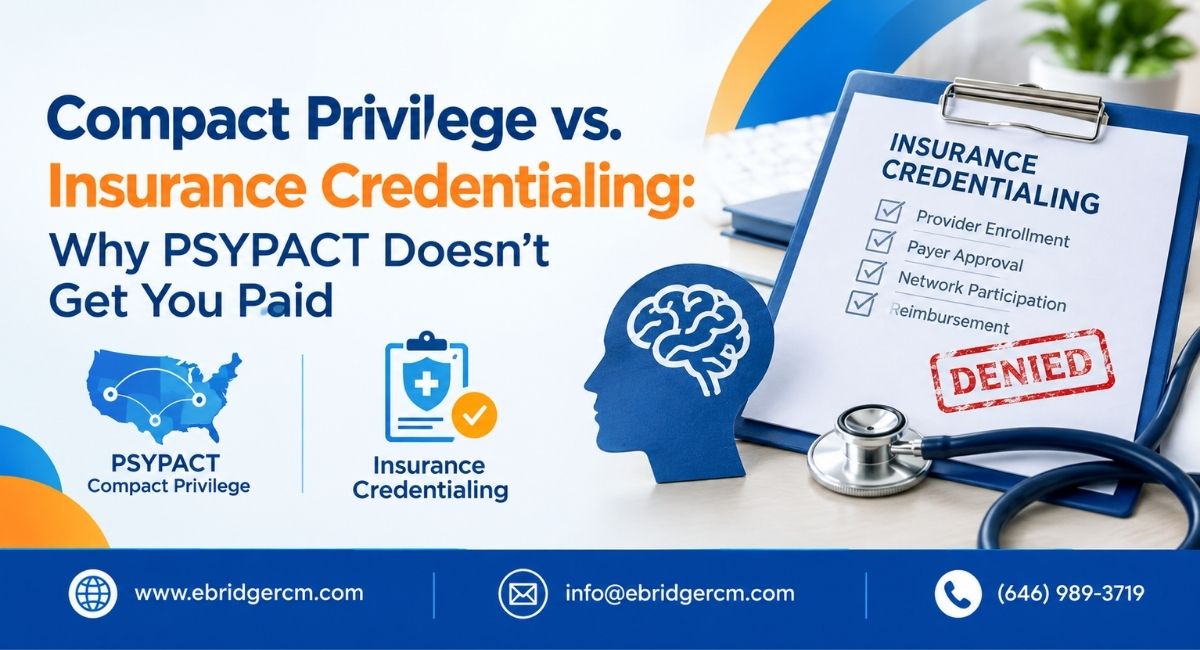
Nothing went wrong with her compact. It did exactly what it was designed to do. The problem is that she treated it as a business approval when it is a regulatory one, and those two things live in completely separate systems with completely separate timelines.
This is the single most expensive misunderstanding in behavioral telehealth right now, and it is worth taking apart carefully.
Two Approvals, Two Authorities
Practicing across state lines and getting paid across state lines are different achievements.
A compact privilege comes from a regulatory body. It answers a legal question: may this clinician lawfully treat a person located in this state? That authority sits with licensing boards and the compact commissions they participate in.
Insurance credentialing comes from a commercial entity. It answers a contractual question: will this insurer accept this clinician into its network and pay in-network rates for services delivered to its members? That authority sits with each individual payer, and no compact commission can grant it.
Neither approval implies the other. You can hold a compact privilege and be entirely out of network. You can be credentialed nationally with a large payer and still be practicing unlawfully if you treat a patient in a state where you hold no authorization.
| Question | Compact privilege answers it | Insurance credentialing answers it |
|---|---|---|
| May I legally treat a patient in this state? | Yes | No |
| Will this insurer pay me in-network? | No | Yes |
| Who grants it? | Licensing boards and compact commissions | Each individual payer |
| How long does it take? | Days to weeks | 60 to 120 days, sometimes longer |
| Does it expire? | Yes, tied to your home license and renewal cycle | Yes, recredentialing roughly every 3 years |
| Does it appear in payer directories? | No | Yes, once the contract is loaded |
Read that table once more before planning any expansion. The row that costs practices the most is the second one.
What the Behavioral Health Compacts Actually Do
Three arrangements dominate behavioral health, and they work differently enough that treating them as interchangeable causes real problems.
PSYPACT
PSYPACT applies to licensed psychologists. A psychologist obtains an E.Passport through the Association of State and Provincial Psychology Boards, then applies for an Authority to Practice Interjurisdictional Telepsychology. That authority permits telepsychology with patients located in participating states. Temporary in person practice runs through a separate authorization.
PSYPACT is the most mature of the three and the most widely operational. Details on participating states and current requirements are maintained at psypact.org.
It covers psychologists only. A master’s level counselor doing clinically similar work is not eligible, no matter how comparable the caseload looks.
The Counseling Compact
The Counseling Compact covers licensed professional counselors and their state equivalents, including LPC, LPCC, LMHC, and LCPC. It grants a privilege to practice in member states, applied for through the compact’s own system.
The important caveat is operational status. As of 2026, roughly 40 jurisdictions have enacted the compact, but only a small number are actually issuing or accepting privileges. A privilege only works when both the home state and the remote state are live. Enacted legislation on a map does not mean you can practice there tomorrow.
The Social Work Licensure Compact
The Social Work Licensure Compact has been enacted in roughly 35 states and has reached activation status. It is not yet issuing multistate licenses. Applications are not open, and no social worker can practice on compact authority today.
Clinical social workers expanding across states still rely on licensure by endorsement in each state. That is slower, and it needs to be built into hiring and expansion timelines rather than discovered later. The document set required is substantial, and our LCSW credentialing documents guide walks through what boards and payers each ask for.
Marriage and family therapists have no compact at all. Every state requires its own license.
The Structural Difference That Matters for Billing
PSYPACT and the Counseling Compact grant a privilege attached to your home state license. The Social Work Compact is designed to grant a multistate license instead.
That distinction shows up in payer enrollment forms. Many of those forms ask for a state license number. A privilege identifier is not a license number. Some payer systems accept it. Some reject the application outright. Some accept it for commercial plans and reject it for Medicaid.
This is why the answer to “will my compact work for credentialing” is payer specific rather than general.
Why Payers Do Not Simply Accept a Compact
From the outside this looks like bureaucratic stubbornness. From inside a payer’s credentialing department it is more understandable.
Payers build networks by state, and often by product within a state. A contract specifies which providers serve which members under which fee schedule. Adding a provider to a network is a contracting action, not a verification action.
Payers also run primary source verification against defined sources. Their systems were built to query state license databases. Compact privilege data lives in different systems that not every payer has integrated.
Payers maintain provider directories that are regulated for accuracy. A directory entry requires a service location, a network assignment, and an effective date. A compact privilege supplies none of those.
Finally, payers manage network adequacy and cost. Even a payer that fully accepts compact credentials may have a closed network in a given state, meaning your application is declined for reasons that have nothing to do with your credential.
None of this changes because your compact is valid. It just means the compact solved a different problem than the one standing between you and payment.
The Correct Sequence
Practices that expand smoothly follow the same order every time.
- Obtain the compact privilege or state license for the target state
- Add the new credential to NPPES and CAQH ProView, then re-attest
- Confirm with each target payer whether they accept a compact privilege for enrollment in that state
- Submit payer applications, in parallel across payers
- Sign the contract and confirm the effective date in writing
- Open scheduling for that state only after the effective date
Step three is the one that is almost always skipped, and it is the cheapest step on the list. A short email to each payer’s provider relations contact, asking whether a compact privilege is acceptable for enrollment in that state and what license documentation they require, saves weeks of rework. Keep the answer in writing.
Step six is the one that costs the most when skipped. Legal authority to practice arrives fast. Contractual authority to bill arrives slowly. Scheduling against the first date rather than the second produces a backlog of denied claims and awkward conversations with patients who thought they were in network.
If you are building this sequence for the first time, our guide to insurance credentialing for mental health providers covers what each payer verifies and how long each stage typically runs.
What to Do While Credentialing Is Pending
A compact privilege in hand and a credentialing application in process is a genuinely useful position. It is not a dead period.
You can see private pay patients in that state immediately, because the legal authority is already granted. Many practices use this window deliberately, launching with a self pay option while the network contracts process.
You can also provide out of network care where the patient has out of network benefits, with clear disclosure about what the patient will owe. This requires care. Patients need an accurate estimate before the first session, not after.
What you cannot do is bill a plan as in network before your effective date. Retroactive effective dates exist at some payers and for some circumstances, but they are granted inconsistently and should never be part of a plan.
One more option is worth considering for groups. If your practice already holds a contract with a payer in that state under a group agreement, adding a clinician to the existing group contract is usually faster than a fresh individual credentialing cycle. This is one of the practical reasons multi-state behavioral health groups favor group contracting, and it is worth deciding early rather than restructuring later.
Cost and Timeline Comparison
Founders often assume the compact route is dramatically cheaper overall. It is cheaper on the licensure side. It changes nothing on the payer side.
| Item | Compact route | Full licensure route |
|---|---|---|
| Authorization cost per state | Roughly 30 to 400 dollars, plus the underlying passport or home license fee | Roughly 150 to 700 dollars initially, plus renewals |
| Authorization time | Days to weeks, where both states are operational | 4 to 16 weeks |
| Payer enrollment cost | Unchanged | Unchanged |
| Payer enrollment time | Unchanged, 60 to 120 days typical | Unchanged, 60 to 120 days typical |
| Payer acceptance | Varies by payer and product | Universal |
| Medicaid acceptance | Often limited or unavailable | Generally accepted |
| Availability | Only where your profession has an operational compact | Everywhere |
The pattern is clear. Compacts compress the front half of the timeline and leave the back half untouched. On a six month expansion, a compact might save you two to three months. That is meaningful. It is not the same as being ready to bill.
Medicaid deserves a separate note. State Medicaid programs and their managed care plans are frequently the strictest about license documentation, and several will not enroll a provider holding only a compact privilege. If Medicaid is a meaningful part of your payer mix in a target state, plan for full licensure there regardless of what your compact allows.
Ready to Strengthen Your Revenue Cycle?
Let eBridge RCM handle the complexities of medical billing, credentialing, claims, and revenue cycle management so your practice can stay focused on patient care.
Errors That Follow From This Confusion
The misunderstanding at the center of this article produces a predictable set of downstream problems.
Marketing runs ahead of contracts. A practice announces availability in a new state as soon as the privilege is issued, books patients, and then has to unwind the expectation that care will be covered.
Eligibility checks get skipped. Staff assume that because the provider can legally practice in the state, network status is settled. It is not, and eligibility verification per patient per plan remains necessary.
Denials get miscategorized. A batch of non-participating denials gets sent to the billing team as a coding problem. The billing team reworks claims that were never going to pay, because the issue sits upstream in enrollment.
Directory listings never appear. Patients searching their insurer’s directory cannot find the clinician, referrals do not arrive, and the practice concludes that demand in the new state is weak when the real issue is invisibility.
Most of these trace back to one assumption. Several are covered in our broader review of medical credentialing mistakes, and the fix in every case is the same: separate the two approvals in your planning and track them independently.
How to Track Both Approvals Without Losing the Thread
Once a practice operates in more than two or three states, memory stops working as a system. The minimum structure is a single record with one row per provider, per state, per payer.
Each row needs the authorization type and its expiry, whether that is a full license or a compact privilege. It needs the payer application date, the current status, and the name of the person handling the file. It needs the contract effective date, which is the date scheduling may open. It needs the recredentialing due date, since payers typically recredential every three years.
Two clocks run in parallel and they are independent. Your compact privilege renews on its own cycle, usually tied to your home license. Your payer contracts recredential on theirs. A lapse in either one stops revenue, and a lapse in the first one can also invalidate the second, since most payer contracts require continuous licensure in good standing.
Set calendar reminders at 120 days and 60 days before each expiry. Payers rarely send useful warnings, and a terminated contract takes longer to restore than it did to obtain.
A Worked Example
Consider a four clinician behavioral health group in New York planning to serve patients in Ohio. The team includes one psychologist, two licensed professional counselors, and one clinical social worker.
The psychologist can obtain PSYPACT authority within weeks and begin treating Ohio patients privately almost immediately. Commercial credentialing with the two largest Ohio plans still takes around three months, so insured patients wait.
The counselors depend on whether Ohio and New York are both operational in the Counseling Compact at that moment. If they are, the privilege arrives quickly and the same three month payer wait follows. If either state is not live, the counselors need licensure by endorsement in Ohio, which adds two to four months in front of the payer stage.
The social worker has no usable compact. Licensure by endorsement in Ohio is the only route, and payer enrollment follows that.
The result is one team with three different start dates in the same market. A practice that plans a single launch date for all four clinicians will miss it. A practice that stages the launch by profession will not.
That staging decision also affects how the group contracts. Adding clinicians to an existing group agreement is usually faster than credentialing each one individually, which is why groups expanding across states tend to move toward group contracting sooner than single state practices do.
Scaling Beyond a Handful of States
At a certain size, the per application model stops working. A group with fifteen clinicians across eight states is managing well over a hundred active credentialing relationships, each with its own effective date and recredentialing clock.
Two things change at that point. The first is roster management. Payers expect a current roster file, and silent mismatches between your roster and theirs produce denials that look random until someone compares the two lists. The second is delegated credentialing. Larger groups that meet payer and accreditation requirements can perform primary source verification themselves and report additions to the payer, which compresses onboarding from months to weeks.
Delegation is not available to small practices and carries real audit obligations. It is worth knowing it exists, because it changes the economics of multi-state growth once a group reaches sufficient volume.
Choosing Between the Two Routes
For most practices this is not an either or decision. It is a sequencing decision.
Use the compact where it is operational and where your payer mix is mostly commercial. It gets clinicians treating patients faster and costs less at the licensure stage.
Use full licensure where Medicaid matters, where your profession has no operational compact, or where a large payer in that state has told you they require a state license number. Full licensure is slower but it removes every downstream question.
Many multi-state groups end up running both. A psychologist enters a new market on PSYPACT authority while the practice pursues full licensure for the social workers on the same team, because those clinicians have no compact available.
The decision should be made market by market, informed by the payer mix you actually intend to serve. Practices comparing internal capacity against outside help can start with our overview of the best credentialing services for mental health providers, which lays out what to expect from a credentialing partner and what should stay in house.
Frequently Asked Questions
Does PSYPACT let me bill insurance in all participating states?
No. PSYPACT grants legal authority to provide telepsychology in participating states. Each payer decides separately whether to credential and contract you for that state. You need both approvals before billing in network.
Will payers accept a compact privilege instead of a state license number?
Some will and some will not, and the answer often differs by product within the same payer. Ask each payer directly before submitting, and get the answer in writing. Medicaid programs are the most likely to require full licensure.
Can I see patients while my credentialing application is pending?
Yes, if you hold valid authorization to practice in that state. You can see private pay patients, or out of network patients with proper disclosure of their costs. You cannot bill a plan as in network before your contract effective date.
How long after getting a compact privilege can I start billing insurance?
Plan on 60 to 120 days for commercial credentialing after your authorization is in place, and longer for Medicaid and its managed care plans. The compact itself does not shorten this stage.
Do I still need CAQH if I have a compact privilege?
Yes. CAQH ProView is the profile most commercial payers verify against during credentialing. Add the compact authorization to your profile and keep your attestation current, since a stale attestation stalls applications silently.
What happens to my compact privileges if my home state license lapses?
Compact privileges are anchored to your home state license. If that license lapses or becomes encumbered, your privileges generally fall with it, and any payer contracts that require continuous licensure are at risk as well.
The Practical Takeaway
A compact privilege is a licensing achievement. Insurance credentialing is a business achievement. Both are necessary to serve insured patients across state lines, and they run on different timelines controlled by different organizations.
Three habits prevent almost all of the damage. Confirm payer acceptance of your compact credential before you apply, not after. Schedule patients against the contract effective date, never against the privilege date. Track licensure expiry and recredentialing deadlines as two separate clocks in one record.
Practices that internalize this build expansion plans that hold. Practices that do not spend their first quarter in a new state reworking denials.
If you want the payer side handled while your clinicians focus on care, eBridge RCM manages credentialing and enrollment for behavioral health and telehealth practices nationwide. Our medical credentialing services in NYC cover payer applications, CAQH maintenance, and recredentialing calendars, and our mental health billing services in New York support practices building out from the Northeast.