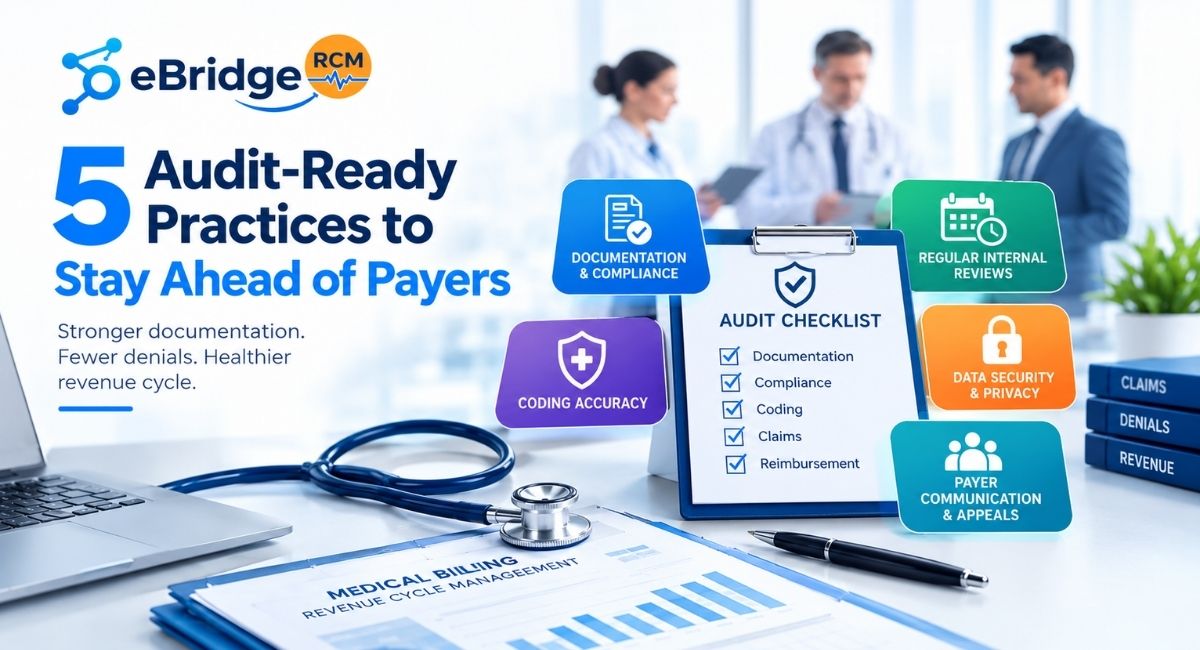
Healthcare practices don’t just compete on patient care anymore. They compete on how clean their billing process is. Payers, both private insurers and government programs like Medicare and Medicaid, are scrutinizing claims harder than ever for accuracy, medical necessity, and compliance.
The numbers back this up. Industry benchmarking from groups like MGMA and Experian Health shows the average initial claim denial rate has climbed past 11% in recent years, up from around 10% just a few years earlier. More than four in ten providers now report denial rates above 10%, a level most revenue cycle analysts treat as a warning sign for financial stability. What makes this more frustrating is where the damage starts: research consistently points to front-end errors, things like eligibility mistakes, missing authorizations, and incomplete patient data, as the root cause behind the majority of preventable denials, not clinical or coding disputes.
A billing error or a documentation gap doesn’t just delay a payment. It can trigger a full payer audit, a recoupment, or a compliance flag that follows your practice for years. Government payers add another layer of pressure through programs like the CMS Recovery Audit Contractor (RAC) initiative, which specifically targets improper Medicare payments after the fact. Building an audit-ready revenue cycle isn’t optional anymore. It’s the baseline. Practices looking to tighten this process often lean on structured support like professional Medical Billing and Credentialing services to meet payer standards consistently.
Understanding Payer Compliance
- Keep billing, documentation, and compliance checks consistent across the revenue cycle.
- Focus on preventing front-end errors before they become denials or audit issues.
Payer compliance means following the specific rules, coding requirements, and submission policies each insurance company sets. When you stay compliant, claims process faster, reimbursements arrive on time, and your practice avoids legal exposure.
When compliance slips, the consequences show up fast. Claims get denied or underpaid. Audit risk climbs. Financial penalties and recoupments start eating into revenue. Day-to-day operations get slower, since staff spend more time fixing problems than preventing them. Industry data suggests the administrative cost of reworking a single denied claim now runs well above $40, and often closer to $60 once staff time, resubmission, and follow-up are factored in. Multiply that across a few hundred denials a month, and the hidden labor cost quickly outpaces what most practices assume they’re losing.
Payer compliance and regulatory compliance overlap, but they’re not the same thing. The Office of Inspector General (OIG) has long recommended that physician practices build a compliance program around a core set of elements: written policies and procedures, designated compliance oversight, regular staff training, open communication channels, consistent enforcement of standards, ongoing risk assessment and auditing, and a clear process for responding to problems once they’re found. Practices don’t need a massive compliance department to apply this. Even a small internal medicine or specialty practice can scale these same principles down to something manageable, and doing so gives auditors, whether internal, payer-initiated, or government-led, a clear paper trail showing the practice takes compliance seriously.
The first real step toward payer compliance is building medical billing checks into daily workflow. That means verifying patient information, cross-referencing codes against documentation, and confirming pre-authorizations before a claim goes out. An organized, repeatable process protects revenue integrity and makes audits far less stressful when they happen.
1. Standardize Documentation Practices
- Use standardized templates for consistent documentation.
- Cross-check billed services against supporting clinical documentation.
- Review high-risk documentation regularly before issues accumulate.
Documentation is the foundation everything else sits on. Inconsistent or incomplete notes are one of the top reasons claims get denied. Standardizing documentation makes sure every encounter, procedure, and claim lines up with what the payer expects and supports medical necessity.
Structured templates for patient encounters, history, and treatment plans keep records consistent and easy to review. Accurate ICD-10 and CPT coding matters just as much, since coding errors remain a leading cause of denials. Supporting evidence, like lab reports, imaging, and referral notes, should live in the patient record too, since payers often request these during an audit. A routine internal review, done weekly or monthly, keeps documentation aligned with billed services before problems pile up.
Medical necessity deserves its own attention here, since it’s one of the most common grounds payers use to deny a claim even when coverage is active. A payer isn’t just checking that a code exists. It’s checking whether the documentation actually supports why that specific service was needed for that specific patient. A note that lists a diagnosis without connecting it to the treatment plan, or a procedure without a clear clinical rationale, leaves an opening for denial regardless of how accurate the coding itself is.
Ready to Leave Billing Headaches Behind? Let’s Build a More Efficient Revenue Cycle
Let eBridge RCM manage your billing, claims, credentialing, and revenue cycle—giving you more time to focus on what matters most: your patients.
Documentation Standards Checklist
| Documentation Area | Requirement | Suggested Frequency | Notes |
| Patient Intake | Complete demographics, insurance, and consent | Monthly | Verify insurance eligibility before visit |
| Treatment Notes | Clear description of diagnosis, procedures, codes | Weekly | Use standardized templates |
| Prior Authorizations | Approvals documented for all applicable services | Daily | Include payer reference number |
| Lab/Imaging Reports | Attach results to patient records | Weekly | Ensure timestamps match encounter |
| Billing Entries | Codes cross-checked against documentation | Daily | Confirm ICD-10/CPT alignment |
Practices managing multiple specialties often run into different documentation challenges from one department to the next. Specialties Billing support helps standardize this across departments, which keeps audit preparedness consistent no matter what service line is being billed.
A few documentation issues show up again and again: vague phrases like “patient is stable” instead of real clinical findings, missing lab or imaging results, mismatched procedure codes, and treatment notes that don’t clearly connect to what was billed. Catching these early cuts down on payer queries and avoids drawn-out claim rejections. Practices that standardize this process well tend to see it pay off twice, once in cleaner first-pass claim acceptance, and again in faster, less contentious audits when they do happen.
2. Conduct Routine Internal Audits
- Sample claims regularly, with extra attention to high-risk codes.
- Track denial patterns to identify and fix recurring problems.
- Keep audit logs of findings and corrective actions.
Internal audits let a practice catch its own mistakes before a payer does. Instead of waiting for an external review to flag a problem, your team reviews claims, coding, and documentation on a regular schedule and fixes what’s wrong before submission.
A solid internal audit process usually includes claim sampling, where a random set of claims gets reviewed weekly or monthly with extra attention on high-risk codes. It also includes code verification, comparing assigned CPT and ICD-10 codes against the actual clinical documentation. Tracking denial patterns matters just as much, since spotting a trend lets you fix the root cause instead of chasing the same error claim by claim. Keeping audit logs of findings and corrective actions shows a real culture of compliance if an external reviewer ever asks.
Internal Audit Scoring System
| Audit Criteria | Score (1-5) | Action Required |
| Coding Accuracy | 5 | None |
| Documentation Completeness | 4 | Update templates |
| Timeliness of Submission | 3 | Train staff on claim submission deadlines |
| Prior Authorization Compliance | 5 | None |
| Denial Resolution Efficiency | 4 | Improve follow-up workflow |
Practices handling higher claim volumes or complex procedures often bring in Monthly Billing Audit services for an unbiased outside review. It’s worth reading our guide on billing audit preparation if your team is building this process from scratch.
Internal audits catch compliance gaps before a payer ever sees them. They reduce denied and delayed claims, build staff accountability, and keep the revenue cycle improving instead of stagnating.
3. Implement Efficient Payer Communication
- Subscribe to payer newsletters and policy updates.
- Log payer calls, emails, and portal communications.
- Respond to denials promptly with complete supporting documentation.
Payer communication gets overlooked constantly, but it’s one of the most important pieces of audit readiness. Clear, consistent communication channels mean claim issues get resolved fast, and your practice stays current on payer policy changes instead of finding out after a denial.
Subscribing to payer newsletters and bulletins keeps your team ahead of coverage changes. Logging every interaction with a payer, phone calls, emails, portal messages, creates a paper trail that matters during disputes. Responding to denied claims quickly, with complete supporting documentation, speeds up resolution. And training billing staff on payer-specific rules cuts down on the back-and-forth that eats up administrative time.
A dedicated payer liaison inside the practice can streamline all of this, so queries get handled efficiently and compliance stays consistent instead of depending on whoever picks up the phone.
A real example: A cardiology practice kept seeing denials on echocardiogram claims, all tied to missing pre-authorization numbers. Once they assigned one staff member to own payer interactions and log every approval, denials dropped 40% within three months. Cardiology Billing teams often build this exact kind of workflow for procedures that require heavy pre-authorization.
4. Use Technology to Support Compliance
- Use coding validation and automated claim scrubbing before submission.
- Monitor denials through dashboards so corrective action happens quickly.
Technology is what makes audit readiness sustainable instead of exhausting. Billing, coding, and claim submission software cuts down on human error and speeds up the entire revenue cycle.
An EHR system with built-in coding validation helps keep CPT and ICD-10 codes accurate from the start. Automated claim scrubbers catch common coding and data entry mistakes before a claim ever leaves your office. Denial tracking dashboards give staff real-time visibility into rejected claims, so corrective action happens fast instead of days later. Clearinghouse integration for electronic claim submission improves accuracy and cuts down on delays across the board. If you’re not sure how much value this adds, our breakdown of claims scrubbing explains exactly what these tools catch before submission.
Dedicated clearinghouse solutions USA handle automated claim scrubbing and electronic submission without requiring practices to build that infrastructure themselves. Pairing this with professional medical coding services NYC helps ensure complex or high-risk procedures get coded correctly the first time.
Technology Tools for Audit-Ready Practices
| Tool | Purpose | Review Frequency |
| EHR Coding Module | Verify code alignment with documentation | Weekly |
| Automated Claim Scrubber | Detect errors before submission | Daily |
| Denial Tracking Dashboard | Monitor rejected claims | Daily |
| Clearinghouse Integration | Electronic submission of claims | Continuous |
| Prior Authorization Software | Track approvals and expiration dates | Weekly |
Beyond catching errors, this kind of technology supports reporting and analytics. That data helps identify trends, tighten workflows, and gives your practice a stronger position if an audit ever happens.
5. Maintain Staff Training and Compliance Culture
- Provide regular training on coding and payer-specific requirements.
- Use real claim examples to reinforce practical compliance skills.
- Keep documented training records and refresh them regularly.
No system, no matter how advanced, replaces well-trained staff. Ongoing education is what actually keeps a compliance culture alive day to day.
Core training should cover CPT, ICD-10, and HCPCS code updates, payer-specific submission rules, documentation and claim protocols for audit response, and HIPAA along with other federal regulations that need to show up in daily workflow, not just a compliance manual nobody reads. Practices supporting complex or high-volume specialties, like USA Obgyn Billing, often build focused training programs around the specific documentation and coding demands of that service line.
Monthly workshops, real claim examples used as teaching tools, recognition for staff who reduce denials, and documented training records all reinforce the same message: compliance isn’t a one-time project. It’s a habit the whole team builds together.
Combined Manual Guide for Audit-Ready Practices
| Practice Area | Key Actions | Tools/Services Recommended | Frequency/Review |
| Documentation | Standardized templates, attach lab results | Internal templates, specialty billing services | Weekly/Monthly |
| Internal Audit | Random claim review, denial analysis | Monthly Billing Audit | Weekly/Monthly |
| Payer Communication | Log interactions, resolve denials promptly | Payer portals, liaison staff | Continuous |
| Technology Integration | Claim scrubbers, EHR coding modules, clearinghouse | Clearing House Solutions, Medical Coding | Daily/Continuous |
| Staff Training & Compliance | Coding updates, audit response training | Specialty billing services, workshops | Monthly/Quarterly |
Payer Audit Readiness: Common Questions Answered
How often should internal audits happen for high-volume practices?
Weekly claim and documentation audits work best for high-volume practices. Monthly audits are a good addition for deeper, more comprehensive reviews.
What role do prior authorizations play in audit readiness?
Documented prior authorizations support the medical necessity of a claim and lower the risk of denial. Missing or expired authorizations are one of the fastest ways to trigger a payer flag.
Can external audit services replace internal audits entirely?
Not really. External audits give you an unbiased outside view, but they work best alongside routine internal audits, not as a substitute for them. Our guide on external billing audit teams covers when it makes sense to bring in outside reviewers.
How is payer compliance different from general regulatory compliance?
Payer compliance is about following an individual insurer’s specific claim rules. Regulatory compliance covers broader laws, like HIPAA or Medicare program requirements, that apply regardless of which payer you’re billing.
How does technology actually reduce billing errors?
Automated claim scrubbers, coding validation tools, and real-time denial dashboards catch mistakes before they turn into rejected claims. That means fewer resubmissions and faster, more predictable reimbursement.
Final Words
Staying ahead of payers takes more than occasional diligence. It takes a structured approach: standardized documentation, regular internal audits, efficient payer communication, the right technology, and staff training that never really stops. For a broader look at where most practices fall short, our billing compliance checklist is a good next read.
Practices that build these habits see fewer denials, faster reimbursement, and a compliance posture that holds up under scrutiny. Adding professional support, whether that’s AR Recovery or full-service Medical Billing, gives your team another layer of expertise so your practice stays audit-ready no matter how payer requirements shift.
For practices looking for a reliable medical billing company in New York, eBridge RCM LLC provides expert billing and RCM support to reduce denials, improve reimbursement, and strengthen financial performance.
Building these practices into daily operations does more than protect revenue. It improves workflow efficiency, supports a better patient experience, and creates a stronger foundation for long-term financial stability.