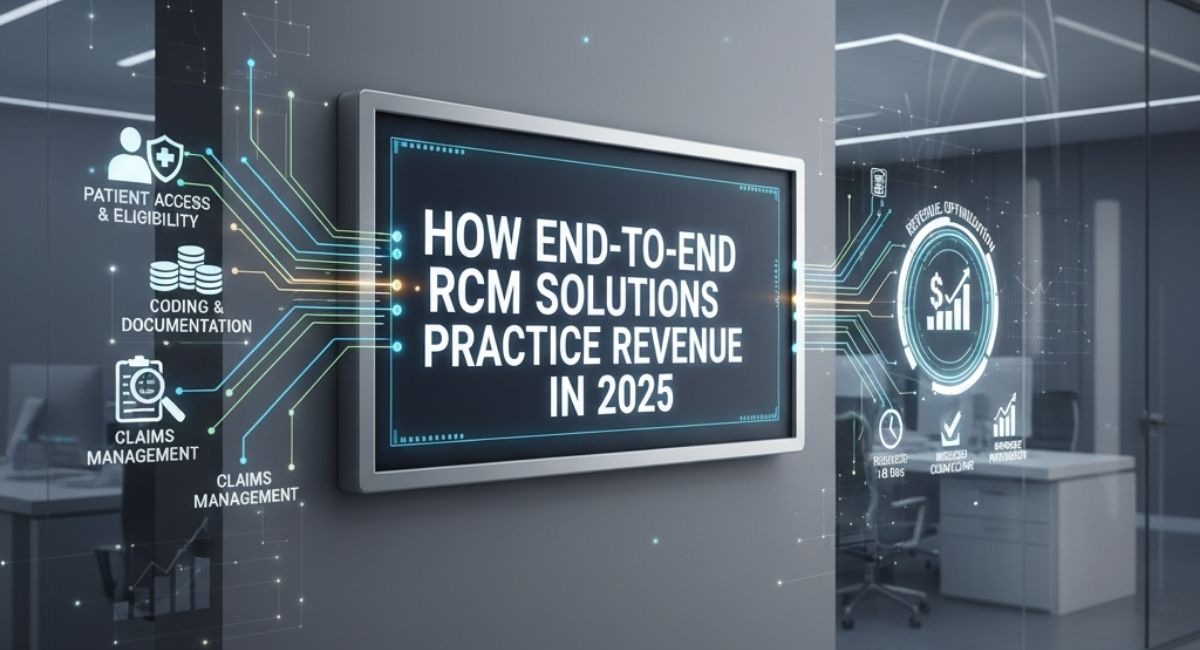
Revenue cycle management (RCM) is the lifeblood of any medical practice’s financial health. In 2026, as payer policies grow more complex and patient expectations shift, practices that rely on piecemeal billing systems risk losing reimbursements, delaying collections, and hemorrhaging revenue. An end-to-end RCM solution offers a comprehensive, integrated path from patient appointment to final collection, plugging gaps that often drag down practice income. In this guide you will learn how a full RCM workflow raises revenue, reduces administrative waste, strengthens payer relationships, and ensures sustainability. We will also show practical steps, a comparison table, and frequently asked questions to arm you with insight as you consider adopting or upgrading RCM.
If you want to dig deeper into specialty billing or connect with a robust outsourced billing partner, you can explore the medical billing services or specialty billing pages offered by eBridge RCM.
What Does “End-to-End RCM” Really Mean?
When we say “end-to-end RCM,” we refer to a unified suite of functions covering every stage of revenue flow: patient scheduling and eligibility verification, coding, claims submission, denials management, accounts receivable follow-up, patient billing, payment posting, analytics, and reconciliation. Rather than each department or software acting in isolation, an end-to-end RCM platform synchronizes workstreams so errors are caught early, data flows smoothly, and decisions are made on solid insights.
Traditional or fragmented approaches may outsource just billing, or use standalone software modules for coding, but these leave gaps—especially when coordination is weak or data must be manually transferred between systems.
Why Practices Need Full-Cycle RCM in 2026
There are several strong drivers pushing practices toward full-cycle RCM. Understanding these will help you frame the business case.
- Increased payer complexity
Insurance rules, prior authorization demands, and payer-specific coding edits change frequently. A disjointed system may fail to adapt quickly enough, leading to denials or underpayments. - Consumerism in healthcare
Patients now often carry higher deductibles or pay a larger share of costs. A partial RCM approach might not support flexible patient billing, self-service portals, or proper cost estimations. - Regulatory compliance demands
Audits, government rules, documentation standards—if a system fails to maintain audit trails or coding accuracy, fines or recoupments may follow. - Cost pressure on operations
Staffing costs, training, and turnover make manual handoffs or error correction expensive. A unified solution reduces redundant effort and rework. - Analytics and revenue intelligence
To make adjustments—e.g. spotting underperforming payers, optimizing collection strategies—you need end-to-end data. Fragmented systems provide only isolated views.
How End-to-End RCM Directly Boosts Practice Revenue
Below is a breakdown of how integrated RCM workflows improve revenue in real, measurable ways. Each section shows a challenge in a partial system and how an end-to-end solution overcomes it.
1. Early Error Prevention and Clean Claim Submission
A major source of lost revenue is claim denials caused by missing information, eligibility failures, or coding mismatches. With a fully integrated solution:
- Eligibility and benefits verification happen at scheduling, so patients whose coverage has lapsed are flagged immediately.
- Coding modules can auto-validate against payer rules and alert coders or clinicians to potential mismatches before claim submission.
- Claims are scrubbed in real time with built-in edits to reduce rejections due to format, missing fields, or invalid codes.
By reducing first-pass denials, practices spend less time in appeals and more time getting paid. Many practices report a 20–40% drop in denials after adopting full-cycle RCM.
2. Faster Turnaround and Shorter Days in Accounts Receivable
In a fragmented approach, delays often creep in between one handoff and another—for example, billing grabbing coded claims, or appeals waiting for status updates. With an integrated platform:
- Status updates flow automatically; billing sees in real time which claims are paid, denied, or under review.
- Automated reminders and workflows prompt follow-up quickly on aged claims.
- Dashboards highlight bottlenecks or escalations so staff can act before claims age too much.
Shortening A/R days means you collect sooner, reduce the risk of write-offs, and improve cash flow.
3. Efficient Denial Management and Appeals
Denials are inevitable in healthcare claims, but how you manage them will determine how much revenue you reclaim. End-to-end systems:
- Classify denials by reason, payer, or trend pattern automatically.
- Assign workflow rules (e.g., low-dollar denials auto-appeal, others flagged for manual review).
- Maintain a rule history so appeals use prior logic and reduce repeated mistakes.
By implementing structured denial workflows, rather than ad hoc follow-up, practices see a higher recovery rate and fewer repeat denials.
4. Streamlined Patient Billing and Engagement
An integrated solution doesn’t stop at payer payments. It carries forward to patient billing smoothly:
- Patient statements respect posted payments and insurance adjustments, reducing confusion.
- Self-service portals allow patients to view balances, set up payment plans, or pay online.
- Automated communication (email, SMS) can send reminders, escalation notices, or balance alerts.
Better patient engagement means fewer “lost” balances, fewer disputes, and more on-time payments.
5. Consolidated Analytics and Revenue Insight
To manage revenue growth, you need visibility across all stages. An end-to-end RCM solution gives:
- Real-time dashboards that display collection rates, days in A/R, denial sources, payer performance.
- Ability to slice data by provider, specialty, payer, location, or time period.
- KPI alerts when metrics deviate from targets (e.g. denial rate rising above threshold).
With these insights, practice leadership can act proactively: negotiate contracts, reassign resources, or adjust payer mix strategies.
6. Reduced Administrative Cost and Overhead
When multiple systems operate separately, staff often duplicate tasks—re-entering data, reconciling between modules, manually generating reports. Integration reduces these wasteful steps. Practices save on staff hours, reduce human error costs, and scale operations without linear growth in overhead.
Steps to Implement End-to-End RCM (2026 Edition)
Below is a hands-on guide you can follow step-by-step to adopt or upgrade to a full RCM solution. Think of this as a playbook to guide implementation, calibration, and continuous improvement.
| Phase | Key Tasks | Milestones / Output |
| Pre-Implementation Planning | Map current workflows and data flows; define KPIs and improvement targets; assemble cross-functional team (clinical, billing, IT, leadership) | Documented process maps, baseline metrics (denial rate, A/R days, collections) |
| Vendor Selection and Contracting | Evaluate end-to-end RCM vendors; ensure modules include coding, billing, denials, analytics, patient statements; negotiate service-level agreements (SLAs) | Signed agreement with vendor, implementation schedule |
| Data Migration & Integration | Import historical claims, patient demographics, payment history; integrate with EHR / EMR; set up clearinghouse / payer interfaces | Clean data loaded; interfaces tested with payers |
| Workflow Configuration | Configure rules for eligibility checks, coding edits, denial classification, appeal logic, patient billing cycles | Rule sets active; test cases pass through workflow without error |
| Staff Training & Change Management | Train staff on new workflow, dashboards, exception handling; establish escalation paths | Staff accepted training; initial pilot use |
| Pilot / Parallel Run | Run new RCM engine in parallel with legacy system for a limited period or subset of claims | Discrepancy reports, tuning adjustments |
| Full Cutover & Monitoring | Switch fully to end-to-end RCM; monitor early metrics daily / weekly | KPI monitoring in place; immediate corrective actions |
| Continuous Improvement | Use analytics to spot new denials, payer trends, underperforming staff; tweak rules and processes | Quarterly improvement cycles, incremental revenue gains |
As you go through each phase, the key is to establish feedback loops so you can iterate. A best practice is to monitor early indicators—e.g., claim scrub error rates, denial volumes, days in A/R—and act rapidly when anomalies surface.
Example Impact: Before and After End-to-End RCM
Here is a simplified example of how metrics might shift after adoption.
| Metric | Before (Fragmented RCM) | After (End-to-End RCM) | Approximate Improvement |
| Denial rate | 8–12% | 4–6% | 30–50% reduction |
| Days in A/R | 55–70 days | 30–45 days | 20–25 days shorter |
| Average collection lag | 45 days | 25–35 days | 10–20 days faster |
| Recovery from denials | 30% | 55–70% | 1.8–2× more recovered |
| Staff time per claim | High manual touches | Automated workflows | 20–40% lower effort |
Because fewer claims are returned, appeals are more effective, and patient billing is smoother, overall revenue often increases by 10–25% (depending on practice size, payer mix, and baseline inefficiencies).
Challenges, Risks, and Mitigations
Even the best system can’t succeed without attention to implementation risk. Below is a list of potential pitfalls and how to handle them.
- Data quality issues during migration
If historical records or payer IDs are inconsistent, claims might be rejected or misrouted. Mitigation: perform thorough data cleansing, deduplication, and pilot test batches before full go-live. - Resistance to change from staff
People often resist new systems, especially when they imply new roles or workflows. Mitigation: involve staff early, solicit feedback, provide hands-on training, maintain transparency about the benefits. - Workflow bottlenecks due to rule misconfiguration
Overly aggressive rules (e.g. rejecting claims with minor discrepancies) may slow throughput. Mitigation: begin with conservative rule sets, monitor exceptions, and gradually tighten logic. - Payer interface or EHR integration issues
Discrepancies in formats or communication protocols may block flows. Mitigation: partner with RCM vendors familiar with your EHR and payer environment, and include interface testing in contracts. - Underestimating ongoing maintenance
Payer rules evolve, new codes arrive, regulatory policies change. Mitigation: plan for regular audits, update rule sets, and reserve resources for upkeep. - Failure to act on analytics insights
Simply having dashboards doesn’t yield results if nobody monitors or acts on them. Mitigation: assign a revenue cycle manager or champion to review metrics weekly and drive improvements.
Best Practices to Sustain Revenue Growth
Once your end-to-end system is live, your job shifts to maintaining performance and evolving with the market. Here are some recommended best practices.
- Conduct periodic billing audits and compliance checks
- Update denial logic and scrubbing rules monthly, based on new payer change logs
- Monitor payer performance and renegotiate contracts based on data
- Benchmark your metrics (denial rates, A/R days) against national standards
- Use predictive odeling or AI enhancements (if available) to identify at-risk claims or patient balances
- Maintain staff training and cross-training so backup resources exist
- Review patient collections workflows and refine self-pay options
A digital RCM partner that supports multiple specialties may be particularly effective. For example, if your practice is in cardiology or dermatology, you can examine how eBridge RCM’s cardiology billing or dermatology billing services structure RCM rules and integrate with specialty workflows.
Internal Linking Examples in Context
In the context of specialty workflows, a practice focusing on internal medicine might compare its model with eBridge RCM’s general medicine billing approach to see how complex chronic care coding is handled. If you practice in gastroenterology, you might examine our gastroenterology billing services to see how GI-specific rules or payer edits are managed. When your contract negotiations or payer auditing arise, you might draw lessons from their monthly billing audit offering. And when you explore migrating to cloud-first processing, their post on benefits of migrating to cloud RCM solutions offers a more technical viewpoint.
Frequently Asked Questions
Q: Is end-to-end RCM only for large practices?
A: No. Practices of medium or even small size benefit because the efficiencies eliminate many manual bottlenecks. The ROI may be even stronger in smaller organizations that lack economies of scale.
Q: How long does it take to see revenue gains?
A: Some improvements—such as reduced denials—may show in the first 30–90 days post-go-live. But full stabilization, workflow maturity, and larger revenue lift typically take 6–12 months.
Q: Do I still need staff if I adopt an end-to-end solution?
A: Yes, but their roles shift. Instead of rework, data entry, or chasing paperwork, staff become monitors, exception handlers, and strategic analysts. Your headcount may remain stable or even shrink modestly.
Q: What about specialty practices with unique coding rules?
A: A robust end-to-end RCM provider should support specialized rule sets; for instance, in pain management, neurology, or urology. You should confirm that specialty billing modules or expertise exist (for example through the specialization services offered by eBridge RCM).
Q: What’s the typical cost or pricing model?
A: Many RCM providers offer a percentage-based model (e.g. a share of collected revenue) or a fixed-fee per claim basis. You should ensure that the contract defines performance thresholds, SLAs, and clawback protections.
Q: How does security and compliance fare in unified RCM?
A: A mature RCM solution should offer audit trails, role-based access, data encryption, and HIPAA compliance building blocks. You should demand evidence of security certifications and periodic compliance audits.
Final Thoughts and Next Steps
In 2026, practices can no longer afford to let revenue leak through gaps between modules or teams. When you adopt a unified end-to-end revenue cycle management solution, you reduce denials, speed collections, decrease administrative cost, and gain actionable insights. The playbook laid out above gives you a practical path from planning to continuous improvement.
To get started, benchmark your current metrics (denials, A/R days, staff effort), evaluate vendors who offer full coding, billing, denials, and analytics capabilities, and structure your contract with clear performance obligations. As you scale or specialize, you may draw on the approaches used by practices partnering with eBridge RCM in specialties like anesthesiology billing or podiatry billing.
If you are ready to move forward, consider engaging a partner who can migrate your system, integrate with your EHR, and manage specialty workflows under transparent SLAs so revenue growth becomes part of your practice’s DNA. Your financial stability in the years ahead may hinge on making the switch sooner rather than later.
eBridge RCM LLC stands ready to support practices with comprehensive RCM services, continuous audits, and specialty billing capabilities.