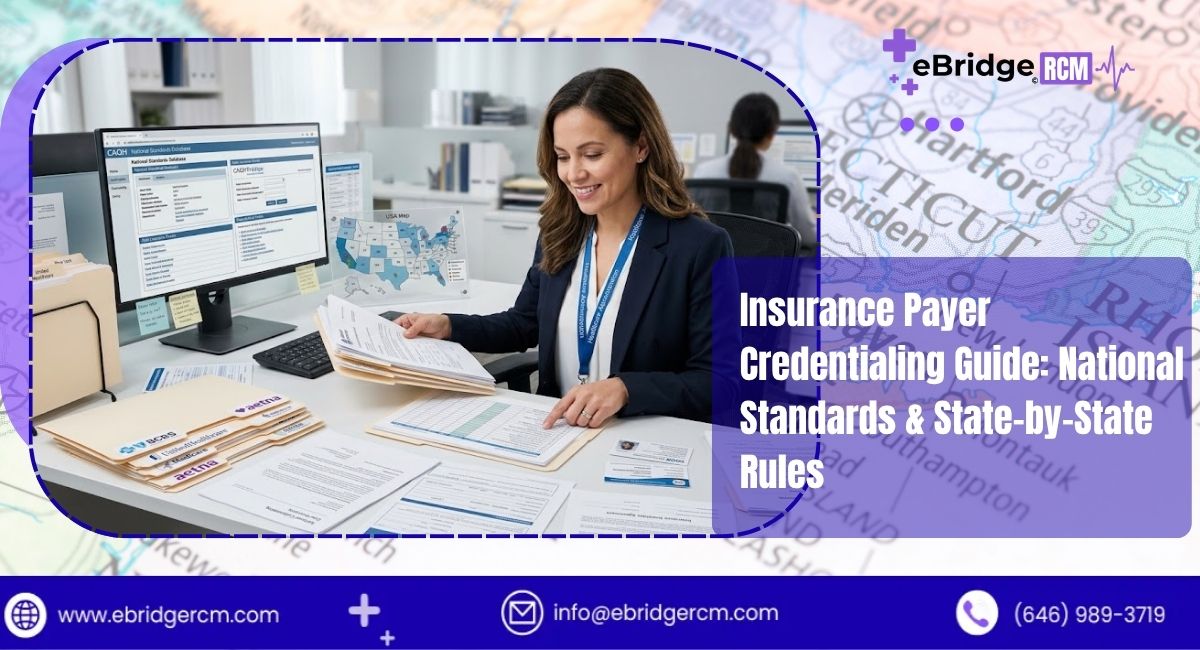
Insurance payer credentialing can determine whether a healthcare provider is properly positioned to participate in an insurance network and bill for covered services. Yet many practices treat credentialing as a one-time application instead of an ongoing process involving verification, payer enrollment, contracting, state requirements, and regular updates.
A provider can have an active license and still be unable to bill a specific payer. A completed CAQH profile does not automatically establish Medicare enrollment. A physician joining an established group may need a separate payer affiliation before claims can be submitted correctly.
The reason is that there is no single credentialing process used by every payer and every state.
National credentialing frameworks provide a foundation for verification and quality control. State licensing boards and Medicaid programs add their own requirements. Commercial insurers may have separate applications, contracts, participation rules, and documentation requirements.
This insurance payer credentialing guide explains how these requirements fit together, what practices should prepare, how state rules affect the process, and what to monitor after approval.
What Is Insurance Payer Credentialing?
Insurance payer credentialing is the process through which a health plan or other payer verifies a healthcare provider’s qualifications before approving the provider for network participation.
The review can involve the provider’s education, training, professional license, board certification, work history, malpractice coverage, hospital privileges, sanctions, and other professional information.
Credentialing is closely related to provider enrollment, but the terms are not interchangeable.
Credentialing focuses on verifying professional qualifications and determining whether the provider meets the payer’s participation requirements. Enrollment establishes the provider’s participation and billing relationship with a particular health plan or government program.
For example, Medicare uses the Centers for Medicare & Medicaid Services (CMS) enrollment process and PECOS. CMS states that providers enrolling in Medicare generally begin by obtaining an NPI and then completing the Medicare enrollment application through PECOS.
Commercial insurance credentialing can involve CAQH ProView, payer-specific applications, contracts, group affiliations, and additional documentation.
This distinction is important because completing one part of the process does not necessarily complete the others.
Why Insurance Payer Credentialing Matters
Credentialing affects more than whether a provider appears in an insurer’s directory.
A practice can experience problems with claims, reimbursement, provider onboarding, and network participation when credentialing information is incomplete or outdated.
For example, consider a physician who joins a medical group. The physician already has an active license, NPI, malpractice insurance, and board certification. The group also has an existing contract with several insurance companies.
That does not necessarily mean the new physician is immediately credentialed under those contracts.
The payer may still need to verify the physician’s qualifications, connect the provider to the group, confirm the practice location, and establish the appropriate participation or effective date.
If the practice starts billing before the payer’s records are properly updated, the resulting claims may require additional attention.
This is why credentialing should be connected to the broader revenue cycle rather than handled as an isolated administrative task. Practices can also review this medical billing compliance checklist when building a broader compliance process.
National Standards for Insurance Payer Credentialing
There is no single federal credentialing checklist that governs every commercial health plan. However, national organizations and regulatory frameworks provide important guidance for how credentialing should be performed.
The National Committee for Quality Assurance (NCQA) is one of the most important organizations in this area. NCQA’s credentialing standards address areas such as credential verification, credentialing committee review, and monitoring of sanctions, complaints, and quality issues. Its framework includes verification through a primary source, recognized source, or contracted agent of the primary source.
That does not mean every physician follows one identical NCQA application. Rather, NCQA provides a framework used by organizations involved in health plan credentialing and credential verification.
For individual practices, the practical approach is to understand these standards while following the specific requirements of each payer and applicable government program.
Primary-Source Verification
Primary-source verification is a core concept in professional credentialing.
Instead of relying solely on documents supplied by the provider, the credentialing organization verifies important information through an authoritative source.
Examples include verifying a professional license with the applicable licensing authority or confirming board certification with the relevant certification organization.
The purpose is to establish that the information in the credentialing file is accurate and current.
NCQA’s current credentialing requirements specifically address verification through primary sources, recognized sources, or contracted agents.
For practices, this means maintaining a document is only one part of credential management. The information may also need to be independently verified.
Core Requirements of Insurance Payer Credentialing
Provider Identity and NPI Information
Accurate provider identification is the foundation of payer enrollment.
Credentialing and enrollment records commonly include the provider’s legal name, individual NPI, taxonomy, practice locations, billing information, and group affiliation.
For group practices, the organizational NPI and individual provider NPI must be used correctly within the applicable billing arrangement.
A mismatch between the provider’s name, NPI, taxonomy, address, or group information can create unnecessary verification questions and enrollment delays.
Practices should therefore compare information across CAQH, NPPES, payer applications, Medicare enrollment records, and their internal practice management systems.
For a deeper explanation of the identifiers involved, see this guide to group NPI vs. individual NPI billing.
State Licensure
Payers generally need confirmation that a provider holds the appropriate license to practice in the jurisdiction where services are provided.
This becomes more important when providers practice across multiple states. Each license may have its own expiration date, status, and disciplinary history.
A credentialing file should therefore track the license number, state, status, effective date, and expiration date.
When a license is renewed, practices should update the relevant payer records rather than assuming the payer will automatically receive the new information.
Education and Training
Credentialing applications may require verification of professional education and postgraduate training.
Depending on the provider, the file can include medical or professional school, internship, residency, fellowship, and specialty training information.
The requirements can vary by specialty and payer. A cardiologist may have different documentation requirements from a behavioral health practitioner or physical therapist.
The important point is consistency. Dates, institutions, specialties, and certifications should match across the provider’s credentialing records.
Cardiology Credentialing Timeline
Board Certification
Board certification can play a role in specialty designation and payer participation.
Where certification is relevant, practices should maintain current information about the certifying organization, specialty, certification status, and renewal requirements.
An outdated certification record can create a discrepancy even when the provider remains fully qualified to practice.
Are Credentialing Delays Keeping You From Getting Paid?
Let eBridge RCM help manage payer enrollment, credentialing paperwork, and follow-ups so your providers can get in-network and start billing with fewer delays.
Work History
Payers may review a provider’s professional history for a specified period. Gaps in employment or practice history may require an explanation.
A complete provider history should clearly show previous employers, practice locations, roles, and dates.
Providers who have relocated, changed employers, or operated several practices should be especially careful when documenting transitions.
Malpractice Coverage
Payers may request evidence of professional liability insurance, including the current carrier, policy dates, coverage limits, and claims information when applicable.
Requirements vary by payer and specialty, so practices should rely on the current payer checklist rather than assuming one standard applies to every network.
Hospital Privileges
Hospital privileges can be relevant to credentialing for certain specialties and payer networks.
However, not every provider needs hospital privileges. Requirements depend on the provider’s specialty, scope of practice, payer policy, and applicable rules.
When hospital privileges are relevant, the practice should maintain current information and document changes promptly.
Sanctions and Exclusions
Credentialing can also involve screening for sanctions, disciplinary actions, exclusions, and other adverse information.
This is particularly important for providers participating in government healthcare programs. Practices should have a documented process for applicable exclusion and sanction checks instead of relying on a one-time review.
CAQH ProView and Insurance Credentialing
CAQH ProView is widely used to organize provider credentialing information for participating health plans and organizations.
Instead of completing an entirely new professional profile for every participating payer, providers can maintain centralized information that authorized organizations may access.
A CAQH profile can contain information about professional education, licenses, work history, malpractice coverage, board certification, practice locations, and other credentials.
CAQH can reduce duplicate data entry, but it does not eliminate payer-specific requirements.
A payer may still require its own application, contract, group affiliation documentation, state-specific forms, attestations, or other enrollment steps.
The practical rule is simple: maintain CAQH accurately, but always follow the individual payer’s current instructions.
NPI, CAQH, and PECOS: What Is the Difference?
These systems are often discussed together, but they serve different purposes.
| System or identifier | Primary purpose | Common use |
| NPI | Identifies healthcare providers and organizations | Used in healthcare transactions and enrollment |
| NPPES | Maintains NPI records | NPI application and provider information |
| CAQH ProView | Centralizes professional credentialing information | Commercial payer credentialing |
| PECOS | Manages Medicare enrollment | Medicare enrollment, updates, and revalidation |
| State Medicaid system | Manages state Medicaid participation | Medicaid provider enrollment |
Understanding the distinction helps prevent one of the most common credentialing mistakes: assuming that an approved record in one system automatically updates another.
Need Help Getting Your Providers Enrolled With Insurance Payers?
From applications to payer follow-ups, eBridge RCM helps manage the credentialing process and keeps your enrollment moving in the right direction.
Medicare Enrollment and PECOS
Medicare enrollment should be handled separately from ordinary commercial payer credentialing.
CMS identifies PECOS as the online Medicare enrollment system used by providers and suppliers. Through PECOS, providers can enroll, update enrollment information, and manage revalidation.
CMS’s provider enrollment guidance lists obtaining an NPI as the first step for providers who do not already have one, followed by completing the Medicare enrollment application through PECOS. The applicable Medicare Administrative Contractor can then request additional information during processing.
A provider may therefore maintain a CAQH profile for commercial payer credentialing while separately managing Medicare enrollment through PECOS.
This separation becomes particularly important when a provider changes practice locations, ownership arrangements, or other enrollment information.
CMS currently instructs providers to report certain Medicare enrollment changes within specific timeframes. For example, changes involving ownership, adverse legal actions, and practice location generally require reporting within 30 days, while other changes generally have a 90-day reporting timeframe.
Practices should always confirm the current CMS requirements for their specific provider type and enrollment situation.
State-by-State Insurance Credentialing Rules
State requirements are one of the most complicated parts of payer credentialing because several different regulatory layers can apply at the same time.
A practice may need to consider professional licensing requirements, state Medicaid enrollment, health plan regulations, provider directory rules, and individual payer policies.
These requirements should not be treated as interchangeable.
A state Medicaid enrollment requirement is different from a commercial payer’s internal credentialing requirement. Similarly, a medical licensing requirement is different from a payer contract requirement.
How State Requirements Affect Credentialing
State-specific differences can involve:
- Professional license requirements
- Medicaid enrollment
- Managed care participation
- Provider disclosures
- Practice ownership information
- Additional documentation
- Health plan credentialing requirements
- Provider directory information
Because state rules and payer policies can change, practices should verify requirements with the applicable state agency, licensing authority, and payer before submitting an application.
State Credentialing Planning Table
| State | Primary checkpoint |
| California | Review professional licensing, Medi-Cal enrollment, and individual health plan requirements |
| Florida | Confirm Florida licensure and applicable Medicaid and commercial payer requirements |
| Illinois | Review state licensing, Medicaid enrollment, and payer-specific requirements |
| Massachusetts | Verify professional licensing and applicable payer or Medicaid requirements |
| New Jersey | Review licensing, Medicaid enrollment, and commercial payer participation |
| New York | Verify professional licensing, Medicaid requirements, and health plan participation rules |
| Pennsylvania | Review licensing, Medicaid enrollment, and payer-specific documentation |
| Texas | Confirm Texas licensure and applicable Medicaid and commercial payer requirements |
| Virginia | Review licensing and payer or Medicaid enrollment requirements |
| Washington | Verify state licensing, Medicaid enrollment, and health plan requirements |
This table is a planning reference, not a replacement for current state or payer guidance. The applicable requirements can depend on the provider’s specialty, license type, practice structure, payer, and participation status.
Medicaid Provider Enrollment and State Requirements
Medicaid deserves separate attention because each state operates its own Medicaid program within the broader federal Medicaid framework.
A provider enrolling in Medicaid may need to submit state-specific documentation even when the provider already has a complete CAQH profile and participates with commercial insurers.
Depending on the state and provider type, the enrollment process can involve information about ownership, licenses, NPIs, taxonomy, practice locations, tax information, and other disclosures.
This is why practices expanding into a new state should begin by identifying the applicable Medicaid agency and enrollment process rather than copying an existing commercial payer application.
The Insurance Payer Credentialing Process
Step 1: Build the Provider File
Start with a complete provider profile.
Gather the information needed to support licensure, education, training, board certification, malpractice coverage, work history, practice locations, and group affiliation.
For group practices, organizational information should be reviewed at the same time.
Step 2: Verify the Information
Before submitting applications, compare the provider’s information across the systems used by the practice.
Pay particular attention to names, addresses, NPIs, taxonomy, license information, group affiliations, and effective dates.
An application can be technically complete and still create delays if its information conflicts with another source.
Step 3: Review Payer Requirements
Each payer should have its own credentialing and enrollment checklist.
Determine whether the payer requires CAQH access, a separate application, group documentation, contract information, additional attestations, or state-specific forms.
Step 4: Submit and Track
After submission, record the payer, provider, submission date, application type, tracking number, outstanding documents, follow-up dates, and final status.
A centralized tracking system becomes increasingly important as the practice adds providers and payer relationships.
Step 5: Confirm Approval and Effective Date
An approval notice should be reviewed carefully.
Confirm that the provider is associated with the correct group and location and that the effective date is documented before relying on the payer relationship for billing.
Step 6: Update Operational Systems
Once credentialing is complete, update the EHR, practice management system, clearinghouse, payer portals, and other systems that depend on provider participation information.
Credentialing information should flow into billing operations rather than remain in a separate administrative file.
Common Insurance Credentialing Mistakes
Credentialing problems often come from small administrative inconsistencies rather than major qualification issues.
Relying Only on CAQH
CAQH can centralize credentialing information, but it does not replace every payer application, contract, or government enrollment system.
Submitting Inconsistent Information
Differences in provider names, addresses, taxonomy, NPIs, group affiliations, or effective dates can lead to verification questions.
Ignoring Group Affiliations
Credentialing the individual provider does not necessarily establish the provider’s relationship with a specific group.
The payer may need separate information linking the clinician to the group, tax entity, location, or billing arrangement.
Waiting Until the Provider Starts
Credentialing should be incorporated into provider onboarding. Waiting until a physician or other clinician is already seeing patients can create a mismatch between clinical operations and payer participation.
Treating Recredentialing as a One-Time Update
Provider records need ongoing maintenance. Licenses, malpractice coverage, certifications, locations, and group relationships can change after initial approval.
Practices should also maintain documentation in a way that supports payer reviews and audits. This audit-ready practices guide provides additional guidance on maintaining organized payer-related records.
Recredentialing and Ongoing Compliance
Credentialing does not end after the payer approves the provider.
Ongoing monitoring is part of maintaining a reliable credentialing program. NCQA’s credentialing framework addresses re-credentialing as well as monitoring sanctions, complaints, and quality issues between credentialing cycles.
Practices should maintain a centralized calendar for important renewal and review dates, including licenses, malpractice coverage, certifications, CAQH attestations, payer re-credentialing, Medicare revalidation, and Medicaid requirements where applicable.
The exact re-credentialing and revalidation cycle depends on the payer or program. Practices should therefore avoid relying on one universal renewal period.
The goal is to identify expiring information before it becomes a payer participation problem.
How Credentialing Problems Affect Revenue
Credentialing issues can eventually become revenue cycle issues.
Consider a practice that hires a physician and submits the provider’s payer applications shortly before the start date. The physician begins seeing patients while some payer enrollments are still pending.
The practice now has to determine whether the provider was eligible to bill the payer on those service dates, whether the claim can be processed under the existing group arrangement, and whether additional action is needed.
This creates unnecessary administrative work.
Credentialing should therefore be coordinated with scheduling, provider onboarding, eligibility verification, billing, and claims management.
Eligibility verification and credentialing serve different purposes. Eligibility confirms the patient’s coverage and benefits. Credentialing confirms the provider’s participation relationship with the payer.
Practices can review this resource on insurance eligibility verification for the patient-side portion of that process.
Credentialing for Group Practices
Group practices have another layer of complexity because the organization and individual providers may have separate enrollment records.
The practice may need to manage the group NPI, individual NPIs, tax information, payer contracts, practice locations, provider affiliations, and billing relationships.
When a new provider joins the group, the practice should not assume that an existing group contract automatically makes the provider billable under every payer.
The payer may need to credential the provider individually and then associate that provider with the group.
The same principle applies when a provider leaves a practice. Payer records may need to be updated so that the provider is no longer associated with the former group or location.
When Should a Practice Outsource Credentialing?
Outsourcing can be practical for practices managing several providers, multiple payer contracts, frequent provider changes, or limited administrative resources.
The value of an external credentialing team is often its ability to maintain a repeatable process across applications, follow-ups, document management, and renewals.
A credentialing workflow may include:
- Provider file preparation
- CAQH maintenance
- Payer application submission
- Application status tracking
- Document follow-up
- License monitoring
- Recredentialing
- Group affiliation updates
Insurance Payer Credentialing Checklist
Before submitting an application, review the provider record for accuracy and completeness.
- Confirm the provider’s legal name, NPI, taxonomy, and practice locations.
- Verify active state licenses and relevant certifications.
- Check education, training, work history, malpractice, and hospital affiliation information.
- Make sure CAQH information is current and properly attested where applicable.
- Review payer-specific and state-specific requirements.
- Confirm group affiliation, billing entity, and organizational information.
- Record the application date, tracking number, follow-up dates, approval, and effective date.
- Schedule future credentialing NY, re-credentialing, revalidation, and renewal tasks.
Frequently Asked Questions About Insurance Payer Credentialing
How long does insurance payer credentialing take?
There is no universal turnaround time. Processing depends on the payer, provider type, application completeness, verification requirements, state rules, and whether additional information is requested.
A practice should avoid relying on a fixed number of days unless the payer has provided a specific processing timeframe.
Is CAQH required for every payer?
No. Many commercial payers use CAQH, but requirements vary.
A payer can still require its own application, contract, group affiliation documentation, or other supporting information.
Is credentialing the same as Medicare enrollment?
No. Medicare enrollment is managed through CMS, with PECOS serving as the online enrollment system for providers and suppliers. Commercial payer credentialing follows the applicable health plan’s process.
Are credentialing requirements the same in every state?
No. Professional licensing, Medicaid enrollment, health plan regulation, and payer requirements can differ by state.
Practices should distinguish between state law, Medicaid program requirements, and individual payer policies.
Does a provider joining a group need to be credentialed?
In many cases, yes. The provider may need individual credentialing and a separate group affiliation or enrollment update.
The exact process depends on the payer and the group’s contractual arrangement.
What happens when a provider’s license expires?
An expired license can affect the provider’s ability to participate with a payer and may create compliance or billing problems.
Practices should monitor license expiration dates and update payer records after renewal.
Final Takeaway
Insurance payer credentialing is best managed as an ongoing operational process, not a single application.
The core work involves accurate provider data, primary-source verification, state licensing, payer requirements, CAQH, Medicare PECOS where applicable, Medicaid enrollment, group affiliations, and ongoing monitoring.
National frameworks such as NCQA provide important credentialing and verification standards, while CMS maintains its own Medicare enrollment requirements through PECOS. State agencies and individual payers then add requirements that practices must evaluate separately.
The most effective approach is to maintain one accurate provider record, verify information before submission, track each payer application independently, confirm participation and effective dates, and monitor credentials after approval.
For practices that need help managing this process, eBridge RCM LLC provides medical credentialing services in USA that support provider credentialing, payer enrollment, recredentialing, and related administrative workflows.