
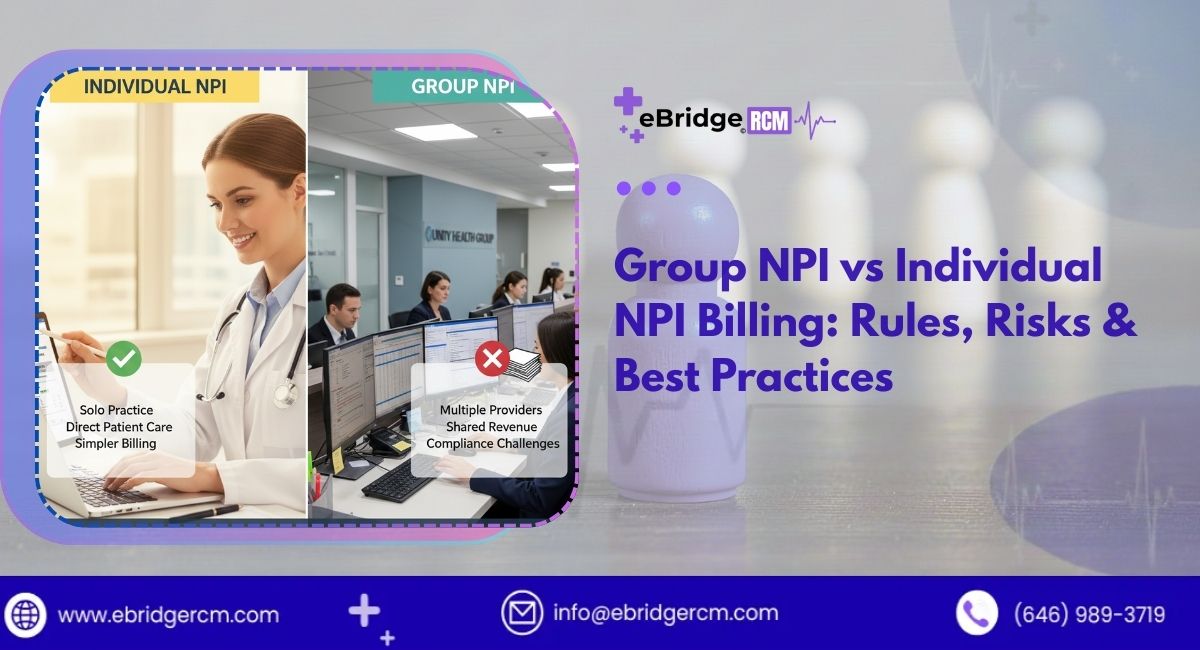
In medical billing, understanding the distinction between Group National Provider Identifier (NPI) and Individual NPI is essential for maintaining accurate claims and optimizing revenue cycle management. Many healthcare providers and billing staff face challenges in selecting the correct NPI, which can lead to claim denials, delayed reimbursements, and regulatory complications. To ensure smooth billing processes, it is critical to grasp the rules, potential risks, and best practices associated with using Group and Individual NPIs. For practices navigating these complexities, our Credentialing Services for Internal Medicine Providers can help streamline NPI management.
An NPI is a unique 10-digit identifier issued to healthcare providers in the United States by the Centers for Medicare and Medicaid Services (CMS). It is used in administrative and financial transactions, such as electronic claims, remittance advice, and patient records. There are two main types of NPIs relevant to medical billing: Individual NPIs assigned to a single provider and Group NPIs assigned to an organization or group practice.
Role of Group and Individual NPIs
Individual NPIs identify a specific provider responsible for delivering healthcare services. This is essential for professional claims where payer reimbursement depends on the rendering provider’s credentials and licensure. On the other hand, Group NPIs represent an entire practice or organizational entity. Claims submitted under a Group NPI indicate that the practice is the billing entity, while individual providers within that group may still appear on the claim as rendering providers.
Specialty practices, such as Cardiology Billing, often rely on accurate NPI usage for successful claim submission.
Key Differences Between Group and Individual NPIs
| Feature | Individual NPI | Group NPI |
| Purpose | Identifies a single healthcare provider | Identifies a healthcare organization or practice |
| Usage | Used for professional services rendered by a specific provider | Used for billing services on behalf of the group practice |
| Billing Impact | Determines provider-specific reimbursement | Allows centralized billing and claim submission for the practice |
| Reporting | Linked to provider credentials and tax information | Linked to practice tax ID and organizational structure |
Rules for Using Group and Individual NPIs
- Claims for professional services must include the Individual NPI of the rendering provider to ensure accurate payment.
- Institutional or facility claims should include the Group NPI as the billing entity, while the rendering provider is noted separately.
- Medicare and commercial payers have strict guidelines on NPI usage. Incorrect pairing of Individual and Group NPIs can trigger denials or audits.
- When a provider works in multiple practices, ensure that NPIs are correctly matched with each practice’s tax ID to prevent claim misrouting.
Risks of Improper NPI Usage
Using the wrong NPI can cause delays and financial losses. Some common risks include:
- Claim denials due to mismatched NPIs
- Compliance violations and potential audits
- Reduced revenue from delayed or denied claims
- Increased administrative burden to correct errors
Best Practices for Group and Individual NPI Billing
Maintain Accurate Records
Regularly update and verify both Individual and Group NPIs with CMS and payers.
Educate Staff
Train billing and administrative staff on correct NPI usage and payer requirements.
Leverage Technology
Implement EMR and RCM systems that automatically validate NPIs during claim submission. Our EMR Integration Services can streamline NPI management and reduce errors.
Centralized Billing Policies
Establish clear rules within your practice for when to use Group NPIs versus Individual NPIs to maintain consistency.
Monitor Denials
Track denials related to NPI mismatches and adjust processes accordingly. Consulting top outsourced medical billing companies in New York can provide valuable insights into NPI management for practices.
Credentialing Verification
Ensure that all providers within a group have properly credentialed Individual NPIs to avoid submission errors. Our Medical Credentialing Services help streamline this process for multiple specialties, including cardiology and internal medicine.
Using NPIs Across Multiple Specialties
Practices that offer diverse services, such as Cardiology Billing, Dermatology Billing, or Mental Health Billing, must carefully manage NPIs to avoid errors. Each provider should have an Individual NPI, while the group practice holds a Group NPI for billing. Correct documentation ensures that each service line is reimbursed appropriately and reduces the likelihood of claim denials.
Are NPI Billing Mistakes Creating Problems With Your Claims?
Using the correct individual or group NPI is important for accurate claim submissions. Let eBridge RCM help manage your medical billing and claims so your team can address provider information issues and keep billing tasks organized.
Practical Examples
Example 1: A cardiology group has three physicians. Each physician has an Individual NPI, and the practice has a Group NPI. When submitting claims for echocardiograms performed by Dr. Smith, the claim should include Dr. Smith’s Individual NPI as the rendering provider and the Group NPI as the billing entity.
Example 2: A multidisciplinary practice provides internal medicine and mental health services. Each department’s providers use their Individual NPIs for claims, while the practice uses a single Group NPI to consolidate billing. This approach improves reporting accuracy and simplifies revenue cycle management.
Common NPI Errors and Solutions
| Error | Consequence | Best Practice |
| Using Individual NPI as billing entity | Claim denial | Always use Group NPI for billing entity fields |
| Incorrect pairing of Group and Individual NPIs | Delayed payment | Verify NPI matches rendering provider and practice tax ID |
| Multiple NPIs for a single provider | Confusion in claims | Maintain updated NPI registry and cross-check before submission |
| Missing NPI | Claim rejection | Ensure both Group and Individual NPIs are entered for all claims |
Auditing and Compliance Tips
Routine auditing ensures NPIs are used correctly and in compliance with payer rules. Consider the following:
- Schedule monthly or quarterly NPI audits to validate accuracy.
- Cross-reference NPIs with CMS and payer databases.
- Document all changes to NPI information for compliance records.
- Engage a professional billing service to perform a compliance review. Services like our Monthly Billing Audit and AR Recovery help reduce errors and improve cash flow.
Final Words
Correct use of Group and Individual NPIs is foundational to effective medical billing. By understanding the rules, mitigating risks, and implementing best practices, healthcare providers can improve claim accuracy, reduce denials, and maintain compliance with regulatory requirements. Whether you operate a single-specialty or multi-specialty practice, following structured NPI management processes is essential for a smooth revenue cycle.
For practices looking to enhance their billing efficiency, eBridge RCM LLC provides comprehensive solutions, including Medical Billing Services and Credentialing Services to ensure accurate NPI usage across all providers. Additionally, our EMR Integration Services support automated validation of NPIs to minimize errors.
Helpful Resources
Benefits of Migrating to Cloud RCM Solutions In medical billing, understanding the distinction between Group National Provider Identifier (NPI) and Individual NPI is essential for maintaining accurate claims and optimizing revenue cycle management. Many healthcare providers and billing staff face challenges in selecting the correct NPI, which can lead to claim denials, delayed reimbursements, and regulatory complications. To ensure smooth billing processes, it is critical to grasp the rules, potential risks, and best practices associated with using Group and Individual NPIs. For practices navigating these complexities, our Credentialing Services for Internal Medicine Providers can help streamline NPI management.
An NPI is a unique 10-digit identifier issued to healthcare providers in the United States by the Centers for Medicare and Medicaid Services (CMS). It is used in administrative and financial transactions, such as electronic claims, remittance advice, and patient records. There are two main types of NPIs relevant to medical billing: Individual NPIs assigned to a single provider and Group NPIs assigned to an organization or group practice.