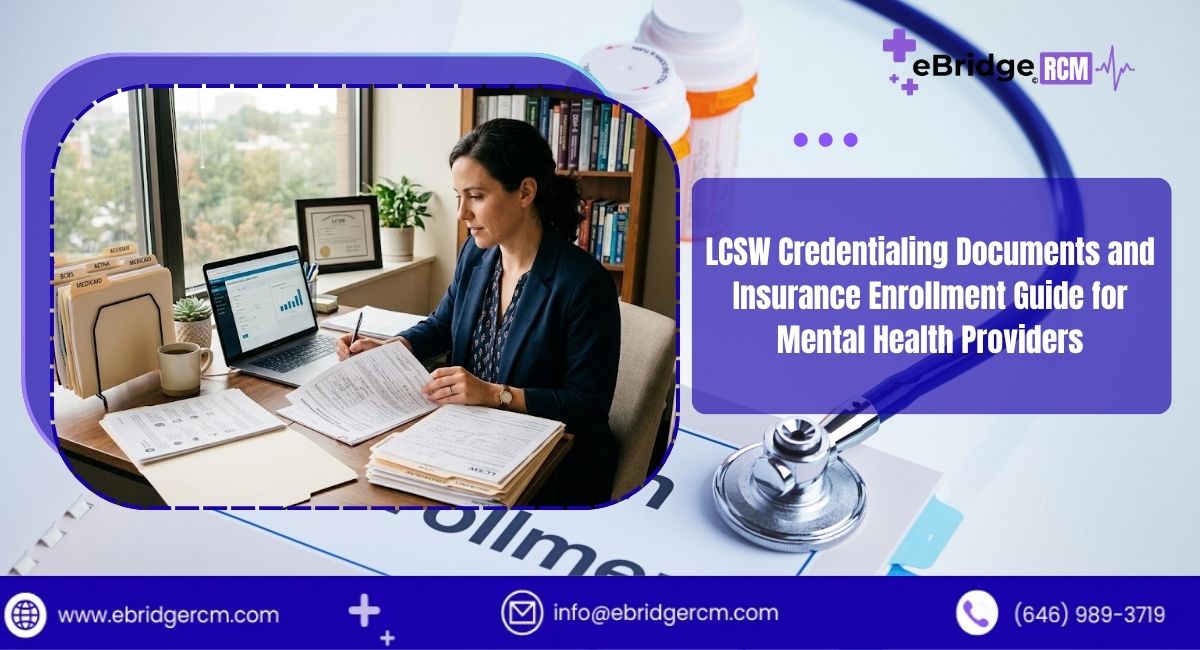
Mental health practices often face delays not because of clinical gaps, but due to incomplete or inconsistent paperwork during insurance onboarding. The LCSW credentialing documents process sits at the center of payer enrollment, reimbursement eligibility, and long-term practice stability. Whether a provider is joining Medicaid, Medicare, or commercial insurance panels, the documentation requirements remain detailed, layered, and highly verification-driven.
This guide explains the full structure of mental health provider enrollment paperwork, breaks down submission categories, and outlines how Licensed Clinical Social Workers can prepare, organize, and maintain credentialing files without repeated rejections.
For providers building long-term systems, this also connects closely with structured workflows such as our internal guide on insurance credentialing for mental health providers, which explains how payer onboarding decisions affect behavioral health reimbursement cycles.
The goal here is simple: reduce administrative friction, improve submission accuracy, and align credentialing with billing readiness.
Understanding Why LCSW Credentialing Documents Drive Insurance Approval
Credentialing is not just a verification formality. It is a structured validation process used by insurance companies to confirm that a provider is legally, professionally, and operationally eligible to treat patients under their network.
For LCSWs, credentialing determines:
- Whether therapy sessions are reimbursable
- Whether a provider can join insurance panels
- Whether claims will pass automated payer checks
- Whether group practices can bill under shared contracts
- Whether compliance standards are met for audits
A single mismatch between documents can delay approval for weeks. This is why many practices adopt structured systems like an insurance payer credentialing guide, which focuses on payer expectations across multiple insurance types.
Credentialing also plays a direct role in revenue flow. Without approval, services cannot be billed even if clinically delivered.
Core Structure of LCSW Credentialing Documents
LCSW credentialing documentation is not a single file submission. It is a collection of verified records grouped into specific categories that insurance payers evaluate independently.
LCSW Credentialing Document Framework
| Category | Purpose | Key Documents |
| Identity Verification | Confirms legal identity | Driver’s license, passport, SSN documentation |
| Licensure Validation | Confirms clinical authority | LCSW license, board verification |
| Education Records | Confirms training background | MSW degree, transcripts |
| Practice Information | Confirms billing entity | W-9, practice address, phone |
| Insurance Coverage | Confirms risk protection | Malpractice certificate |
| Work History | Confirms experience | CV, employment record |
| Enrollment Systems | Standardizes submissions | CAQH profile |
Each category must match exactly across all payer systems to avoid rejection or manual review delays.
Identity and Legal Documentation Requirements
Identity verification is the first checkpoint in all insurance credentialing workflows. Insurance payers prioritize consistency across federal, state, and tax systems.
Required Identity Documents for LCSW Enrollment
Providers are typically required to submit:
- Government-issued photo identification
- Social Security card or IRS documentation
- Legal name change documentation (if applicable)
- National Provider Identifier (NPI) confirmation
The NPI plays a central role in linking providers to billing systems. Any mismatch between NPI records and credentialing forms can result in claim rejections.
A detailed explanation of this system is covered in What is NPI and why it matters in billing workflows, which explains how provider identification affects billing accuracy and payer recognition.
Common Identity Issues in Credentialing
- Name differences between license and NPI record
- Outdated SSN documentation
- Missing legal name change proof
- Incorrect demographic details in CAQH profile
Licensure and Educational Verification for LCSWs
Licensure is the most critical validation point in LCSW insurance credentialing requirements. Insurance companies require proof that providers meet state-level clinical standards.
Required Licensure Documentation
Providers must submit:
- Active LCSW license issued by the state board
- License verification letter (sometimes directly from board)
- MSW degree certificate
- Official academic transcripts
- Supervision completion documentation (if applicable)
Licenses must remain active throughout the entire credentialing review process.
Education Verification Expectations
Insurance payers review:
- Accredited university confirmation
- Degree authenticity
- Graduation dates
- Clinical training hours
Practice Information and Enrollment Paperwork Structure
This category links the provider to a physical or virtual practice location used for billing purposes.
Required Practice Documentation
- IRS Form W-9
- Practice address and service locations
- Phone, fax, and billing contact details
- Business entity structure
- Ownership details for group practices
Providers working in group settings must ensure consistency between organizational records and individual enrollment files.
Operational structure also affects billing efficiency, especially when practices transition between solo and group models. This is further explained in transitioning from solo provider to group practice, which highlights how administrative structure impacts credentialing and billing alignment.
Common Practice Setup Errors
- Mismatched tax information
- Incorrect practice location listings
- Missing group affiliation details
- Inconsistent billing contact information
CAQH Profile and Insurance Enrollment Systems
The CAQH ProView system is widely used for centralizing provider credentialing data. Instead of submitting the same documents to multiple payers, providers maintain one verified profile.
Key CAQH Requirements for LCSWs
- Updated demographic details
- Verified licensure records
- Employment history
- Malpractice insurance details
- Attestation every 120 days
- Digital signature confirmation
Why CAQH Errors Cause Delays
- Incomplete work history
- Expired attestation
- Missing insurance details
- Outdated practice addresses
A detailed breakdown is available in CAQH credentialing for mental health providers, which explains how profile maintenance affects payer approvals.
Malpractice Insurance Requirements for Credentialing
Malpractice insurance is mandatory for most LCSW credentialing applications.
Required Malpractice Documentation
- Certificate of malpractice insurance
- Coverage limits (per claim and aggregate)
- Effective and expiration dates
- Covered services description
- Insurance carrier details
Common Malpractice Documentation Issues
- Expired policy during review
- Missing certificate updates
- Insufficient coverage limits
- Incorrect provider name on policy
Work History and Professional Background Documentation
Insurance companies assess clinical stability through employment history and professional experience.
Required Work History Documents
- Updated CV with full timeline
- Employment verification letters
- Clinical supervision records
- Gap explanations for career breaks
- Hospital affiliations (if applicable)
CV Consistency Requirements
- Must match CAQH profile exactly
- No unexplained employment gaps
- Consistent job titles across documents
Compliance and Regulatory Documentation Requirements
Compliance documentation ensures that providers meet ethical and legal healthcare standards.
Common Compliance Documents
- HIPAA training certification
- Background check reports (if required)
- Ethics training records
- Board disciplinary disclosures
- State compliance confirmations
Audit-ready documentation ensures:
- Faster payer approvals
- Reduced re-submission cycles
- Lower denial rates
Step-by-Step LCSW Credentialing Submission Process
Credentialing is not random submission. It follows a structured operational flow.
Step 1 – Document Collection
- Gather identity, licensure, and education records
- Verify expiration dates
- Ensure name consistency
Step 2 – CAQH Profile Completion
- Enter all demographic data
- Upload verified documents
- Complete attestation
Step 3 – Insurance Applications
- Submit payer-specific enrollment forms
- Attach supporting documents
- Confirm taxonomy codes
Step 4 – Follow-Up and Tracking
- Monitor application status weekly
- Respond to payer requests quickly
- Maintain submission logs
Step 5 – Approval and Network Entry
- Confirm effective dates
- Validate billing setup
- Begin claim submissions
Credentialing Timeline Expectations for LCSWs
| Payer Type | Processing Time |
| Medicaid | 30–90 days |
| Medicare | 60–120 days |
| Commercial Insurance | 45–150 days |
| Behavioral Health Panels | 30–120 days |
Delays are often caused by missing documentation rather than payer backlog.
Common LCSW Credentialing Errors and Their Impact
Credentialing delays often come from avoidable mistakes.
- Expired malpractice insurance
- Name mismatch across documents
- Incorrect NPI registration
- Missing employment history
- Incomplete CAQH attestation
- Outdated practice information
Re-Credentialing and Ongoing Documentation Maintenance
Credentialing is a continuous cycle, not a one-time task.
Re-Credentialing Requirements
- Updated license verification
- Renewed malpractice insurance
- Updated CAQH profile
- Recent CV updates
- Compliance confirmations
Role of Credentialing in Revenue Cycle Performance
Credentialing directly impacts reimbursement speed and claim acceptance.
- Determines payer approval status
- Influences claim acceptance rates
- Impacts reimbursement timelines
- Reduces denial frequency when accurate
Best Practices for Managing LCSW Credentialing Documents
- Update CAQH every 120 days
- Store digital copies of all documents
- Track expiration dates
- Conduct quarterly audits
- Standardize CV formatting
- Maintain consistent provider identifiers
Final Perspective on LCSW Credentialing Documents and Enrollment Strategy
The LCSW credentialing documents process is a structured system that connects clinical licensing, insurance enrollment, compliance validation, and billing readiness into one workflow. Providers who treat it as a documentation system rather than a one-time task reduce delays and improve reimbursement consistency.
For practices aiming to streamline credentialing, enrollment, and billing workflows, structured support such as credentialing services in New York and nearby states, along with integrated mental health billing systems from eBridge RCM LLC, can help maintain accuracy across payer systems and reduce operational delays.