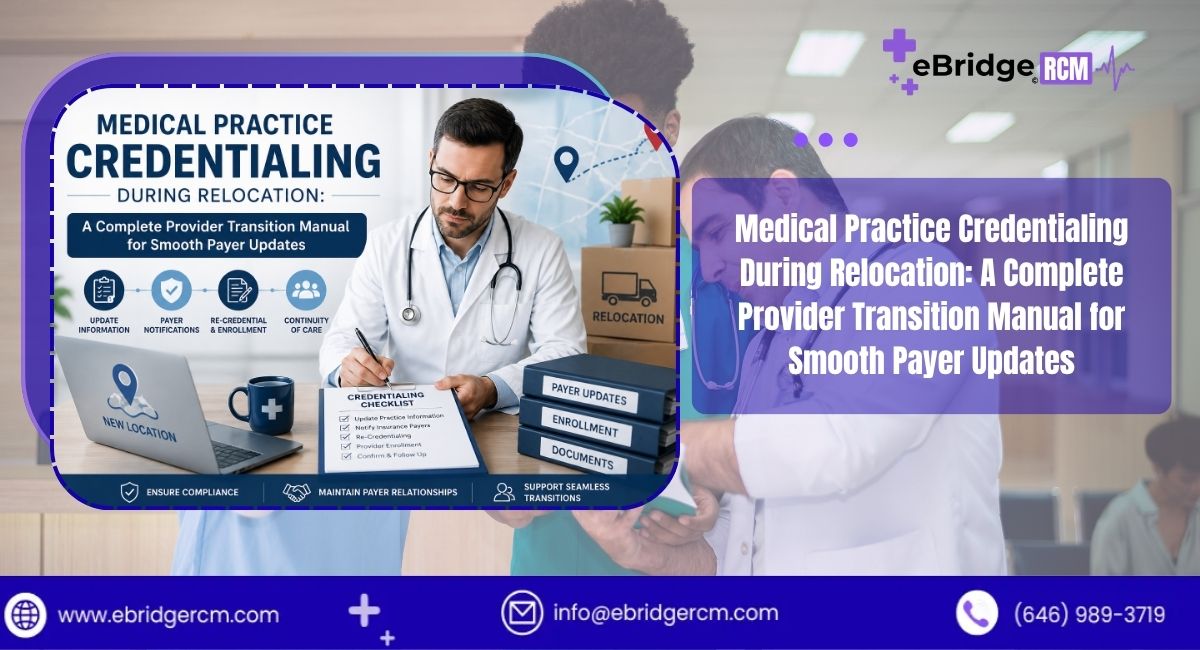
Relocating a medical practice is not only about moving equipment, updating an address, or shifting patients to a new clinic. The most sensitive and time-bound part of the entire transition sits behind the scenes in payer systems, enrollment records, and compliance databases. This process is known as Medical Practice Credentialing During Relocation, and it directly impacts whether providers can continue billing insurance companies without disruption.
A relocation without structured credentialing updates often leads to claim rejections, payment delays, and even temporary suspension from payer networks. In many cases, providers assume that updating an address in one or two systems is enough, but payer credentialing involves multiple interconnected databases such as CAQH, Medicare PECOS, Medicaid state portals, and private insurance directories.
This guide breaks down the entire process in a structured and practical way so providers, administrators, and billing teams can manage relocation without losing revenue flow. For a deeper understanding of payer workflows and enrollment systems, you can also refer to foundational resources like insurance payer credentialing guide and related operational insights from credentialing services for internal medicine providers.
Why Credentialing Becomes Sensitive During Practice Relocation
Credentialing is not a one-time approval process. It is an ongoing validation of a provider’s identity, practice location, licensing, insurance participation, and compliance status. When a provider moves to a new location, payers treat it as a significant change that requires verification.
The main reason relocation triggers credentialing updates is simple: payer contracts are location-specific. A provider credentialed in one state or group practice cannot automatically bill from a new address without revalidation.
Here is what typically changes during relocation:
- Practice service address and billing address
- State licensing jurisdiction
- Medicare and Medicaid enrollment region
- Commercial payer network assignment
- Group affiliation changes (if moving from solo to group or vice versa)
- Tax ID association updates
- Service location mapping in payer directories
Even small mismatches between systems can lead to claim denials. Many practices first realize this issue only after revenue interruption occurs.
Relocation is also closely tied to revenue cycle performance. As explained in discussions around billing continuity and system transitions in articles like benefits of migrating to cloud RCM solutions, operational changes in infrastructure often expose gaps in credentialing and payer alignment.
Core Objective of Credentialing During Relocation
Before diving into steps, it is important to understand what successful credentialing relocation aims to achieve:
- Maintain uninterrupted insurance participation
- Prevent claim rejections due to outdated provider data
- Ensure timely revalidation with Medicare and Medicaid
- Update CAQH and payer databases consistently
- Preserve contracted reimbursement rates
- Avoid re-credentialing delays that affect cash flow
Without a structured approach, even experienced providers face downtime between old and new locations.
Pre-Relocation Credentialing Preparation Checklist
Preparation begins well before physical relocation. Ideally, credentialing planning should start 60 to 120 days before moving.
Key Pre-Move Actions
- Review all payer contracts for address change clauses
- Identify which payers require re-credentialing vs simple updates
- Check CAQH attestation status
- Verify Medicare PECOS enrollment details
- Confirm Medicaid re-enrollment requirements in new state
- Audit group NPI and individual NPI alignment
- Notify billing clearinghouse of upcoming change
- Review active authorization dependencies
Credentialing Readiness Table Before Relocation
| Area | Action Required | Risk if Ignored |
| CAQH Profile | Update practice location and re-attest | Profile mismatch and claim rejection |
| Medicare PECOS | Submit change of information | Billing suspension |
| Medicaid Enrollment | State revalidation | Loss of state reimbursements |
| Commercial Payers | Address update or re-credentialing | Network termination |
| NPI Registry | Update practice address | Directory mismatch |
| Clearinghouse | Notify new billing setup | Claim transmission failure |
This stage is often underestimated. Many delays reported in payer enrollment cycles stem from incomplete pre-move preparation, as highlighted in insights on credentialing delays and revenue impact in how physician credentialing delays affect practice revenue.
Updating CAQH and Central Credentialing Systems
CAQH remains one of the most important databases in provider credentialing workflows. During relocation, it becomes the central hub that must reflect accurate provider information.
What Must Be Updated in CAQH
- New practice address
- Updated phone numbers and fax details
- Service location changes
- Tax identification updates if applicable
- Hospital affiliations (if changed)
- Attestation re-submission
Failure to update CAQH leads to downstream mismatches across payer systems. Many insurers rely on CAQH as a primary verification source, meaning outdated information can halt claims even if other systems are correct.
Best Practice Approach
- Update CAQH before notifying payers
- Re-attest immediately after changes
- Cross-check profile completeness
- Upload updated W-9 forms and licenses
Relocation is also a good time to review broader credentialing integrity. Many practices combine relocation updates with corrections of previous errors identified in audits such as those described in medical credentialing mistakes.
Medicare and Medicaid Re-Enrollment After Relocation
Government payers follow stricter validation rules compared to commercial insurers. Even a minor address change can trigger revalidation or re-enrollment requirements.
Medicare PECOS Updates
Providers must:
- Log into PECOS system
- Submit “Change of Information” request
- Update practice service location
- Verify reassignment status for group providers
- Attach updated documentation if requested
In some cases, Medicare may require a full re-credentialing process depending on state change or group structure modification.
Medicaid State-Level Revalidation
Medicaid processes vary by state but typically require:
- New enrollment application in destination state
- Termination from previous state (if applicable)
- Updated license verification
- Tax ID validation
- Site visit in certain cases
Common Delays in Government Payer Updates
- Missing documentation
- Incorrect taxonomy codes
- Unverified practice ownership changes
- CAQH mismatches
- Delayed state processing cycles
These issues are frequently observed in payer onboarding challenges discussed in specialty-focused guides such as cardiology credentialing workflows in Cardiology Credentialing Process Step-by-Step-Guide.
Commercial Insurance Credentialing During Relocation
Private insurance payers such as Aetna, UnitedHealthcare, Cigna, and Blue Cross Blue Shield require structured updates when a provider relocates.
There are generally three scenarios:
1. Simple Address Update
- Same state
- Same group contract
- Same tax ID
2. Re-credentialing Required
- Moving to a new state
- Changing group affiliation
- Adding new specialty location
3. Contract Termination and Reapplication
- Relocation outside payer network coverage area
- Significant organizational restructuring
Commercial Payer Update Comparison Table
| Payer Type | Requirement | Processing Time |
| National Commercial Payers | Address update or re-credentialing | 30–120 days |
| Regional Insurers | Often full re-credentialing | 60–180 days |
| Managed Care Organizations | Contract revalidation | 90–150 days |
During this stage, coordination between billing and credentialing teams becomes critical. Poor alignment often results in denied claims, especially when billing systems are not synchronized with payer directories.
For a deeper operational perspective on billing alignment, resources such as internal medicine RCM best practices help connect credentialing updates with revenue performance.
Provider Enrollment Updates and NPI Alignment
A frequently overlooked part of relocation is NPI consistency. Providers must ensure both individual NPI and group NPI records reflect updated practice details.
Key Areas to Review
- NPI registry address accuracy
- Taxonomy alignment with specialty
- Group NPI association updates
- Billing vs rendering provider mapping
Incorrect NPI mapping can lead to claim mismatches even when credentialing is approved.
Common Errors During Relocation
- Billing submitted under old address
- Rendering provider not linked to new group
- Taxonomy mismatch between CAQH and NPI registry
- Duplicate provider entries in payer systems
These errors often result in unnecessary administrative rework and delayed reimbursements.
Documentation Required for Credentialing Updates
Relocation requires updated documentation submission across multiple systems. Having a structured file repository helps reduce delays.
Required Document Checklist
- Updated W-9 form
- State medical license
- DEA certificate (if applicable)
- Malpractice insurance certificate
- Board certification documents
- Hospital privilege letters
- New practice lease agreement
- Updated CV or work history
- CAQH attestation confirmation
Document Management Table
| Document Type | Purpose | Submission Frequency |
| License | State compliance | On every relocation |
| Malpractice Insurance | Risk verification | Annual or update-based |
| W-9 Form | Tax identification | On address change |
| CAQH Profile | Central credentialing | Ongoing updates |
Incomplete documentation is one of the top reasons credentialing applications get delayed, especially during relocation transitions.
Billing System Coordination During Credentialing Transition
Credentialing does not operate in isolation. It directly impacts billing workflows, clearinghouse routing, and revenue cycle performance.
If billing systems continue using outdated credentialing data, claims will be rejected regardless of clinical accuracy.
Key Billing Adjustments During Relocation
- Update payer IDs in billing software
- Modify clearinghouse routing tables
- Revalidate ERA and EFT setup
- Update practice address on claims forms
- Align billing provider with new location
This stage is often handled alongside broader system updates, similar to workflows described in EHR integration discussions.
Internal Workflow Coordination Between Teams
Relocation credentialing requires coordination across administrative and financial teams.
Key Stakeholders
- Credentialing specialists
- Billing department
- Practice manager
- Compliance officer
- IT/EHR team
- Front desk administrative staff
Communication Flow
- Credentialing team initiates updates
- Billing team aligns payer systems
- Compliance verifies documentation
- IT updates system records
- Practice manager monitors timelines
Without coordination, duplicate submissions or missing updates often occur.
Timeline Management for Credentialing During Relocation
A structured timeline helps avoid gaps in reimbursement.
Recommended Timeline Table
| Timeline | Activity | Outcome |
| 120–90 days before move | Start payer review | Identify credentialing requirements |
| 90–60 days before move | Submit CAQH updates | Central data alignment |
| 60–30 days before move | Notify payers | Begin re-credentialing |
| 30–0 days before move | Finalize documentation | Avoid claim interruption |
| Post-move (0–90 days) | Monitor claims | Fix rejections quickly |
Timelines may vary depending on payer processing speed and state regulations.
Common Challenges in Credentialing Relocation
Even well-prepared practices face issues during relocation.
Typical Challenges
- Slow payer response times
- Missing or outdated documentation
- Confusion between billing and service addresses
- Duplicate credentialing applications
- CAQH attestation delays
- State licensing processing backlog
These challenges often result in temporary revenue disruptions if not managed proactively.
Strategies to Maintain Revenue Continuity During Transition
Credentialing relocation is not only administrative; it directly affects cash flow.
Practical Strategies
- Submit claims only after payer confirmation
- Maintain dual-location billing buffer
- Track claim rejection trends daily
- Prioritize high-value payers first
- Use clearinghouse reports for monitoring
Strong revenue cycle alignment plays a major role in minimizing financial disruption during transitions. Concepts related to billing accuracy and patient retention.
Long-Term Credentialing Maintenance After Relocation
After relocation is completed, credentialing does not end. Continuous maintenance ensures long-term compliance.
Post-Relocation Actions
- Re-attest CAQH every 120 days
- Monitor payer directory accuracy
- Track credentialing expiration dates
- Audit billing discrepancies monthly
- Maintain updated documentation folder
Practices that maintain ongoing credentialing hygiene face fewer claim denials and faster reimbursement cycles.
Better Billing. Stronger Revenue. A Healthier Practice. Let’s Make It Happen.
From billing and claims to credentialing and revenue cycle management, eBridge RCM takes care of the details so you can focus on your patients.
A Practical View: What Successful Relocation Credentialing Looks Like
A well-managed credentialing relocation process typically shows:
- No interruption in insurance billing
- Smooth payer transitions without contract loss
- Updated CAQH and PECOS alignment
- Clean claim submission from day one
- Minimal rework in billing cycles
This level of coordination usually comes from structured credentialing systems or external support models such as those described in, which help practices manage multi-payer updates efficiently.
Final Section: Bringing It All Together
Relocating a medical practice is a multi-layered process, but credentialing remains the backbone of financial continuity. Every update, from CAQH to Medicare enrollment and commercial payer contracts, must align perfectly to avoid disruptions in revenue flow.
A structured approach to Medical Practice Credentialing During Relocation ensures that providers continue delivering care without administrative barriers affecting reimbursement. When handled carefully, relocation becomes a controlled transition rather than a revenue-risk event.
For practices looking to streamline this process and reduce administrative workload, professional support in credentialing, billing, and coding can help maintain consistency across payer systems. Services like medical billing and medical coding in New York often work alongside credentialing workflows to ensure end-to-end revenue cycle stability.
For end-to-end support in credentialing workflows during relocation, providers often rely on structured assistance from best credentialing solutions in New York offered by experienced RCM teams such as eBridge RCM LLC.