The Credentialing Problem No One Talks About Until It Costs Them Revenue
A licensed therapist opens a private practice in Newark. She sees patients, submits claims, and then waits. Weeks pass. The insurance company keeps sending back requests for additional documentation. Three months in, she learns that her credentialing application was incomplete, and she has been providing services that she cannot bill for retroactively.
This scenario plays out constantly across New Jersey, from Bergen County to Cape May. Behavioral health providers, including psychiatrists, licensed clinical social workers, licensed professional counselors, and addiction specialists, face one of the most complex credentialing environments in the country. New Jersey has a dense network of Medicaid managed care organizations, commercial payers, and behavioral health carve-out plans, each with its own timelines, requirements, and renewal cycles.
Credentialing is not a one-time task. It is an ongoing process that directly determines whether a practice gets paid. When it goes wrong, the financial impact is immediate and real.
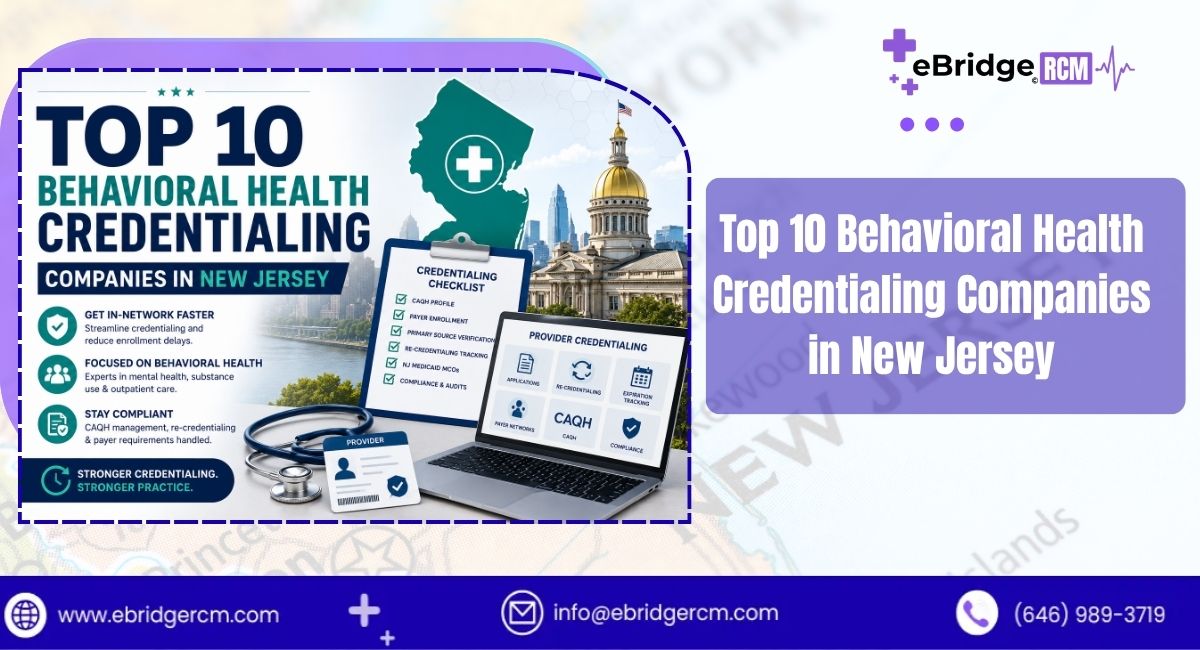
This guide covers ten credentialing companies actively serving behavioral health providers in New Jersey, what each one offers, and how to evaluate which type of service best fits a practice’s size and needs.
Why Behavioral Health Credentialing in New Jersey Is Uniquely Challenging
Before looking at specific companies, it helps to understand why behavioral health credentialing in New Jersey requires specialized knowledge that general medical credentialing companies often lack.
Behavioral Health Carve-Outs
Many commercial insurers in New Jersey, including Horizon Blue Cross Blue Shield and Aetna, use behavioral health carve-out organizations to manage mental health and substance use benefits separately from medical benefits. This means a provider credentialed with Aetna for primary care is not automatically credentialed with Aetna’s behavioral health network. Each carve-out entity, such as Optum Behavioral Health or Beacon Health Options (now Carelon Behavioral Health), requires its own credentialing application.
Medicaid Complexity
New Jersey’s Medicaid program, NJ FamilyCare, contracts with multiple managed care organizations. Each MCO, including Horizon NJ Health, Amerigroup, WellCare (now Centene), and Aetna Better Health of New Jersey, requires separate credentialing even for the same provider. Behavioral health providers who want full Medicaid access need to complete applications across multiple entities.
CAQH and State-Specific Requirements
While CAQH ProView serves as a centralized credentialing database used by most payers, New Jersey state-specific requirements add additional layers. Providers must maintain state licensure through the New Jersey Division of Consumer Affairs, hold appropriate DEA registrations if prescribing, and meet specific continuing education requirements depending on discipline. Understanding how CAQH credentialing for mental health providers intersects with individual payer applications is a task that trips up many new practices.
Re-Credentialing Cycles
Most payers require re-credentialing every two to three years. Missing a re-credentialing deadline can result in termination from a panel, which means losing access to a large segment of patients. Behavioral health practices with multiple providers find it difficult to track these cycles without a dedicated system.
What to Look for in a Behavioral Health Credentialing Company
Not every credentialing company has the same capability set. When evaluating options, behavioral health practices in New Jersey should assess the following:
Behavioral health specialization: Some companies serve all medical specialties, while others focus specifically on mental health, psychiatry, and substance use disorder providers. Specialization usually means more accurate applications and fewer back-and-forth errors with payers.
Payer network knowledge: A company that works regularly with New Jersey-based payers, including Horizon NJ Health, Optum Behavioral Health, Magellan, and Carelon, will navigate their requirements more efficiently than a company primarily serving other states.
CAQH management: Active maintenance of a provider’s CAQH ProView profile is foundational. Companies that include this as part of their service reduce a significant administrative burden.
Timeline transparency: Good credentialing companies provide status updates, track application progress, and alert clients when payers request additional information.
Re-credentialing tracking: Ask whether the company monitors expiration dates and initiates re-credentialing proactively, not reactively.
Payer enrollment support: Credentialing is the verification process, and payer enrollment is the contract execution step. Some practices confuse the two. Companies that handle both reduce the gap between credentialing approval and actual billing capability.
If you are setting up a new mental health practice or expanding a group, reviewing how physician credentialing delays affect practice revenue provides useful context on why timeline management matters financially.
Top 10 Behavioral Health Credentialing Companies in New Jersey
1. eBridge RCM LLC
eBridge RCM LLC is a revenue cycle management and credentialing company with a specific focus on behavioral health, psychiatry, and mental health providers. Their credentialing team handles the full spectrum, from initial CAQH setup and primary source verification to payer-specific applications and ongoing re-credentialing cycles.
What sets eBridge apart in the New Jersey market is their combined approach: credentialing is integrated with medical billing and revenue cycle management, so practices do not need to coordinate between multiple vendors when a credentialing issue creates a billing gap. Their team understands the behavioral health carve-out structure used by major NJ payers and manages applications with Optum Behavioral Health, Carelon, Magellan, and the state’s Medicaid MCOs directly.
They also provide insurance credentialing for mental health providers as a standalone service, which makes them accessible for solo practitioners who do not need full RCM outsourcing. For group practices looking to add providers frequently, their re-credentialing and revalidation services are structured to keep all provider panels current without disruptions.
eBridge RCM serves practices across New Jersey including Newark, Jersey City, Trenton, Cherry Hill, and the North Jersey metro corridor. For practices that also want to address billing alongside credentialing, their mental health billing services cover the full revenue cycle.
Best for: Solo and group behavioral health practices in New Jersey seeking an integrated credentialing and billing solution.
2. Medversant Technologies
Medversant is a technology-driven credentialing company known for its provider management platform. They serve large health systems and multi-specialty groups, with credentialing workflow automation as a core feature. For behavioral health practices operating within a larger hospital or health system context in New Jersey, Medversant offers structured workflow tools.
Their platform integrates with many payer portals and allows centralized tracking of application status. The company handles primary source verification, sanction monitoring, and license expiration alerts.
Best for: Larger behavioral health organizations or hospital-affiliated practices needing enterprise-level credentialing management.
3. Credential My Doc
Credential My Doc focuses specifically on physician and provider credentialing, with a process built around transparency and fast turnaround. They serve behavioral health providers including psychiatrists and LCSWs, and their team is familiar with New Jersey payer-specific requirements.
Their service includes CAQH profile creation and maintenance, payer application tracking, and dedicated account managers who handle follow-ups directly with insurance companies. They offer tiered service packages, which makes them accessible for smaller practices with tighter budgets.
Best for: Individual providers and small group practices looking for responsive service with a dedicated contact.
4. QGenda
QGenda is a healthcare workforce management and provider operations platform that includes credentialing as part of a broader scheduling and provider lifecycle system. While it is not a pure-play credentialing firm, it is widely used by hospitals and large behavioral health systems to manage provider onboarding, privileges, and ongoing credential tracking.
Its credentialing module integrates provider data, licensure tracking, and re-credentialing workflows into a centralized dashboard. This helps reduce manual follow-ups and ensures providers remain compliant with payer and facility requirements. However, organizations often use QGenda alongside payer enrollment or credentialing specialists for full insurance paneling.
For behavioral health systems that already operate at scale, QGenda is especially valuable for aligning credentialing status with staffing, scheduling, and workforce planning.
Best for: Large behavioral health systems and hospital-affiliated practices needing integrated credentialing + workforce management.
5. Headway
Headway is a behavioral health-focused platform that helps mental health providers get credentialed with insurance payers and start accepting in-network patients faster. Unlike traditional credentialing companies, Headway acts as both a credentialing facilitator and a payer network partner.
It streamlines CAQH setup, payer enrollment, and contracting, allowing therapists, psychiatrists, and psychiatric nurse practitioners to reduce administrative delays. Headway also provides billing support and handles insurance claims processing, which reduces operational burden for solo and group practices.
For providers entering insurance networks for the first time, especially in competitive states like New Jersey, Headway significantly shortens the time-to-panel compared to traditional credentialing workflows.
Best for: Solo and small group behavioral health providers who want fast insurance onboarding and integrated billing support.
6. Verisys (formerly Morristown NJ-adjacent operations)
Verisys is a compliance and credentialing intelligence company that focuses on continuous monitoring of provider credentials. Their platform monitors license status, DEA registration, malpractice history, and exclusion databases in real time, alerting practices when something changes.
While Verisys is less focused on the initial enrollment and application submission side of credentialing, they are valuable for organizations that need ongoing compliance assurance. Behavioral health practices in New Jersey working with Medicaid must verify that all providers remain excluded-free from OIG and SAM databases, which Verisys handles automatically.
Best for: Practices with established panels that need ongoing compliance monitoring rather than initial credentialing support.
7. Symplr
Symplr is one of the largest enterprise credentialing and compliance platforms in the United States, widely used by hospitals, health systems, and large provider networks. Its credentialing solution (including CredentialStream) supports full provider lifecycle management, from initial enrollment to ongoing re-credentialing and compliance monitoring.
The platform is highly configurable and integrates CAQH data, payer requirements, licensing boards, and privileging workflows into a centralized system. Symplr also supports audit readiness and regulatory compliance, making it especially useful for organizations operating across multiple states, including New Jersey.
In addition to credentialing, Symplr offers broader compliance, workforce management, and healthcare operations tools, which makes it more suitable for large-scale systems rather than small private practices.
Best for: Hospitals, large behavioral health networks, and multi-state healthcare organizations needing enterprise-grade credentialing and compliance infrastructure.
Resources like the private practice insurance credentialing guide can help providers prepare before engaging any credentialing company.
8. DrCatalyst
DrCatalyst offers virtual medical staffing and support services, including credentialing. Their credentialing support team operates as an extension of a practice’s administrative staff rather than as an independent vendor. Behavioral health practices that want more direct involvement in their credentialing process tend to do well with this model.
Their team handles CAQH maintenance, application submissions, payer follow-ups, and tracking. They work with both commercial and government payers in New Jersey and are familiar with the state’s behavioral health payer ecosystem.
Best for: Practices that prefer a staffing-model approach to credentialing support rather than a traditional vendor relationship.
9. Payer Enrollment and Credentialing Services (PECS)
PECS is a credentialing company that handles both payer enrollment and provider credentialing, recognizing that the two processes need to be coordinated. Many practices go through credentialing only to find that enrollment is delayed separately, creating a gap where they are approved but not yet contracted. PECS manages both steps together.
For behavioral health providers in New Jersey, PECS covers commercial payers, Medicaid MCOs, Medicare, and managed behavioral health organizations. Their process includes status tracking and proactive communication with payers when applications are pending beyond expected timelines.
Understanding the distinction between credentialing and enrollment, and the insurance payer credentialing process, is useful when evaluating any company’s service scope.
Best for: Practices that have had issues with the enrollment step being separated from the credentialing process.
10. MedTrainer
MedTrainer is a cloud-based compliance and credentialing platform that combines credentialing management with staff training, policy management, and compliance tracking. For larger behavioral health organizations, having credentialing, compliance documentation, and training in one platform reduces administrative overhead significantly.
Their credentialing module tracks license expirations, manages CAQH profiles, and provides document storage for all provider credentials. MedTrainer is particularly useful for behavioral health organizations that are growing their clinical team and need a scalable system rather than a one-off service.
Best for: Growing behavioral health organizations needing a technology platform rather than a pure service model.
Comparison of Key Service Features
| Company | Behavioral Health Focus | NJ Medicaid MCO Experience | CAQH Management | Re-Credentialing Tracking | Billing Integration |
| eBridge RCM LLC | Yes | Yes | Yes | Yes | Yes |
| Medversant | Partial | Partial | Yes | Yes | No |
| Credential My Doc | Partial | Yes | Yes | Yes | No |
| QGenda | Partial | Limited | Yes | Yes | Limited |
| Headway | Yes | Yes | Yes | Yes | Yes |
| Verisys | No (compliance only) | No | No | Yes | No |
| Symplr | Yes (enterprise healthcare credentialing system) | Yes | Yes | Yes | No |
| DrCatalyst | Partial | Yes | Yes | Yes | Partial |
| PECS | Partial | Yes | Yes | Yes | No |
| MedTrainer | Partial | Partial | Yes | Yes | No |
Looking for the Right Behavioral Health Credentialing Partner in New Jersey?
Make credentialing easier and stay focused on growing your behavioral health practice.
How Credentialing Affects Your Revenue Cycle Directly
Credentialing is not separate from billing. It is the foundation on which billing is built. A provider who is not yet credentialed cannot bill. A provider whose re-credentialing lapses loses billing privileges retroactively in some cases. A provider credentialed under the wrong taxonomy code may have claims denied systematically for months before anyone notices.
Understanding revenue cycle tips for mental health providers gives a clear picture of how credentialing status feeds into claim processing. Clean claims require verified provider credentials. Payer enrollment must be active and accurate. When something breaks in credentialing, it shows up as a denial in billing.
For group practices, the complexity multiplies. Adding a new therapist or psychiatrist means initiating a full credentialing cycle before that provider can bill. Groups that are transitioning from solo provider to group practice often underestimate how much credentialing work is involved when adding multiple providers to panels simultaneously.
New Jersey-Specific Payers Every Behavioral Health Provider Should Know
Understanding which payers to prioritize for credentialing depends on the patient population a practice intends to serve. Here is a brief overview of key payers in New Jersey’s behavioral health landscape:
Horizon Blue Cross Blue Shield of New Jersey: The largest commercial insurer in the state. Behavioral health benefits are managed through an internal behavioral health unit as well as Carelon for certain plans. Credentialing processes can be lengthy, often running 90 to 120 days.
Aetna and Aetna Better Health of New Jersey: Aetna manages commercial behavioral health in NJ, while Aetna Better Health manages Medicaid behavioral health services. These require separate applications despite being under the same parent company.
UnitedHealthcare / Optum Behavioral Health: United uses Optum Behavioral Health as its carve-out for mental health benefits. Optum has its own credentialing database and credentialing timeline.
Horizon NJ Health: The Medicaid HMO subsidiary of Horizon BCBS. Credentialing here is required for providers who want access to NJ FamilyCare members enrolled in this plan.
Amerigroup (now Elevance Health): One of the NJ FamilyCare MCOs with a significant Medicaid enrollment. Behavioral health credentialing through Amerigroup requires applications to their behavioral health network separately.
Magellan Health (Carelon Behavioral Health): Magellan manages behavioral health carve-out benefits for several major payers in NJ. Understanding their specific documentation requirements is critical.
LCSW, LPC, and Other Non-Physician Credentialing in New Jersey
Behavioral health credentialing is not limited to psychiatrists and psychologists. Licensed clinical social workers, licensed professional counselors, licensed marriage and family therapists, and certified alcohol and drug counselors all have their own credentialing pathways with different payers in New Jersey.
Some payers credential these provider types directly. Others require supervision attestations, group practice affiliation documentation, or taxonomy code verification before enrolling non-physician behavioral health providers. For LCSWs specifically, reviewing the LCSW credentialing documents guide clarifies exactly what documentation each payer category requires.
This is an area where generalist credentialing companies sometimes fall short. Working with a company that has experience across the full range of behavioral health license types avoids errors in application submissions that can trigger unnecessary delays.
Questions to Ask Before Hiring a Credentialing Company
Before signing with any credentialing company, behavioral health practices should get clear answers on the following:
1. How do you handle payer follow-up when an application stalls? Some companies submit applications and then wait passively for payer responses. Better companies proactively follow up every 10 to 14 days and escalate when necessary.
2. What is your average credentialing timeline for New Jersey payers? Realistic timelines vary by payer. Companies that promise unrealistically fast timelines may be overpromising. Most NJ commercial payers take 60 to 90 days, and some Medicaid MCOs take longer.
3. Do you manage CAQH profile updates on an ongoing basis? CAQH attestations must be updated every 120 days. Companies that only set up a CAQH profile but do not maintain it create problems down the line.
4. How do you track re-credentialing deadlines? Ask whether they send proactive alerts or whether the practice is responsible for tracking renewal dates. Automated re-credentialing tracking is a standard feature to expect from quality companies.
5. What happens if a claim is denied due to a credentialing error? The best companies have processes for resolving credentialing-related denials and coordinating with the billing team to recover affected claims.
Common Credentialing Mistakes Behavioral Health Providers Make
Even when working with a credentialing company, practices sometimes contribute to delays or errors through their own actions or inactions. Common issues include:
Providing outdated malpractice certificates with incorrect effective dates. Payers verify the dates on these documents carefully, and even a one-day discrepancy can pause an application.
Failing to update CAQH profiles promptly after a license renewal or address change. Stale CAQH data causes payers to flag applications for additional verification.
Applying for panels that are closed without checking panel status first. A closed panel application wastes time for everyone involved. A knowledgeable credentialing company checks panel status before submitting.
Missing state-required disclosures for mental health providers. New Jersey has specific disclosure requirements for certain license types that must be included in payer applications.
For a full breakdown of what can go wrong, medical credentialing mistakes covers the most frequently encountered errors and how to prevent them.
How Credentialing Fits Into Your Mental Health Practice Setup
Credentialing should begin before a practice opens, not after. The typical timeline from application submission to active billing capability ranges from 90 to 150 days depending on the payer. A practice that waits until the first patient is scheduled to start credentialing will lose months of billing revenue.
The credentialing process should run parallel to other setup tasks: securing office space, building a website, setting up an EHR, and establishing billing workflows. If you are building a practice from the ground up, reviewing the mental health practice setup checklist shows how credentialing fits into the full timeline.
For practices that are relocating to New Jersey from another state, understanding medical credentialing during relocation is especially important because out-of-state license transfers and new state enrollments add complexity to an already detailed process.
FAQ: Behavioral Health Credentialing in New Jersey
How long does behavioral health credentialing take in New Jersey?
Most commercial payers in New Jersey take 60 to 90 days to complete the credentialing process after a complete application is submitted. Medicaid MCOs can take 90 to 120 days or longer, depending on application volume and completeness. Starting early and submitting complete applications the first time reduces delays significantly.
Can I bill while my credentialing is pending?
Some payers allow retroactive billing once credentialing is approved, but this varies by payer and is not guaranteed. It is risky to assume retroactive billing will be available. The safest approach is to complete credentialing before seeing patients on that plan or to offer self-pay rates temporarily.
Is CAQH mandatory for New Jersey behavioral health credentialing?
Most major commercial payers in New Jersey require an active and attested CAQH ProView profile as part of the credentialing application process. Maintaining it with current and accurate information is essential.
What is the difference between credentialing and payer enrollment?
Credentialing is the process by which a payer verifies a provider’s qualifications, licenses, and background. Payer enrollment is the contracting step that gives the provider the ability to bill and receive payment. Both steps are required to become an in-network participating provider. Some companies handle only one or both.
Do LCSWs and LPCs need to credential separately from psychiatrists?
Yes. Non-physician behavioral health providers have their own provider types, taxonomy codes, and application pathways. Some payers handle all behavioral health provider types through a single application, while others have separate processes by discipline. A credentialing company with behavioral health experience will know which payers treat these applications differently.
How often does re-credentialing need to happen?
Most payers require re-credentialing every two to three years. Some Medicaid plans require revalidation annually. Missing a deadline can result in termination from the panel. Practices should work with a company that tracks and initiates re-credentialing proactively rather than waiting for a termination notice.
Can a credentialing company help if I have a prior sanction or malpractice history?
Yes, a qualified credentialing company can advise on how to disclose prior issues accurately and which payers are more likely to accept providers with prior history, depending on the nature and recency of the issue. Accurate disclosure is always required.
Making the Right Choice for Your New Jersey Practice
Behavioral health credentialing in New Jersey is not a problem that resolves itself. The payer landscape is layered, the timelines are long, and the consequences of errors reach directly into a practice’s revenue. Choosing the right credentialing company is one of the most practical decisions a behavioral health provider makes when setting up or growing a practice.
For providers looking at the full picture, including credentialing, billing, and revenue cycle management together, eBridge RCM LLC stands out as a comprehensive solution specifically built around behavioral health and mental health practices. Their team handles the complexity of New Jersey’s multi-payer environment without requiring practices to coordinate across multiple vendors.
If you are starting a new practice, expanding an existing one, or dealing with credentialing delays that are affecting your revenue, reaching out to a specialized behavioral health credentialing company is the right first step. Do not wait until a claim denial shows you that something went wrong upstream.
Helpful Resources
- eBridge RCM Credentialing Services : Full credentialing and payer enrollment for behavioral health providers.
- Mental Health Billing Services : Billing and revenue cycle management built for mental health practices.
- Psychiatry Billing Services : Specialty billing for psychiatrists and psychiatric nurse practitioners.
- Medical billing New Jersey Services : State-specific revenue cycle and credentialing services for NJ providers.