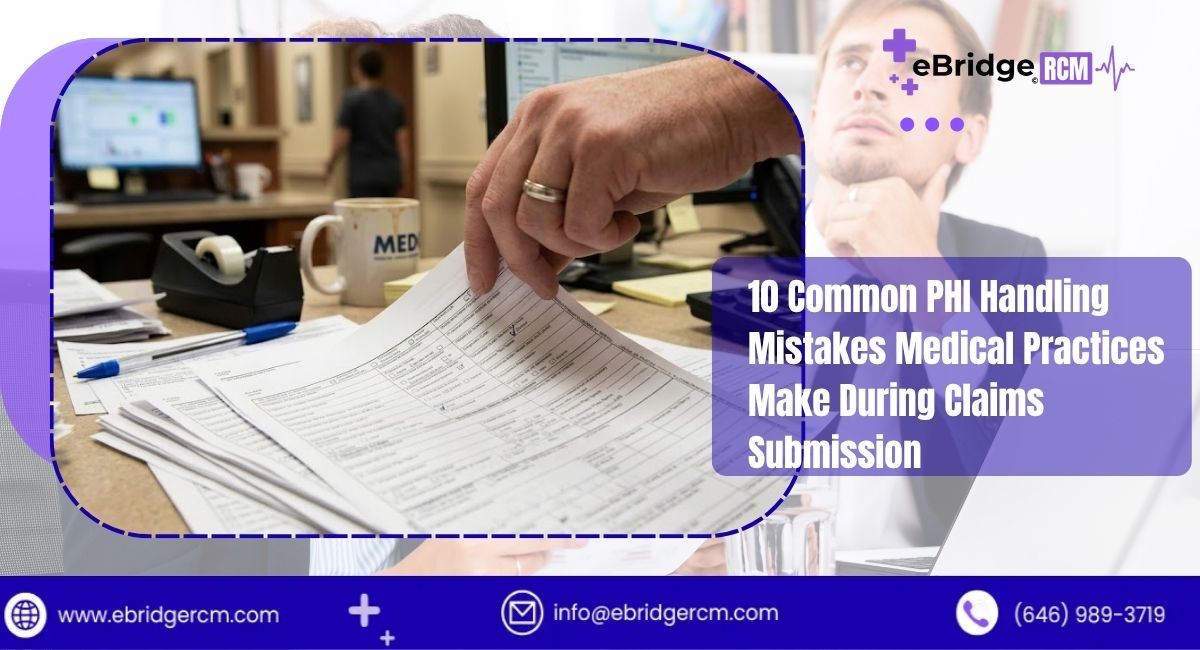
A medical claim can be coded correctly, submitted on time, and supported by proper documentation, yet still create significant financial and compliance problems. The reason is often not the diagnosis code or procedure code. It is the way Protected Health Information (PHI) was handled during the billing process.
Healthcare organizations exchange thousands of pieces of sensitive patient information every day. Patient names, insurance details, medical record numbers, treatment information, payment records, and demographic data move through electronic health records, practice management systems, clearinghouses, payer portals, and billing platforms. Every transfer creates an opportunity for mistakes.
When PHI is mishandled during claims submission, the consequences extend beyond claim delays. Medical practices may face HIPAA investigations, payer scrutiny, audit findings, patient complaints, and revenue cycle disruptions.
Many billing teams focus heavily on coding accuracy and denial management while overlooking data handling risks that occur before a claim ever reaches an insurance company.
The reality is simple. A claim can be denied because of an incorrect modifier. It can also be delayed because protected information was entered incorrectly, sent through an unsecured channel, or accessed by unauthorized personnel.
Understanding the most common HIPAA billing errors helps practices strengthen compliance, reduce reimbursement delays, and improve operational performance across the revenue cycle.
Why PHI Management Matters During Claims Submission
PHI includes any information that can identify a patient and is connected to healthcare services, treatment, payment, or insurance activities.
Examples include:
- Patient names
- Dates of birth
- Insurance identification numbers
- Medical record numbers
- Billing account details
- Diagnosis information
- Treatment history
- Contact information
The Health Insurance Portability and Accountability Act (HIPAA) requires healthcare organizations to protect this information through administrative, physical, and technical safeguards.
Claims submission involves multiple touchpoints where PHI is collected, processed, transmitted, and stored. If controls are weak, errors become inevitable.
They recognize that PHI protection directly affects revenue performance, as discussed in HIPAA IT security for revenue cycle management.
How HIPAA Billing Errors Affect Revenue Cycle Performance
PHI mistakes rarely stay isolated.
One incorrect patient identifier may result in:
- Claim rejection
- Delayed payment
- Rework by billing staff
- Additional payer communication
- Increased administrative costs
When repeated across hundreds of claims, small mistakes create major revenue leakage.
Healthcare organizations often see increased denial rates, longer accounts receivable cycles, and higher compliance risks when PHI controls are inconsistent.
Before reviewing the ten most common mistakes, it helps to understand that most compliance failures occur because of workflow weaknesses rather than malicious intent.
1. Emailing Patient Information Through Unsecured Channels
One of the most common HIPAA billing errors occurs when staff members email patient information without proper security measures.
This often happens when:
- Sending claim documents
- Requesting insurance verification
- Sharing billing records
- Communicating with external vendors
Unencrypted email can expose:
- Patient names
- Insurance information
- Treatment details
- Account balances
Example
A billing coordinator sends claim correction documents to an insurance representative using a personal email account. The email contains patient identifiers and diagnosis information.
Even if the information reaches the intended recipient, the transmission method may violate HIPAA requirements.
Prevention
Use:
- Encrypted email solutions
- Secure file transfer systems
- HIPAA-compliant communication platforms
2. Entering Incorrect Patient Demographic Information
Many claim delays originate from inaccurate patient demographics.
Common examples include:
- Misspelled names
- Incorrect birth dates
- Wrong insurance ID numbers
- Inaccurate addresses
While these may seem like routine data entry issues, they involve PHI and directly impact claim processing.
Impact
Incorrect demographic information often triggers:
- Clearinghouse rejections
- Payer denials
- Eligibility verification failures
Practices that implement strong eligibility verification procedures generally reduce these issues significantly.
3. Allowing Unauthorized Access to Billing Records
Not every employee needs access to every patient record.
Unfortunately, many healthcare organizations provide broad system access that exceeds job responsibilities.
HIPAA’s minimum necessary standard requires organizations to limit access based on role.
Common Access Problems
- Shared user accounts
- Generic login credentials
- Excessive permission settings
- Inactive users remaining active
Example
A front desk employee gains access to billing reports containing sensitive financial information unrelated to their duties.
This creates unnecessary compliance exposure.
Prevention
Implement:
- Role-based access controls
- Multi-factor authentication
- Access reviews
- User activity monitoring
4. Incomplete Documentation Supporting Claims
Claims submission depends heavily on supporting documentation.
Incomplete records can create both reimbursement and compliance challenges.
Examples include:
- Missing provider signatures
- Incomplete treatment notes
- Missing medical necessity documentation
- Inaccurate encounter records
Without complete records, practices may struggle during payer audits.
Organizations preparing for audits often benefit from reviewing audit-ready healthcare practice strategies.
Why This Matters
Documentation serves as evidence that services were provided appropriately and billed correctly.
Incomplete records weaken that evidence.
5. Storing PHI in Unsecured Locations
Despite widespread adoption of electronic systems, some practices still store sensitive information in unsecured locations.
Examples include:
- Desktop spreadsheets
- Personal devices
- Shared drives
- Unprotected cloud folders
Risk Factors
Unauthorized access can occur through:
- Device theft
- Insider misuse
- Cyberattacks
- Accidental sharing
Modern practices increasingly rely on secure cloud environments because they provide stronger security controls than fragmented storage methods.
6. Failing to Verify Information Before Claims Submission
A significant percentage of claim rejections occur because information was never verified before submission.
Critical items include:
- Patient identifiers
- Insurance eligibility
- Policy information
- Provider credentials
- Coding accuracy
This is why many organizations utilize claims scrubbing processes for billing accuracy.
Claims scrubbing technology helps identify errors before claims reach payers.
Workflow Improvement
Verification checkpoints should occur before:
- Charge entry
- Claim generation
- Electronic submission
7. Sharing PHI With Vendors Without Proper Agreements
Medical billing frequently involves third-party vendors.
Examples include:
- Revenue cycle management companies
- Clearinghouses
- Software providers
- IT service providers
HIPAA requires Business Associate Agreements (BAAs) when vendors access PHI.
Common Mistake
Practices engage outside service providers without formal agreements.
This creates compliance vulnerabilities even when the vendor handles information appropriately.
Best Practice
Review:
- Vendor contracts
- Business Associate Agreements
- Security standards
- Data handling policies
8. Weak EHR and Billing System Integration Controls
Modern billing depends on continuous data exchange between systems.
Electronic Health Records, practice management software, and clearinghouses must exchange information accurately.
When integrations fail, PHI errors multiply.
Examples include:
- Duplicate patient records
- Inconsistent demographic updates
- Missing insurance information
- Incorrect provider data
Organizations frequently encounter these issues because of poor configuration or insufficient monitoring.
A detailed review of common EHR integration mistakes in medical billing can help identify potential workflow weaknesses.
Similarly, practices can strengthen performance through better EHR integration for billing accuracy.
9. Ignoring Audit Trails and Activity Monitoring
HIPAA requires organizations to monitor access to PHI.
Many practices collect audit logs but rarely review them.
This creates blind spots.
Audit Logs Help Identify
- Unauthorized access
- Suspicious activity
- Workflow errors
- Compliance violations
Example
A billing employee repeatedly accesses records unrelated to assigned responsibilities.
Without monitoring, the activity may continue unnoticed.
Prevention
Perform regular:
- Access reviews
- Audit log analysis
- Security assessments
- Compliance audits
10. Inadequate Staff Training on HIPAA Billing Requirements
Technology alone cannot prevent compliance failures.
Employees remain one of the largest risk factors in healthcare data protection.
Common training gaps include:
- Email security
- Password management
- Data sharing protocols
- Claims documentation requirements
- Patient information handling
Real Scenario
A new billing specialist exports patient account information to a personal device to work remotely.
The employee may not realize the action violates organizational policies.
Regular education significantly reduces these risks.
The Relationship Between HIPAA Billing Errors and Claim Denials
Many organizations separate compliance issues from reimbursement challenges.
In reality, they are closely connected.
The same errors that expose PHI often create:
- Eligibility failures
- Claim rejections
- Payment delays
- Audit findings
Organizations focused on denial reduction frequently address compliance controls at the same time.
Resources discussing medical billing denial prevention strategies can provide additional context.
Common PHI Mistakes and Their Consequences
| PHI Handling Error | Operational Impact | Compliance Risk |
| Unsecured email | Claim delays | High |
| Incorrect demographics | Claim rejection | Medium |
| Unauthorized access | Investigation risk | High |
| Missing documentation | Audit findings | High |
| Unsecured storage | Data exposure | High |
| Unverified claims | Denials | Medium |
| Missing BAA agreements | Vendor risk | High |
| Integration failures | Data inconsistencies | Medium |
| Ignored audit logs | Undetected violations | High |
| Poor staff training | Repeated errors | High |
Building Billing Workflow Safeguards
Strong billing workflow safeguards combine people, processes, and technology.
Key safeguards include:
Administrative Controls
- Written compliance policies
- Workforce training
- Vendor management procedures
- Incident response planning
Technical Controls
- Encryption
- Access controls
- Audit logs
- Secure integrations
Operational Controls
- Claim validation workflows
- Eligibility verification
- Documentation reviews
- Quality assurance checks
For practices seeking stronger data quality controls, specialized medical coding services USA help improve documentation and coding accuracy.
Practical Steps Medical Practices Can Take Today
Improving PHI handling does not require a complete operational overhaul.
Start with:
- Review access permissions.
- Audit billing workflows.
- Encrypt communication channels.
- Update employee training programs.
- Monitor audit logs regularly.
- Validate claims before submission.
- Review vendor agreements annually.
- Test EHR integrations.
- Standardize documentation procedures.
- Establish routine compliance reviews.
These actions reduce both compliance exposure and reimbursement delays.
Commonly Asked Questions for HIPAA billing errors
What are HIPAA billing errors?
HIPAA billing errors are mistakes involving the handling, storage, transmission, or use of protected health information during billing activities.
Can HIPAA violations cause claim delays?
Yes. PHI-related errors often trigger claim rejections, payer investigations, documentation requests, and reimbursement delays.
What is the most common PHI handling mistake?
Improper transmission of patient information through unsecured email remains one of the most frequently reported issues.
How can billing teams reduce PHI risks?
Through staff training, access controls, secure communication tools, auditing, and claim validation processes.
Why are audit trails important in medical billing?
Audit trails help organizations monitor access to PHI, identify inappropriate activity, and demonstrate compliance during investigations.
Do outsourced billing companies need HIPAA compliance?
Yes. Any vendor handling protected health information must comply with HIPAA requirements and typically requires a Business Associate Agreement.
Final Thoughts
HIPAA billing errors are rarely isolated events. They affect claims processing, compliance performance, patient trust, and revenue cycle outcomes simultaneously.
The ten mistakes covered in this guide represent some of the most common vulnerabilities healthcare organizations face during claims submission. Improper emailing of patient data, incomplete documentation, unauthorized access, weak integrations, and insufficient training can all create significant operational and regulatory consequences.
The most effective organizations treat PHI protection as part of the billing workflow rather than a separate compliance task. When billing teams, coders, administrators, and technology systems work together under clearly defined safeguards, claim accuracy improves and compliance risks decline.
If your organization is looking to strengthen billing compliance, reduce claim delays, and improve operational oversight, eBridge RCM LLC provides specialized support through medical billing, coding, audit, and revenue cycle management solutions designed to support both reimbursement performance and HIPAA compliance.