A patient has a spinal cord stimulator trial on a Monday. The leads work well. The physician schedules the permanent implant for the following Wednesday, nine days later. The practice bills both procedures with no modifiers. The second claim denies. The facility, meanwhile, billed the generator with the wrong device code, and its payment comes back far below the contract rate.
Nothing went wrong in the operating room. The problem was in the billing sequence.
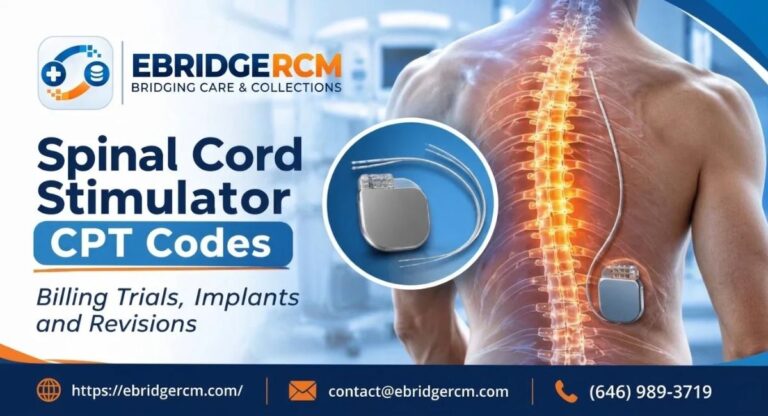
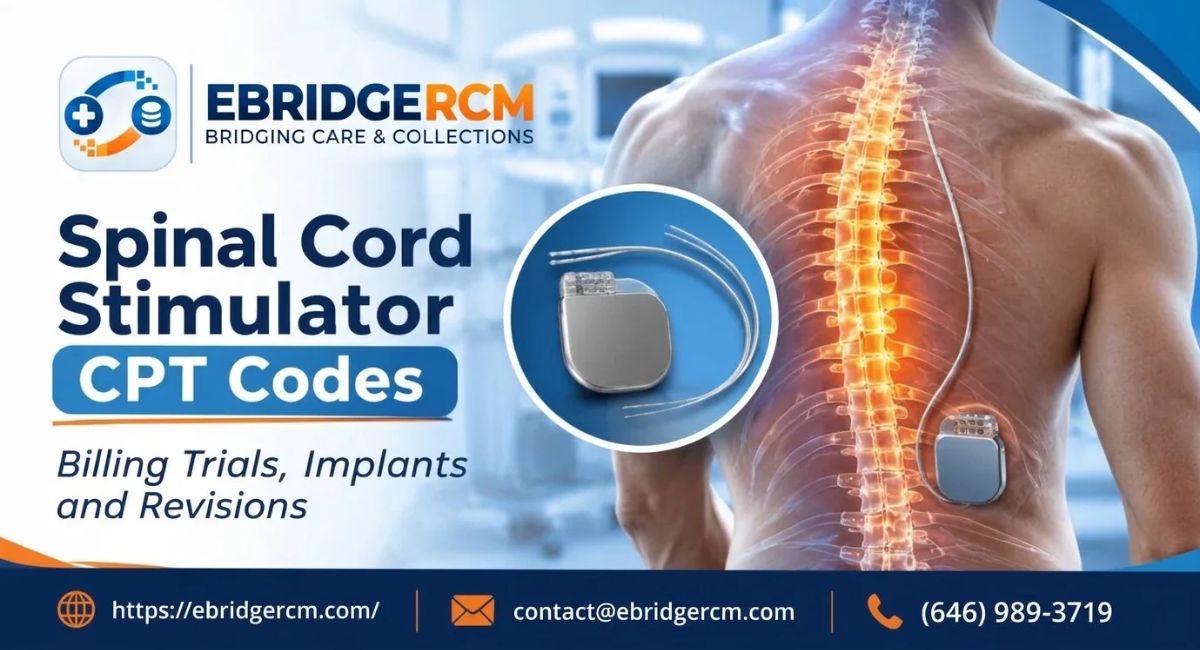
Spinal cord stimulator (SCS) billing is harder than most pain procedures. One patient may move through an evaluation, a trial, an implant, several programming visits and sometimes a revision. Each stage has its own code, its own global period and its own payer rules. And two parties bill at the same time: the physician and the facility.
This guide follows the patient journey from the first consult to the last revision. It shows which CPT codes apply at each stage, how the physician claim differs from the facility claim, and where claims most often fail. It touches on Medicare National Coverage Determination (NCD) 160.7 where it affects billing, but it does not review coverage criteria in detail.
Why SCS Claims Fail More Often Than Other Pain Claims
Most interventional pain procedures are one-time events. An epidural injection or a facet block begins and ends in a single visit. An SCS episode can span weeks or months.
That creates four pressure points:
- Staged procedures. The trial and the implant are linked, and global periods can overlap.
- Device costs. The generator and leads cost far more than the procedure fee. The facility must report them correctly.
- Prior authorization. Most payers require approval before the trial, the implant or both.
- Two claim types. A physician claim and a facility claim describe the same surgery in different ways.
A coder who works only from the operative note will miss some of these issues. The coder must also watch dates, global periods, payer policy and the device log.
The Billing Journey at a Glance
The table below maps each stage to its main physician code. Facility reporting is covered in a later table.
| Stage | Main CPT Code | What It Describes |
| Trial, percutaneous leads | 63650 | Percutaneous placement of an epidural neurostimulator electrode array |
| Permanent, percutaneous leads | 63650 | Same code, new date of service |
| Permanent, paddle lead | 63655 | Laminectomy placement of plate or paddle electrodes |
| Pulse generator placement | 63685 | Insertion or replacement of the pulse generator or receiver |
| Programming | 95971, 95972 | Programming of a spinal cord stimulator by a physician or qualified professional |
| Analysis without programming | 95970 | Electronic analysis of the implanted system |
| Lead removal, percutaneous | 63661 | Removal of percutaneous electrode array |
| Lead removal, paddle | 63662 | Removal of plate or paddle electrodes |
| Lead revision, percutaneous | 63663 | Revision or replacement of percutaneous electrode array |
| Lead revision, paddle | 63664 | Revision or replacement of plate or paddle electrodes |
| Generator revision or removal | 63688 | Revision or removal of the pulse generator or receiver |
These descriptions are summaries. The AMA publishes CPT, and descriptors, guidelines and edits change from year to year. Confirm exact wording in the current code set before billing.
Before the Trial: Evaluation, Authorization and Visit Coding
The first billable event is usually an office visit. The physician reviews the pain history, the failed treatments and the imaging. If the physician decides that a trial is appropriate, this visit becomes the decision point for surgery.
The Decision Visit and Modifier 57
Some procedures carry a 90-day global period. Under that rule, an evaluation and management (E/M) visit on the day before or the day of the procedure is normally bundled. If that visit is where the decision for surgery was made, modifier 57 is added to the E/M code to show it.
For SCS, the trial code 63650 carries a 10-day global period in the Medicare fee schedule, and the generator code 63685 carries a 90-day period. Check the current fee schedule for the exact global period on each code. If the decision visit falls the day before or the day of a procedure with a 90-day global, modifier 57 is likely needed.
Visits weeks before the procedure are not bundled, so they do not need the modifier. They are billed under the normal E/M rules.
Psychological Evaluation
Many payers and the Medicare NCD ask for a psychological assessment before a permanent implant. The psychologist or other qualified professional bills this service under their own number. The SCS practice usually does not bill it. But the billing team should track it, because the authorization request often needs the report.
Prior Authorization
Most commercial payers require authorization for the trial, the implant, or both. The request should list the codes, the levels, the facility and the date range. If the planned codes change after approval, for example from percutaneous leads to a paddle lead, the authorization may need an update.
The Centers for Medicare & Medicaid Services (CMS) has been pushing for more standard prior authorization processes. For context on how those changes may affect pain practices, see this overview of the CMS prior authorization rule.
Where NCD 160.7 Fits
Medicare NCD 160.7 covers electrical nerve stimulators, including implanted spinal cord stimulators, under certain conditions. It shapes who qualifies for a trial and what has to be documented before a permanent device. Local Coverage Determinations (LCDs) from Medicare contractors can add more detail. This article does not set out those criteria. Practices should read the NCD and the LCD for their jurisdiction in the Medicare Coverage Database.
From a coding view, the key point is simple. The diagnosis, the documentation and the code sequence should match what the policy expects. A claim can be coded perfectly and still be denied if the record does not meet the policy.
The Trial: Coding 63650
A trial tests whether the stimulator helps the patient before a permanent device is placed. In most cases the physician places temporary percutaneous leads in the epidural space and connects them to an external generator. The patient goes home for several days and tracks relief.
The Lead Code
Code 63650 describes percutaneous implantation of a neurostimulator electrode array in the epidural space. The code is reported per electrode array. If two leads are placed, the claim usually shows 63650 with two units, or two lines, depending on the payer’s format.
Count the leads from the operative note and the device record. The note should state how many arrays were placed, at which spinal levels, and from what entry point. A mismatch between the note and the claim is a common audit finding.
What Is Not Billed Separately
The external trial generator is part of the device supply, not a separate physician service. The physician does not bill a code for it. The facility may have its own device reporting, covered later.
Imaging is another issue. Fluoroscopy is used during lead placement, but the CPT descriptor for 63650 does not mention it in the same way that removal and revision codes do. NCCI edits and payer policy decide whether a separate imaging code can be billed. In practice, fluoroscopy is usually treated as part of the procedure. Check the current edit tables rather than assuming either way.
Programming During the Trial
During lead placement, the physician or a manufacturer representative tests the stimulation to confirm coverage of the painful area. Representatives cannot bill for this work. If the physician personally performs the programming, 95971 or 95972 may apply, depending on complexity. In most trial cases the programming is brief and done by the representative, so no code is billed. Only report programming that the physician or a qualified professional actually performed and documented.
Removing Trial Leads
When the trial ends, the temporary leads are removed. If the patient moves forward to a permanent implant, the trial leads are usually removed at or before the implant. If the trial fails, the leads come out and the episode ends.
Whether lead removal can be billed on its own depends on timing and payer policy. Many payers treat removal of temporary leads within the global period as part of post-operative care. Others allow code 63661 in certain cases. Confirm the policy before billing removal, and do not assume it is payable.
Site of Service
Trials are done in different settings. Some are done in a hospital outpatient department, some in an ASC, and some in an office with the right equipment. The site of service changes how the physician and facility are paid. Place of service must match the real location on every claim.
From Trial to Permanent Implant
The permanent implant is a separate surgery. It may be done a week after the trial or several weeks later. The timing affects the global period and the modifiers.
Choosing the Lead Code
If the permanent leads are percutaneous, the physician reports 63650 again, on the new date of service. If the surgeon places a paddle lead through a laminectomy, the code is 63655. These two codes describe different surgeries and are not interchangeable. The operative note should state the approach, the levels, and whether a laminotomy or laminectomy was performed.
The Generator Code
The pulse generator is placed in a surgical pocket, usually in the buttock or abdomen. Code 63685 covers insertion or replacement of the generator, including creating the pocket and connecting the leads. The code is the same for rechargeable and non-rechargeable generators. The device choice affects the facility’s device reporting, but not the physician’s CPT code.
Reporting Lead and Generator Together
A permanent implant often includes leads and a generator in one session. The claim then lists 63650 (or 63655) and 63685. When more than one procedure is performed in the same session, multiple procedure rules apply. The code with the highest value is paid in full. The others are reduced, so modifier 51 is added to the lesser codes unless the payer’s system applies the reduction automatically. Always check each payer’s modifier 51 rules.
Modifier 58 and the Trial Global Period
Here is where the opening example went wrong. The 10-day global period of the trial code begins on the trial date. If the permanent implant is done by the same physician inside that period, the payer may see it as part of the trial’s post-operative care and deny it.
Modifier 58 tells the payer that a later procedure was planned or staged, and is related to the first. It lets the second procedure be paid inside the global period of the first. If the implant falls outside the 10-day window, the modifier is usually not needed. But if the timing is close, check the dates carefully and apply the modifier when the rule calls for it.
Trial Leads That Stay In
Some practices convert a trial into a permanent system by leaving the trial leads in place and connecting them to a new generator. In that case, the lead work was already billed with the trial, so the implant would include only the generator code, 63685. The note must show that no new leads were placed. A claim that bills new leads when none were placed is a serious problem in an audit.
Anesthesia and Other Professionals
If an anesthesia professional takes part, they bill their own services under separate rules. The surgeon does not bill for anesthesia, and sedation given by the surgeon follows its own code rules. The record should show who gave the sedation, how long, and what monitoring was done.
Programming and Analysis: 95970, 95971 and 95972
After implant, the device must be programmed. Settings are adjusted over time to improve pain relief. This work has its own code family.
The Code Groups
- 95970: Electronic analysis of the implanted neurostimulator system, without programming
- 95971: Programming of a spinal cord or peripheral nerve stimulator, simple
- 95972: Programming of a spinal cord or peripheral nerve stimulator, complex
The simple and complex codes depend on how many parameters are changed. In general, simple programming involves a small number of parameters, while complex programming involves more. CPT sets the exact threshold and the time units, and the rules can change, so check the current descriptors. Some versions of the code set also include an add-on code for additional time on complex programming. Verify whether that applies in the current year.
Who Can Bill
The code can be billed only when a physician or other qualified health care professional performs the service. Device manufacturer representatives cannot bill. If a representative programs the device while the physician is not directly involved, the practice generally cannot bill the programming code.
Payers also have rules on supervision and incident-to billing. The documentation must show who did the programming, what parameters were changed, and why. Notes that say only “device programmed” will not hold up in review.
Programming During the Global Period
Programming after a procedure may fall inside a global period. Programming and analysis codes do not follow the same global rules as surgical codes in most schedules, but payer policy differs. Check how each payer treats programming during the post-operative window.
Frequency Limits
Some payers limit how often programming can be billed. A patient with a new implant may need several visits in the first few weeks. A stable patient may need only one or two a year. If the billing team sees repeated denials on programming, a frequency limit is a likely cause.
Revisions, Replacements and Removals
Devices fail, leads move and batteries run down. Each problem has its own code path.
Lead Revision and Replacement
Codes 63663 and 63664 cover revision, including replacement when performed, of electrodes. Use 63663 for percutaneous arrays and 63664 for paddle leads. Fluoroscopy is included when performed.
If a lead has moved and the physician repositions it, that is a revision. If the lead is replaced with a new one, that is also reported with the revision code, since the descriptor includes replacement.
Lead Removal
Codes 63661 and 63662 cover removal of the electrode array or paddle. Use 63661 for percutaneous arrays and 63662 for paddle leads.
If a revision includes removal and replacement in the same session, the revision code covers it. Do not bill removal and a new insertion code on top of it.
Generator Replacement, Revision and Removal
When a battery reaches end of life and the generator is replaced, 63685 applies, since the descriptor covers insertion or replacement. When the generator is removed with no replacement, or the pocket is revised, 63688 applies.
If both leads and the generator are removed in one explant surgery, the claim may show 63661 or 63662 plus 63688. Review edits and payer rules for that pairing.
Modifiers for Related Return Trips
A patient who returns to the operating room for a complication, such as lead migration, may be inside the global period of the original surgery. Modifier 78 reports an unplanned return to the operating room for a related problem during the global period. The payment is usually reduced, since the original global fee already includes some of the work.
Modifier 79 applies to an unrelated procedure during the global period. Use it with care, and only when the note shows that the second problem is truly unrelated.
Warranty and Credit Replacements
When a device fails early, the manufacturer may replace it at no cost or at a reduced cost. In that case, the facility must report the credit. Modifier FB applies when the device is provided at no cost or with full credit. Modifier FC applies when partial credit is received. Payers use these modifiers to reduce the device payment. Leaving them off can lead to an overpayment and a later refund request.
Physician Claim and Facility Claim
The same surgery creates two claims. They overlap in procedure codes but differ in what they report and how they are paid.
| Item | Physician Claim | Facility Claim |
| Who bills | Surgeon or practice | Hospital outpatient department or ASC |
| What is paid | The professional work of the surgeon | The facility, staff, supplies and the device |
| Procedure codes | 63650, 63655, 63685, 63661–63664, 63688 | Same procedure codes, tied to the facility payment system |
| Device reporting | Not billed | Device HCPCS codes reported by the facility |
| Place of service | Matches the actual site, such as ASC or hospital outpatient | Matches the facility type |
| Modifiers | 51, 57, 58, 78, 79 and laterality when needed | FB and FC for credited devices, plus procedure modifiers |
| Programming codes | 95970–95972 when performed by the physician or qualified professional | Not applicable in most cases |
What the Facility Reports for Devices
The generator, the leads and the other hardware are part of the facility’s cost. Facilities report these items with HCPCS device codes, which begin with the letter C for hospital outpatient claims. Examples include codes for implantable neurostimulator generators, rechargeable generator systems, and neurostimulator leads. The exact code depends on the device type, so use the manufacturer’s device record and the current HCPCS code set.
For many SCS procedures, the device cost makes up a large part of the facility payment. A wrong device code, a missing device line or a missing credit modifier can change the payment in a major way. The facility billing team should match each claim to the implant log before submission.
Why Coordination Matters
If the physician bills 63650 with two units but the facility bills only one lead, the claims do not match. A payer that compares both claims may deny one or both. The physician and facility teams should share the operative note and the implant record so both claims describe the same surgery.
Diagnosis Coding for SCS Claims
The diagnosis codes should show why the stimulator was needed and, for revisions, why the device had to be changed. Examples of ICD-10-CM codes that often appear include:
- G89.4 for chronic pain syndrome
- G89.29 for other chronic pain
- M96.1 for postlaminectomy syndrome, not elsewhere classified
- G90.5- for complex regional pain syndrome type I, using the specific subcode
- Z96.82 for presence of a neurostimulator
- Z45.42 for an encounter for adjustment and management of a neurostimulator
For lead migration, breakdown or other device problems, the T85.1- category covers mechanical complications of implanted electronic neurostimulators. Pick the subcode that matches the device and the problem in the note.
Use the most specific code the record supports. Vague pain codes on an implant claim can raise questions. For more on how diagnosis errors cost revenue, review these ICD-10 coding errors that cost practices.
Four Cases That Show How the Rules Work
Short stories help show where the rules meet real claims. Each case assumes the note supports the details given.
The Nine-Day Trial
A physician places two percutaneous leads on a Monday. The trial succeeds. On the following Wednesday, nine days later, the same physician places the permanent generator and keeps the same leads.
The trial claim shows 63650 with two units. The implant claim shows 63685 only, since no new leads were placed. Because the generator procedure falls inside the trial’s 10-day global period, modifier 58 is applied if the payer requires it. The facility reports the generator device on the implant claim.
The Paddle Lead Conversion
A patient with a failed trial of percutaneous leads moves to a paddle lead through a laminectomy. The surgeon places a paddle and a generator in one session.
The claim shows 63655 and 63685. The authorization must match, since it may have approved only percutaneous leads. The surgeon also confirms whether the payer wants modifier 51 on the lesser code.
Lead Migration at Week Three
Three weeks after the implant, a lead moves. The surgeon repositions it in the operating room.
The claim shows 63663 for revision of a percutaneous lead. If the event falls inside the global period of the original surgery, modifier 78 applies. The diagnosis points to the T85.1- category for the mechanical complication. The facility may report a replacement lead if one was used.
The Battery Under Warranty
A patient’s generator fails early. The manufacturer sends a replacement at no cost. The surgeon replaces the generator.
The physician bills 63685. The facility bills the procedure and reports the device with modifier FB, since it received full credit. If the facility leaves the modifier off, the payer pays the full device amount and may later ask for a refund.
Controls That Prevent Denials
SCS claims draw review because of the high payment amounts and the layered rules. A sound process includes a few habits:
- Build a patient episode record that tracks the trial date, implant date, global period end and authorization dates
- Compare the operative note, device log and both claims before submission
- Track programming visits by date and payer limit
- Review NCCI edits and payer policy each quarter
- Audit a sample of SCS charts each month
Teams should also track the reason codes on denials. A pattern, such as repeated denials on the implant claim, often points to a missing modifier or a global period issue. The guide to insurance denial codes can help teams read those notices, and this article on top medical billing denials prevention outlines wider fixes.
Independent reviews also help. An outside team can spot patterns that internal staff miss. This overview of external billing audit teams in healthcare explains how those reviews work.
Timing matters as well. Each payer sets a filing limit, and corrected claims must meet it. Delays in the trial-to-implant sequence can push claims close to that limit.
Related Pain Procedure Coding
Practices that perform SCS often perform other interventional procedures too. Coding rules for those services follow different logic. For the injection codes used before many patients reach a stimulator, see the guide on epidural steroid injection CPT codes. For the nerve-targeting procedures that often come next in a treatment plan, see the guide on facet joint injection CPT codes.
Peripheral nerve stimulation uses different codes from spinal cord stimulation. Do not apply the 6365x series to peripheral nerve work, since those codes describe epidural placement.
When Outsourced Coding and Billing Help
SCS billing asks a team to track dates, units, modifiers, device records and payer rules at once. A missed step in any area can delay payment for weeks. Practices that perform few implants may not see enough volume to keep experts on staff.
eBridge RCM LLC supports practices with pain management billing in USA built around these workflows. Its team offers medical coding services in New York that review operative notes, code selection and modifiers before claims go out. For practices that want end-to-end claim handling, its medical billing services in NYC cover submission, follow-up and denial work.
Key Billing Guidelines for Spinal Cord Stimulator Procedures
SCS billing works best when the team treats it as one connected episode, not a set of separate claims. Track the trial date, the implant date and the global periods. Match the lead count in the note to the units on the claim. Use the right code for percutaneous and paddle leads. Bill programming only when a qualified professional performs it. And make sure the physician claim and the facility claim describe the same surgery.
The codes are not complicated one at a time. The risk comes from timing, modifiers and mismatched records. A shared episode record, a pre-bill check and a monthly audit will prevent most of the denials described here.
If your practice needs support with SCS coding, claim review or denial follow-up, eBridge RCM LLC, a medical billing company in USA, helps pain management practices keep claims accurate and revenue steady. Visit eBridge RCM LLC to speak with a team that handles these claims every day.