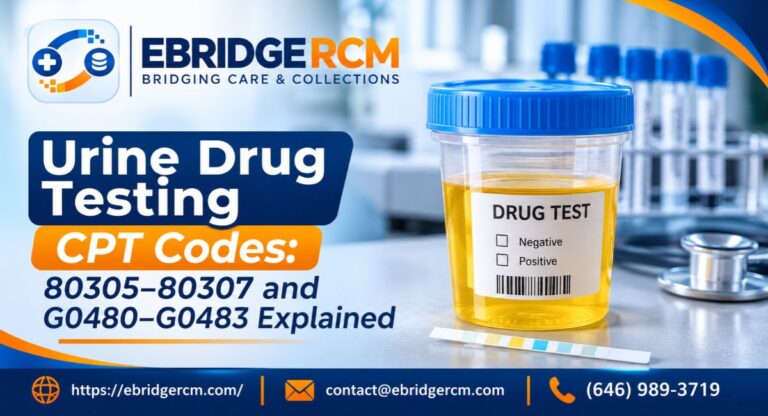
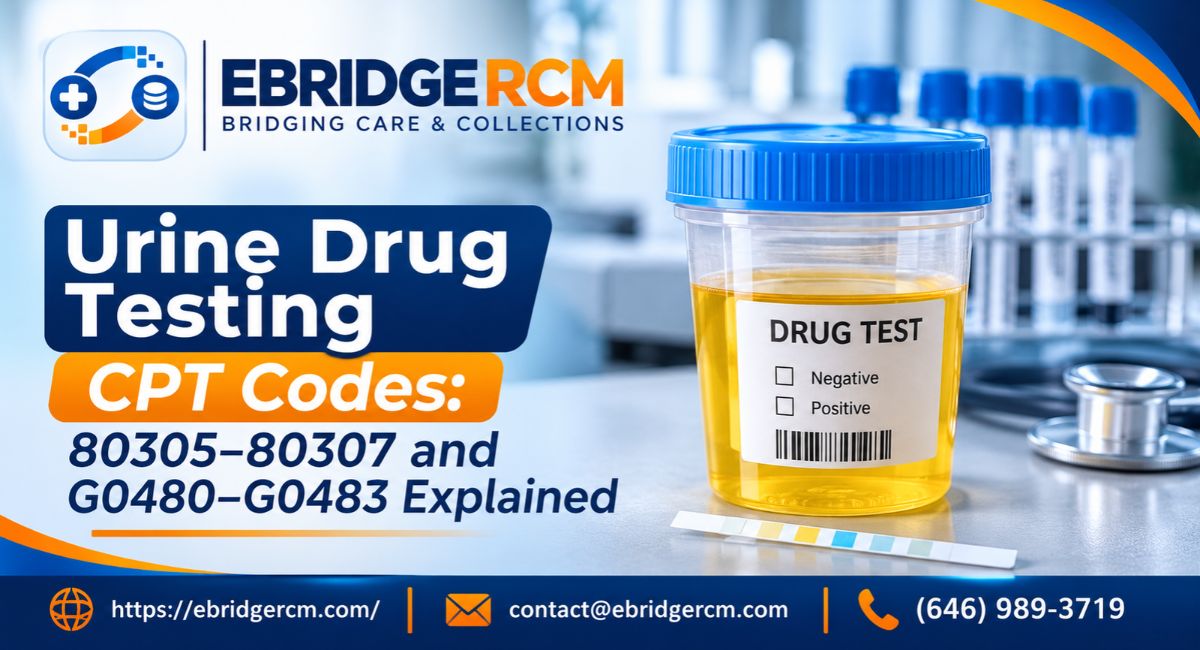
A patient hands the front desk a urine cup at a pain clinic. A nurse reads a quick screen in two minutes. The same sample then goes to a reference lab for a deeper test. Two weeks later, the practice receives a denial. The payer says the in-office test was billed with the wrong code. A second notice says the lab claim lacks medical necessity.
The patient, the cup and the results were all real. The billing did not match the path the sample took.
Urine drug testing (UDT) looks like a small service, but it carries some of the heaviest audit attention in pain management. The codes depend on the test method. The rules change when the test is done in the office rather than a lab. The documentation must show why the test was ordered and how the result guided care.
This guide follows the specimen from collection to claim. It explains presumptive and definitive testing, the CPT codes 80305 to 80307, the HCPCS codes G0480 to G0483, CLIA rules, the QW modifier, and the difference between office and laboratory billing. It also covers documentation habits that hold up in a payer review.
Follow the Specimen: Where Coding Decisions Happen
A single urine sample can trigger several coding decisions. It helps to walk the path in order.
- The patient provides a sample, and the staff checks that it is valid
- A quick screen is done in the office, or the sample is sent out
- If a result needs confirmation, a more precise test is done, usually at a lab
- The physician reviews results and decides on the next step in care
- Each party that performed a test bills for its own work
At each point, a different code or rule applies. The first big split is between presumptive and definitive testing.
Presumptive Versus Definitive Testing
These two terms describe two levels of testing, and the codes follow the same split.
Presumptive testing is a screen. It tells the clinician whether a drug class is likely present. It does not name the exact drug with certainty, and it may produce false positives or false negatives. Cups, cards and immunoassay analyzers are common tools.
Definitive testing identifies specific drugs and metabolites with high accuracy. It uses methods such as gas chromatography with mass spectrometry (GC-MS) or liquid chromatography with mass spectrometry (LC-MS). It can tell apart drugs that look similar on a screen.
In many clinics, the sequence is simple. The office does a quick presumptive screen. If the result is unexpected or unclear, the sample goes to a lab for definitive testing. But the sequence is a clinical choice, and the codes must match what was actually done.
Presumptive Codes: 80305, 80306 and 80307
CPT describes three presumptive codes. The difference between them is the method used to read the result, not the number of drugs checked.
| CPT Code | Method | Typical Examples |
| 80305 | Direct optical observation only | Dipsticks, cups, cards or cartridges read by eye |
| 80306 | Instrument-assisted direct optical observation | The same devices, read by a reader instrument |
| 80307 | Instrument chemistry analyzers | Immunoassay analyzers, chromatography, or mass spectrometry systems used for screening |
The American Medical Association (AMA) publishes CPT. These descriptions are summaries, so confirm exact wording in the current code set.
What the Codes Include
Each presumptive code includes sample validation when it is performed. Sample validation checks whether the specimen is real and unaltered, for example by testing creatinine, pH or specific gravity. Because validation is included, these checks are not billed separately.
Reported Once Per Date of Service
The presumptive codes are reported per date of service, not per drug class and not per device. A cup that tests for ten drug classes is billed once. If the office runs two different screening methods on the same day, the coder should not stack two presumptive codes. Payers generally expect one code per day for presumptive testing. Use the code that matches the method used, and check payer and NCCI guidance when more than one method was involved.
Choosing Between the Three
The method decides the code. Ask these questions:
- Was the result read by eye from a cup or card? That points to 80305.
- Was a reader device used to interpret the same type of cup or card? That points to 80306.
- Was an instrument chemistry analyzer used? That points to 80307.
The note should state the device or method. A note that says only “UDS positive for opiates” does not support any code choice. The coder should not guess the method from the result.
Old Codes
Before 2017, UDT billing used a different set of CPT and HCPCS codes. The current presumptive and definitive structure replaced those older codes. If a template or fee schedule still lists old codes, update it.
Definitive Codes: G0480 Through G0483
Definitive testing has two coding paths. CPT has drug-specific definitive codes in the 80320 to 80377 range. HCPCS has the G codes G0480 to G0483, which count by drug class. Medicare uses the G codes. Many commercial payers accept one set or the other, and some prefer the CPT codes. Always confirm what each payer expects.
How the G Codes Count
The G codes are reported per day, and the number of drug classes sets the code:
| HCPCS Code | Drug Classes Tested |
| G0480 | 1 to 7 |
| G0481 | 8 to 14 |
| G0482 | 15 to 21 |
| G0483 | 22 or more |
The count is by class, not by individual drug and not by metabolite. If the lab tests for three opioid drugs and two of their metabolites, that is one class for counting. If it tests opioids, benzodiazepines and stimulants, that is three classes. Both G0480 and the later codes include specimen validity testing.
Only one of these four codes should be reported per day for a given patient. The labs choose the code that matches the total class count. The ordering practice does not bill these codes if the lab performs the test.
The Simple Definitive Code
HCPCS also has a code for a simpler form of definitive testing, G0659, which applies when the lab method does not meet all the quality features required of the G0480 group. Labs use it in specific cases. It does not carry a class count. The lab decides which code applies, and the ordering practice does not need to select it.
Definitive Versus Presumptive on the Same Day
A patient can have both a presumptive and a definitive test on the same date. Each is a different service. But payers may question the pairing, especially if the definitive test was ordered with no clear reason. The record should show why the definitive test was needed, such as an unexpected screen result or a clinical question the screen could not answer.
CLIA: The Rule Behind Who Can Run What
The Clinical Laboratory Improvement Amendments (CLIA) set standards for any facility that tests human samples. The Centers for Medicare & Medicaid Services (CMS) runs the program. Every practice that performs UDT in the office needs the right CLIA certificate for the tests it runs. The CMS CLIA page explains certificate types and how to apply.
Waived Versus Non-Waived Tests
CLIA sorts tests by complexity. Waived tests are simple, with a low risk of error. Many point-of-care cups are in this group. A practice that runs only waived tests can hold a Certificate of Waiver. Non-waived tests, including moderate and high complexity tests, require a stricter certificate, along with quality control, staff qualifications and inspections.
Instrument chemistry analyzers used for 80307 may fall in the non-waived group, depending on the device. The practice must match its certificate to the test it runs. Billing a test that the CLIA certificate does not cover can lead to denials and compliance problems.
The CLIA Number on the Claim
Claims for lab services need the CLIA certificate number of the performing lab. On the standard paper claim form, this goes in box 23, and the electronic claim has a matching field. A missing or wrong number is a common cause of rejections. If the practice has more than one site, each site may have its own number, so check that the claim matches the place where the test was run.
Modifier QW
Modifier QW tells the payer that the test was performed under a CLIA Certificate of Waiver. Medicare and some other payers require it for waived tests. It applies when the device and the certificate match. If the test is not waived, QW should not be added.
For presumptive tests, the need for QW depends on the device and the payer. Check the current Medicare guidance and each payer’s policy, since lists of waived tests change. A missing QW on a waived test may cause a denial. An unneeded QW on a non-waived test can cause one as well.
Who Bills: The Office or the Lab
One of the most common errors in UDT billing is billing for work someone else did.
In-Office Tests
If the practice runs the presumptive test in its own office with its own CLIA certificate, the practice bills the presumptive code. The claim lists the right method, the right modifier when needed and the CLIA number.
Tests Sent to a Reference Lab
If the sample goes to an outside lab, the lab bills for the test it performs. The ordering practice does not bill the definitive code for that work. Medicare in particular expects the performing lab to bill directly. Some other payers have rules about purchased services and markups. Billing for a lab’s work under the practice’s name can create serious compliance risk.
The Combined Case
A common workflow is an in-office screen followed by a lab confirmation. In that case, the practice bills the presumptive code for the screen, and the lab bills the definitive code. Each claim stands alone and should match the record of the party that did the work.
Collection and Handling
Collecting a urine specimen is generally not separately payable. A handling code may exist for transporting a sample to an outside lab, but payer rules vary and many do not pay for it. Check the payer policy before billing any collection or handling fee.
Why Coordination Matters
The ordering practice and the lab should share a clear order. The order should name the tests wanted, the reason for testing and the ordering provider. A lab that receives a vague order may run a large panel that the practice did not intend, and the payer may deny the claim or ask for a refund.
Documentation That Stands Up in Review
Payers that review UDT claims look at medical necessity and process. Good documentation covers both.
The record for each test should show:
- The reason for testing, linked to the patient’s condition and treatment plan
- The drugs and drug classes the test was meant to check, based on the patient’s medications and risk
- The method or device used, and where the test was run
- The result and who reviewed it
- How the result changed care, or why it did not
- The ordering provider’s signature and date
Individualized Orders
Standing orders that test every patient for every drug on a fixed schedule draw scrutiny. Payers expect testing to reflect the individual patient’s history, current medications and risk level. A note that says “UDS per protocol” with no patient detail is weak. A note that links the test to the patient’s opioid therapy and recent clinical events is stronger.
Review and Action
A result that no one reads has little value. The physician should document that the result was reviewed. If it was unexpected, the note should say what was done. If it was consistent with the plan, the note should say so. This shows the test served a clinical purpose.
Consent and Agreements
Many pain practices use treatment agreements that mention drug testing. These agreements do not replace the clinical reason for each test. But they show that the patient knew about testing. Keep them in the chart.
Medicare LCDs and Payer Policies
Coding accuracy is only part of the picture. Medicare Administrative Contractors (MACs) publish Local Coverage Determinations (LCDs) for controlled substance monitoring and drugs of abuse testing. Commercial payers publish their own policies.
These policies often address:
- Which patients qualify for testing, often based on risk
- How often presumptive and definitive tests can be done
- When definitive testing is allowed after a presumptive result
- How many drug classes can be billed without added support
- Documentation the payer expects
This article does not review coverage criteria. They differ by jurisdiction and change over time. Billing teams should keep a current copy of each payer’s policy and check it when a pattern of denials appears. The Medicare Coverage Database lets staff search LCDs by contractor and by topic.
Frequency Limits
Some policies limit how often testing can be done in a set period unless the note supports more frequent testing. A claim that exceeds the limit will be denied even if the code is correct. A tracking log by patient and date helps catch this before the claim goes out.
Prior Authorization
Some payers require authorization for definitive testing, or for large panels. Check each payer’s rules, since the requirement may apply to the lab, the practice or both.
Diagnosis Coding for Drug Testing
The diagnosis should show why the test was ordered. ICD-10-CM codes that often appear on UDT claims include:
- Z79.891 for long-term use of opiate analgesics
- Z79.899 for other long-term drug therapy
- Z51.81 for an encounter for therapeutic drug level monitoring
- G89.29 or G89.4 for chronic pain
- F11.- codes for opioid use disorder, when documented and applicable
Use the most specific code the record supports. Do not use codes meant for legal or employment testing when the test was ordered for clinical care. For more on how weak diagnosis coding costs revenue, see these ICD-10 coding errors that cost practices.
Common Errors in UDT Billing
Most denials trace back to a short list of mistakes.
- Billing per drug class for presumptive tests. The presumptive codes are per date of service.
- Billing two presumptive codes on one date. Report one code that matches the method.
- Billing sample validation separately. It is included in the code.
- Billing a lab’s work under the practice’s name. The performing lab bills for its own tests.
- Missing or wrong CLIA number. Claims for lab services need the right number.
- Missing QW on a waived test, or QW on a non-waived test. Match the modifier to the device.
- Counting metabolites as drug classes. The G codes count classes.
- Using standing orders without patient-specific support. Payers look for individual need.
A pre-bill review catches many of these before they become denials. For a wider look at how payers describe denial reasons, see this guide to insurance denial codes.
Three Short Cases
The Cup and the Reader
A clinic uses a cup with a small reader device that interprets the strips. The coder first assumes 80305 because the device is a cup. But the note says the reader was used. The correct code is 80306. The coder updates the claim and confirms the payer’s QW rule for the device.
The Screen and the Send-Out
A patient on long-term opioid therapy gives a sample. The clinic runs an in-office screen and bills the presumptive code that matches the method. The result is unexpected, so the physician orders definitive testing at a reference lab. The lab bills the G code that matches the class count. The clinic does not bill the definitive test. The note explains why confirmation was needed.
The Standing Order Problem
A practice tests every patient monthly for the same large panel. A payer reviews a sample of claims and finds that notes do not explain why each panel was chosen. The payer asks for repayment on several claims. The practice moves to individualized orders, based on each patient’s medications and risk, and documents the reason in each note.
Keeping Drug Testing Audit-Ready
UDT is a frequent target of payer review because of volume and payment size. Good controls include:
- A written policy on who may order tests and how
- Individualized order forms that tie tests to the patient’s care
- A log of tests by patient, date, method and result
- A check that the CLIA certificate matches the tests run
- A monthly review of a sample of charts against claims
For a broader set of internal controls, see this medical billing compliance checklist. An outside review can also help.
This overview of external billing audit teams in healthcare explains how those reviews work.
Related Pain Clinic Coding
For spinal injection billing, review our guide to epidural steroid injection CPT codes. It explains the codes and billing requirements for these procedures.
Facet joint injections follow different coding rules. Our guide to facet joint injection CPT codes covers the key details.
Clinics that perform muscle injections should also understand the correct codes. Read our guide to trigger point injection CPT codes for guidance on code selection and billing.
Spinal cord stimulator procedures require separate coding for trials, implants and revisions. See our guide to spinal cord stimulator CPT codes to learn more.
Each procedure has its own documentation and billing requirements. Use procedure-specific checklists to reduce coding errors and claim denials.
When Outsourced Support Helps
UDT billing involves several rules. Your team must select the correct codes, apply modifiers and follow CLIA requirements. It must also check payer policies and maintain complete documentation.
Managing these tasks takes time. The workload grows when your practice handles both in-office tests and lab send-outs.
eBridge RCM LLC helps practices manage these tasks through its pain management billing services in USA. The team supports coding, claim submission and follow-up.
Accurate coding also starts with clear documentation. Its medical coding services in New York help review code selection, modifiers and clinical notes before claim submission.
Laboratories that perform definitive drug testing also need specialized billing support. eBridge RCM LLC provides laboratory billing services in USA to help manage lab claims, payer requirements and follow-up.
Key Takeaways on Urine Drug Testing CPT Codes
Urine drug testing codes follow the method, not the drug list. Presumptive codes depend on how the result was read. Definitive G codes depend on the number of drug classes. The party that performs the test bills for it. And the CLIA certificate, the QW modifier and the CLIA number on the claim must all match the test that was run.
Strong notes matter as much as correct codes. Tie each test to the individual patient, record the method and the result, and show how the physician used the information.
A short checklist, an updated policy file for each payer and a monthly chart review prevent most of the problems described here.
If your practice needs help with drug testing codes, claim review or denial follow-up, eBridge RCM LLC, a medical billing company in USA, supports pain management practices with accurate coding and steady revenue cycle support. Visit eBridge RCM LLC to speak with a team that handles these claims every day.