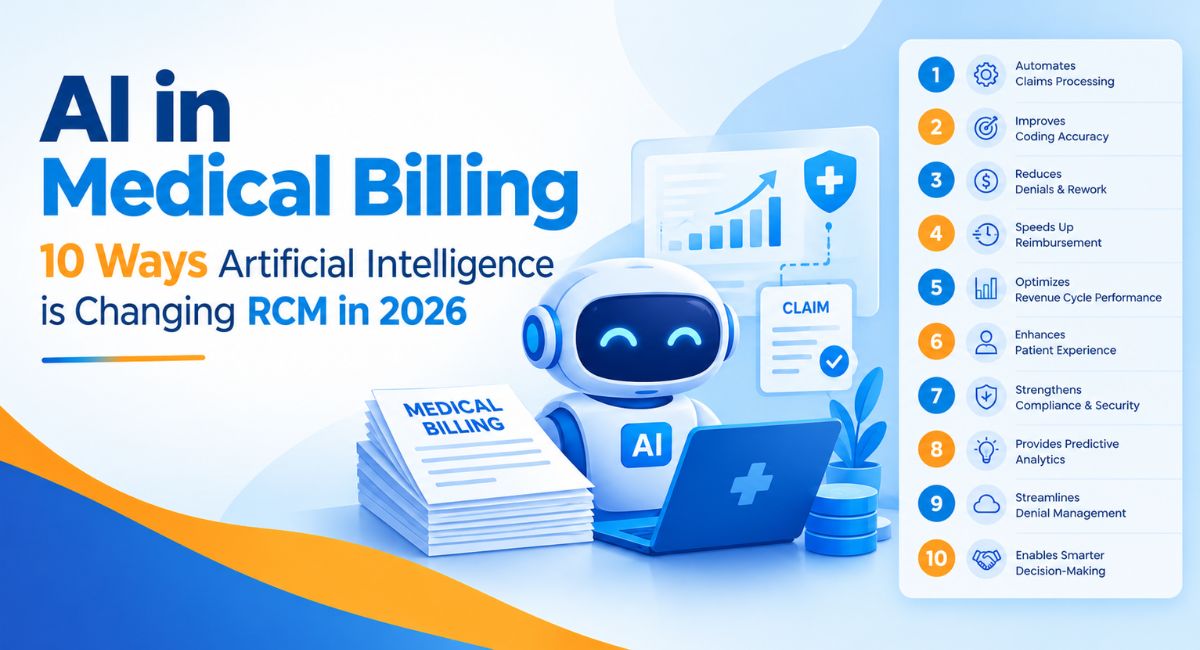
A claim can be clinically correct and still become a revenue problem because an eligibility response was missed, a code was incomplete, a payer asked for documentation, or a denial sat untouched for too long. These are not unusual failures in a busy practice. They are workflow failures created by volume, fragmented systems, and limited staff time. That is where AI in medical billing is becoming useful. In 2026, the strongest use cases are not about replacing an entire billing department with a machine. They are about helping people process more information, spot exceptions earlier, and move routine work through the revenue cycle with fewer manual touches. The practical question for a practice is therefore not whether artificial intelligence sounds impressive. The better question is which RCM tasks have enough repetition, data, and clear decision rules to benefit from AI without weakening billing controls.
What AI Actually Does In Medical Billing
Artificial intelligence in medical billing covers several technologies rather than one product category. Machine learning models can classify patterns in claims, payment behavior, and denial histories. Natural language processing can read clinical or administrative text and extract useful information. Rules engines can apply payer-specific conditions. Generative AI can summarize records, draft explanations, or help staff review a complex account. Automation tools can then move approved outputs between an EHR, practice management system, clearinghouse, and work queue. The most useful implementations combine these capabilities. A model may flag a likely coding issue, a rules engine may verify that the claim meets a known payer condition, and a human may approve the final change. This layered approach matters because revenue cycle work is full of exceptions, and it’s part of why the line between medical billing vs. revenue cycle management can get blurry as AI touches more of the process. The goal is controlled assistance, not blind automation.
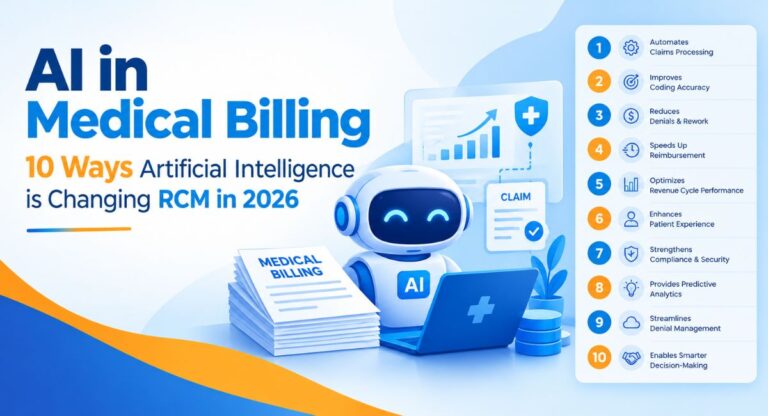
1. Eligibility Verification Becomes More Proactive
Eligibility is one of the clearest places for AI medical billing tools to help because the same verification questions occur repeatedly. An intelligent workflow can prioritize upcoming appointments, verify insurance eligibility against prior records, flag coverage changes, and route unusual responses to staff. Instead of treating every account as equally urgent, the system can focus attention on patients whose coverage, benefits, or subscriber data creates a higher billing risk. For example, if a practice sees that a payer response repeatedly fails because of a subscriber mismatch, an AI-assisted workflow can identify the pattern before the next batch of claims is submitted. Human staff still need to verify the source data and correct demographics when necessary. AI is most valuable when it turns eligibility from a one-time administrative check into an ongoing risk signal connected to scheduling and billing.
2. Coding Review Can Catch Inconsistencies Before Submission
Coding is another area where AI can support a human reviewer. A model can compare documentation with the codes selected in the EHR and identify possible mismatches, missing details, unusual combinations, or patterns associated with previous denials. This does not mean the software should independently decide what a clinician meant. Coding requires professional judgment and must follow the documentation and applicable coding guidance. The useful role for AI is to reduce the amount of manual searching a coder must do. If an encounter contains several diagnoses and procedures, the system can bring the reviewer to the portions of the record that deserve attention. It can also learn from a practice’s historical corrections. Over time, this creates a feedback loop in which recurring errors become easier to spot before claims leave the practice.
3. Claims Scrubbing Gets More Predictive
Traditional claim scrubbing checks fields against known rules, for readers unfamiliar with the process, it helps to first understand what claims scrubbing is before layering AI on top of it. AI can add a predictive layer by looking for combinations that have historically led to rejections or denials. Consider a practice that sees a recurring problem with payer-specific billing rules for a certain service. A predictive model can flag similar claims before submission, even when the error is not a simple missing-field problem. This can reduce avoidable rework and make a clearinghouse workflow more useful. The important distinction is between a warning and a final decision. A claim should not be automatically changed simply because a model predicts risk. The billing team needs to see why the claim was flagged, what source data supports the alert, and what action is available. Explainability is especially important when automation affects reimbursement.
4. Claims Status Work Can Shift From Manual Checking To Exception Management
Status checks consume time because staff often log into payer portals, clearinghouses, or other systems to answer a simple question: what happened to this claim? Automation can collect status information, while AI can organize the results into useful work queues. Paid claims can move out of active follow-up. Claims with no meaningful update can be scheduled for another check. Claims with a response that suggests a problem can be routed to the appropriate team. The benefit is not merely fewer clicks. The larger benefit is that staff can spend less time searching for information and more time deciding what to do about it. A good workflow also keeps an audit trail of the status received, the date it was checked, and the action taken.
5. Denial Management Becomes More Targeted
Denials contain structured and unstructured signals. The reason code matters, but so do payer, provider, procedure, diagnosis, place of service, timing, and previous account history. AI can group denials by root-cause pattern and help a billing manager see which issues deserve attention first, which is a meaningful step toward efforts to reduce AR and claim denials across the board. A queue might reveal that one payer is generating a high volume of authorization denials while another is producing eligibility-related rejections. That information can change how a practice allocates staff time. AI can also help draft a summary for a reviewer, but the appeal itself still needs careful validation. Staff should confirm the payer rule, clinical documentation, authorization record, and filing requirements. The strongest denial workflows use AI to prioritize and summarize, while humans remain accountable for the final correction or appeal.
6. Accounts Receivable Follow-up Can Focus On Value And Age
AR teams often work through large reports where every balance looks important. AI can help rank accounts by factors such as balance size, age, payer behavior, expected recoverability, filing deadlines, and prior follow-up results. This creates a more practical worklist. A high-value account approaching a filing or appeal deadline may deserve immediate attention, while a low-value balance with a predictable payer response may be handled through a different process, and for practices without the internal bandwidth to work every account, dedicated AR recovery services in USA can fill that gap. The model should not simply maximize the dollar amount. It should reflect the practice’s policies, payer contracts, and compliance requirements. Human reviewers can also use AI-generated summaries to understand the history of an account without reading every note. That can make AR follow-up more consistent, especially when multiple people work the same payer queues.
7. Payment Posting Can Use Automation With Validation
Payment posting is highly structured, which makes it a strong candidate for automation. Electronic remittance information can be matched to claims, contractual adjustments can be identified, and routine transactions can be posted with validation checks. AI can add value when the remittance contains an unusual pattern or when the expected payment does not align with historical behavior. The system can flag the account rather than silently posting an incorrect adjustment. This distinction protects the integrity of the financial record. Staff should review exceptions, especially unusual contractual adjustments, takebacks, recoupments, coordination of benefits issues, or unclear remittance messages. A well-designed workflow can also reconcile posted payments against bank deposits and identify items that need investigation.
8. Patient Billing Questions Can Be Routed And Summarized
Patient financial communication is another area where AI can reduce repetitive work. A system can classify incoming questions about statements, balances, insurance payments, deductibles, or missing information and route them to the right queue. It can also summarize the account history for the representative who handles the conversation. Generative AI may help draft a plain-language response, but the draft should be grounded in verified account data and practice policy. Patient communication deserves a higher level of review because an inaccurate explanation can damage trust and create a compliance concern. The best approach is to use AI as a drafting and routing assistant rather than as an autonomous financial decision maker.
9. RCM Reporting Can Move From Description To Prediction
Many revenue cycle reports explain what already happened. AI can help teams ask what is likely to happen next. A practice could use historical data to identify trends in denial volume, days in AR, payment variance, or outstanding balances. It might detect that a particular payer’s response pattern is changing or that a new workflow is creating more rework. Predictive reporting does not remove the need for traditional metrics. It adds another layer. Managers still need reliable definitions, clean source data, and consistent measurement. If the underlying data is incomplete, the prediction can be misleading. The value comes when a prediction leads to a specific operational action, such as reviewing a payer rule, training staff, or changing the order in which claims are worked.
10. Compliance And Audit Preparation Can Become Continuous
Billing compliance is easier to manage when review is not postponed until an audit or payer request arrives. AI can help scan transactions for unusual patterns, identify missing documentation, compare workflows with defined policies, and organize records for review. This is particularly useful in high-volume environments where manual sampling can only cover a small portion of activity. However, AI output is not itself evidence of compliance. A compliance professional still needs to determine whether a finding is valid, what rule applies, and what corrective action is appropriate. Practices should also document how automated tools are used, who reviews their output, and how corrections are made. This creates a clearer governance trail as AI becomes part of daily RCM work.
Where Human Oversight Remains Essential
The most responsible approach to AI in healthcare revenue cycle management is selective automation. People should remain involved when a decision depends on:
- Clinical context or ambiguous documentation
- Payer contract interpretation
- Patient-specific circumstances
- A potential compliance issue
A human reviewer should also be able to override an automated recommendation and record the reason. Practices should establish clear ownership for model performance, data access, security, and quality review. Staff training matters because an automation error can scale quickly if nobody checks it. AI should make a good billing process stronger. It should not be used to hide a weak process or replace basic controls such as accurate registration, timely documentation, appropriate coding, claim validation, and reconciliation.
How To Implement AI Without Disrupting The Revenue Cycle
Start with one measurable problem. A practice might choose eligibility exceptions, claim rejection prevention, denial prioritization, or payment variance review. From there, the rollout generally follows a few key steps:
- Document the current workflow, baseline the relevant metrics, and identify the data the tool will use.
- Run the technology in a controlled period where staff can compare automated recommendations with actual outcomes.
- Track false positives, false negatives, staff time, correction rates, and financial impact.
- Complete security and privacy reviews before production use, especially when protected health information is involved.
Integration is equally important. An AI tool that requires staff to copy information between systems can simply move the manual burden to another screen. The strongest projects fit into existing EHR and billing workflows and produce clear next actions.
A Practical 2026 Checklist
Before adopting an AI-enabled RCM workflow, a practice should be able to answer several practical questions:
- What task is being automated?
- What data does the tool require?
- Does the output have a clear explanation?
- Who reviews exceptions, and how are errors corrected?
- What happens when the model is unavailable?
- How is access controlled, and how will performance be measured after implementation?
The answers should be written into operating procedures rather than left to informal practice. Teams should also review vendor agreements, security controls, data retention, and appropriate use policies. AI can support revenue cycle performance, but governance is part of the implementation, not an afterthought. The objective is a dependable workflow that staff can understand and manage.
The Real Future Of Medical Billing Is Human Plus Machine
AI is changing medical billing by making routine work more searchable, predictable, and exception-driven. The technology can help verify eligibility, review coding, scrub claims, monitor status, prioritize denials, work AR, post payments, handle patient questions, analyze trends, and support audit preparation. Yet these capabilities are most effective when connected to sound processes and human review. In 2026, practices do not need to automate everything to benefit from AI. They need to choose the right tasks, use reliable data, and define where people remain responsible. That is a more practical model for the future of medical billing. Technology handles repetition and pattern recognition. Skilled billing and coding professionals handle judgment, exceptions, communication, and accountability.
Here is a quick recap of how that division of labor plays out across the revenue cycle:
| RCM Task | AI’s Role | Where Humans Stay in Control |
|---|---|---|
| Eligibility verification | Flags coverage changes and risk patterns before the visit | Verifying source data, correcting demographics |
| Coding review | Surfaces mismatches and documentation gaps | Final coding decisions, clinical judgment |
| Claims scrubbing | Predicts likely rejections before submission | Approving or overriding flagged claims |
| Claims status | Organizes results into exception-based queues | Deciding what action to take on flagged accounts |
| Denial management | Groups denials by root cause, drafts summaries | Validating payer rules, filing appeals |
| AR follow-up | Ranks accounts by value, age, and recoverability | Applying policy and payer contract context |
| Payment posting | Matches remittances, flags unusual variance | Reviewing exceptions, takebacks, COB issues |
| Patient billing questions | Routes and summarizes account history | Reviewing accuracy before sending to patients |
| RCM reporting | Identifies trends and predicts likely outcomes | Interpreting results, deciding on action |
| Compliance/audit prep | Scans for anomalies, organizes records | Determining validity and corrective action |
Data Quality Determines AI Quality
AI systems learn from the information they receive, so inaccurate registration, inconsistent payer identifiers, missing provider data, and incomplete documentation can produce poor recommendations. Before implementation, practices should review the fields that feed the targeted workflow. If an eligibility tool depends on subscriber information, registration accuracy becomes part of the AI project. If a denial model depends on claim history, the historical data must distinguish true denials from corrected claims and administrative reversals. Data quality work may feel less exciting than buying new software, but it often has a larger effect on the result. A reliable data pipeline gives staff more confidence in alerts and makes it easier to investigate an unexpected outcome.
| Data Issue | Downstream Effect on AI Recommendations |
|---|---|
| Inaccurate patient registration | Eligibility tools flag false coverage risks or miss real ones |
| Inconsistent payer identifiers | Predictive scrubbing can’t reliably match historical patterns |
| Missing or incomplete provider data | Claims models misattribute risk across providers |
| Incomplete clinical documentation | Coding review surfaces noise instead of real mismatches |
| Unlabeled corrected/reversed claims in history | Denial models learn from distorted “true denial” counts |
Governance Keeps Automation Accountable
A practice should document who owns an AI-enabled workflow, what the system is allowed to do, what it can recommend, and what requires approval. Governance can include access controls, review schedules, performance thresholds, change management, and a documented escalation process. Vendors should be evaluated on security, integration, support, data handling, and transparency rather than only on feature lists. Staff should know how to report a suspected automation error. Management should periodically review whether the tool is still producing useful results as payer behavior and workflows change. This creates a controlled operating environment in which technology can evolve without becoming an unmanaged dependency.
A Realistic Practice Scenario
Consider a multi-provider practice that receives a steady stream of commercial claims. The billing team notices that many avoidable issues begin before the claim is created. Patients sometimes arrive with changed coverage, certain services frequently need additional documentation, and a small group of payers generates repeated denials. An AI-assisted workflow could first prioritize upcoming visits that have a higher coverage risk. It could then flag documentation or coding patterns that deserve review before submission. After claims are sent, automated status checks could remove paid claims from the follow-up queue and route unresolved accounts to staff. The team could use denial classification to identify recurring root causes and use payment variance alerts to investigate unusual reimbursements. Nothing in this example requires a machine to make the final clinical or compliance decision. The technology simply moves routine information work into a more organized process and gives people better exceptions to review.
The Strongest AI Projects Create A Feedback Loop
An effective AI workflow should improve through measured feedback. When a reviewer accepts an alert, corrects it, or determines that it was unnecessary, that outcome can help the organization evaluate whether the rule or model is useful. The practice can compare predictions with actual claim outcomes and adjust thresholds when the alert volume is too high or too low. This is important because payer behavior, coding patterns, staffing, and service mix change over time. A model that worked well during one period may need review later. Leaders should schedule periodic quality checks and avoid treating an AI system as a set-and-forget product. Continuous monitoring gives the practice a way to preserve accuracy while the surrounding revenue cycle changes.
Make Staff Review Measurable
Human review should be measured as part of the AI workflow. Track how often staff accept, reject, or modify recommendations and which types of alerts generate the most useful outcomes. Review a sample of automated transactions for accuracy, not only the cases that generated warnings. This can reveal silent errors that an exception-only process might miss. Management can then adjust rules, thresholds, training, or vendor configuration. A simple review schedule can prevent the organization from assuming that a tool remains accurate forever.
Frequently Asked Questions
Is AI replacing medical billers?
Not broadly. AI is better suited to repetitive classification, review, routing, and prediction. Human professionals remain important for judgment, exceptions, payer interpretation, patient communication, compliance, and quality control.
Can AI reduce claim denials?
It can help identify patterns associated with preventable errors and prioritize high-risk claims, but results depend on data quality, workflow design, payer rules, and human review.
Is AI safe for PHI? Is AI safe for PHI?
Safety depends on the specific system, configuration, access controls, vendor terms, and organizational policies. Practices should complete appropriate privacy and security reviews before using PHI with any AI tool.
Which RCM task should be automated first?
A good starting point is a repetitive, high-volume task with clear inputs and measurable outcomes, such as eligibility verification or claim scrubbing.
What should humans still review?
Clinical coding judgment, unusual payer situations, appeals, compliance concerns, patient-specific financial explanations, and any AI recommendation that could materially change a claim or account.
Final Thoughts
A useful first step is to map the revenue cycle from registration through final payment and mark every point where staff repeatedly search, copy, compare, classify, or prioritize information. Those are the places where AI and automation may provide the most immediate value. Choose one workflow, set a baseline, test it, review the exceptions, and expand only when the results are reliable. Practices that take this measured approach can gain efficiency without turning billing into a black box. For additional guidance on RCM standards and compliance, organizations can refer to CMS’s official resources. If your organization is reviewing its RCM processes, a structured assessment can also identify where technology and experienced billing support fit best. Partnering with a specialized provider of medical billing services in the USA can help practices evaluate workflows, improve claims operations, and build stronger revenue cycle controls.